
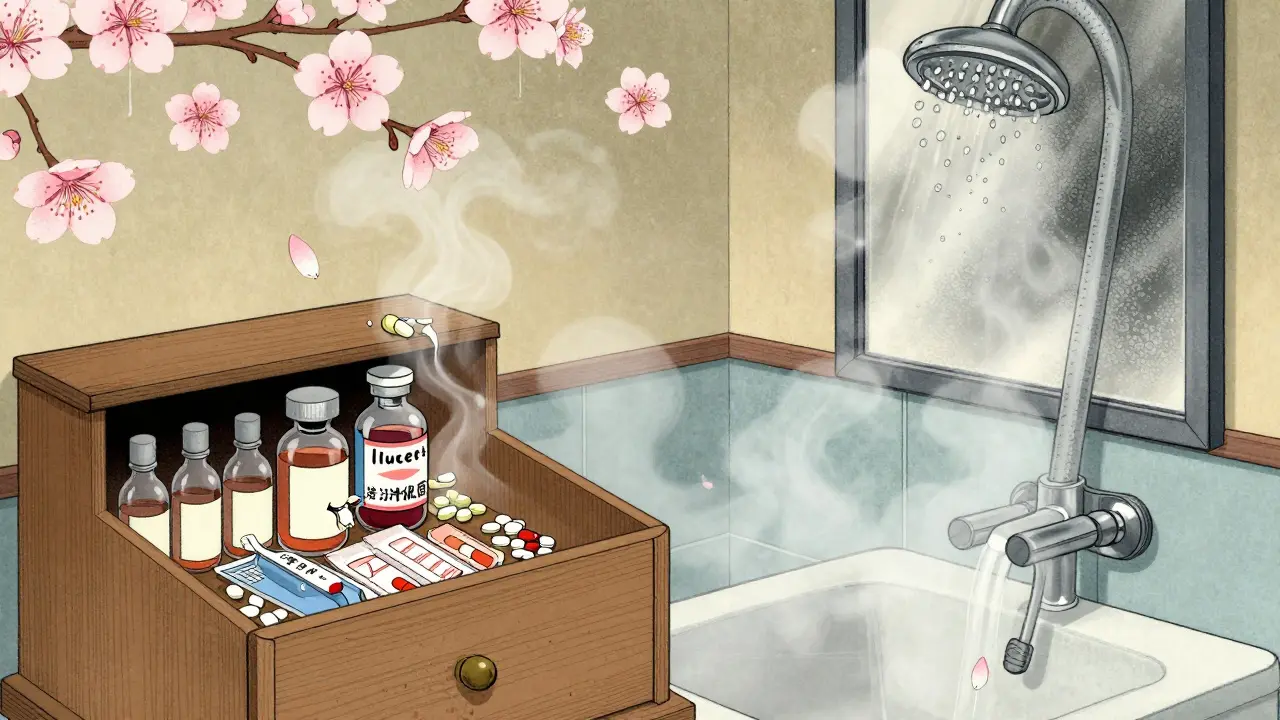
Most people keep their medications in the bathroom. It’s convenient - right next to the sink, easy to reach after brushing your teeth. But here’s the truth: storing medications in the bathroom is one of the most common and dangerous mistakes you can make with your health.
Why the Bathroom Is the Worst Place for Medicine
Bathrooms are humid, hot, and unpredictable. Every time you take a shower, steam fills the air. Humidity levels can jump from 40% to over 90% in minutes. Temperature swings? They’re normal. A room that’s 68°F when you wake up can hit 90°F during a hot shower. These conditions don’t just make your mirror fog up - they wreck your medicine. Pharmaceuticals are designed to stay stable under specific conditions. Most pills, capsules, and liquids need to be kept between 59°F and 77°F (15°C-25°C). That’s room temperature. Not steam room temperature. When medications are exposed to heat and moisture, their chemical structure breaks down. Tablets absorb water and start to crumble. Capsules get sticky or brittle. Liquid medications can separate or grow mold. Even the packaging can degrade, letting in more moisture. This isn’t theoretical. A study in Circulation found that patients who stored their blood pressure meds in the bathroom had inconsistent control of their condition 30.2% of the time. That’s not a small risk - it’s a life-threatening one.Medications That Fail Fast in Humidity
Some drugs are especially sensitive. If you keep these in the bathroom, you’re risking serious consequences:- Insulin: This protein-based medication loses effectiveness if it gets warmer than 86°F (30°C). A degraded vial won’t lower your blood sugar properly - and you won’t know until it’s too late.
- Nitroglycerin: Used for chest pain, this lifesaving drug degrades in humidity. A weakened tablet could mean the difference between surviving a heart attack and not making it.
- Birth control pills: The FDA found humidity can reduce hormone potency by up to 35%. That’s not a small drop - it’s enough to make contraception unreliable.
- Antibiotics: If they lose strength, they won’t kill the infection. That doesn’t just mean you feel sick longer - it contributes to antibiotic resistance, a global health crisis.
- Blood glucose test strips: Not a medication, but critical for diabetes management. When exposed to bathroom moisture, they give wrong readings in 68% of cases, according to the Journal of Diabetes Science and Technology.
It’s Not Just About Potency - It’s About Safety
A bathroom medicine cabinet isn’t just bad for your drugs - it’s dangerous for your family. Most cabinets are unlocked. Kids, teens, and even pets can get into them. The CDC reports that 70% of misused prescription opioids come from home medicine cabinets. Opioids, sedatives, and stimulants stored in the bathroom are just as accessible as toothpaste. A 2022 NIH study of 220 U.S. households found that 80% kept medications in easily reachable places - mostly bathrooms and kitchen counters. Of those households, 63% had children under 18, and 57% had pets. The American Academy of Pediatrics says all medications should be locked away. Yet most people still leave them out. And it’s not just kids. Elderly relatives visiting your home might grab the wrong pill. A confused senior might think a faded, sticky tablet is still good. A teenager might experiment. All of it starts with easy access.
What Happens When Medications Go Bad?
You might think, “It’s just a little old. It’ll still work.” But degradation isn’t always visible. A pill might look fine - no discoloration, no cracks - but its active ingredients could be 30% weaker. That’s not a placebo effect. That’s a real drop in dosage. Real cases show the damage:- A woman in Nottingham took her warfarin (a blood thinner) from the bathroom cabinet. After a refill, her INR levels spiked dangerously - her blood wasn’t thinning properly. The pharmacy later found the tablets were sticky and crumbling. The moisture had broken down the active ingredient.
- A child in London had an allergic reaction because the antihistamine in the bathroom cabinet had lost potency. Emergency room records from Great Ormond Street Hospital show that 4.3% of pediatric medication errors in 2022 were linked to degraded drugs.
- A Reddit thread from March 2023 with 87 comments featured users whose blood pressure returned after switching to a new bottle - only to find out the new bottle had been stored in the same damp cabinet. One nurse reported that 42% of patients’ bathroom-stored meds showed physical signs of damage. Only 8% of meds stored elsewhere did.
Where Should You Store Medications Instead?
The best place? A cool, dry, locked cabinet - away from heat, sunlight, and moisture. That means:- Inside a bedroom dresser
- A high closet shelf in a hallway
- A locked box on a shelf in the laundry room
- Bathrooms (obviously)
- Kitchens (near the stove or dishwasher)
- Cars (summer temps can hit 140°F)
- Window sills (sunlight degrades drugs)
What About Expired or Unused Medications?
If you have old pills, liquids, or patches, don’t flush them. Don’t throw them in the trash. Don’t just leave them in the cabinet to gather dust. The safest way? Take them to a pharmacy that offers a drug take-back program. In the UK, most community pharmacies accept unused or expired meds. Some police stations and hospitals do too. If no take-back is available, mix pills with coffee grounds or cat litter, seal them in a container, and throw them in the trash. This makes them unappealing and hard to misuse. Why does this matter? The NIH estimates $98 million worth of unused meds sit in U.S. homes. Improper disposal leaks into water systems - and 46% of medications found in rivers and lakes come from household disposal. It’s not just a health issue. It’s an environmental one.
What’s Changing? Better Packaging, Better Awareness
Pharmacies are catching on. In 2023, 73% of prescription bottles included storage instructions - up from 41% in 2015. Many now come with humidity-indicating desiccant packets. Some labels change color if exposed to unsafe heat or moisture. The American Pharmacists Association launched “Store It Safe” in 2022. They’ve handed out over 1.2 million flyers. Apps that remind you to check your storage conditions have boosted proper habits by 47% in clinical trials. But the biggest barrier? Habit. A 2023 survey found 68% of Americans still store meds in the bathroom - even though 89% know it’s a bad idea. That gap between knowing and doing is dangerous.Simple Steps to Get It Right
You don’t need a fancy cabinet. You just need to change one habit:- Check every bottle for storage instructions. Look for “store at room temperature” or “protect from moisture.”
- Move all meds out of the bathroom - today.
- Find a dry, cool, locked spot - a drawer in your bedroom works.
- Use a locking pill box if you have kids or visitors.
- Dispose of expired or unused meds at a pharmacy drop-off.
- Check your cabinet every three months. If pills look odd - sticky, cracked, discolored - toss them.
Final Thought: Your Medicine Should Work - When You Need It
You spend money on these drugs. You follow the schedule. You trust them to keep you alive. But if they’ve been sitting in a steamy cabinet, they might not be doing their job. It’s not about being perfect. It’s about being smart. Move your meds. Lock them up. Check them often. Your body - and the people who depend on you - deserve medicine that works.Can I store pills in the bathroom if I keep them in a sealed container?
No. Even sealed containers can’t fully block moisture and heat from a bathroom environment. Humidity seeps in over time, and temperature swings still affect the pills inside. The only reliable way to protect medication is to store it in a cool, dry place - like a bedroom drawer - away from bathrooms entirely.
What if my medicine says to store it at room temperature? Isn’t the bathroom room temperature?
"Room temperature" means 59°F-77°F (15°C-25°C), stable and dry. Bathrooms rarely stay there. Showers, hot water, and steam push temperatures above 90°F and humidity above 80%. That’s not room temperature - it’s a sauna. Medications labeled for room temperature still degrade under those conditions.
How do I know if my medicine has gone bad?
Look for changes: pills that are sticky, cracked, discolored, or smell odd. Capsules that are swollen or leaking. Liquids that are cloudy or have particles. If you see any of this, don’t take it. Even if it’s not expired, it may not work. When in doubt, take it to a pharmacy for disposal.
Can I store my insulin in the fridge door?
No. The fridge door opens and closes often, causing temperature swings that can damage insulin. Store insulin in the back of the fridge, where it’s coldest and most stable - between 36°F and 46°F. Once opened, most insulin can be kept at room temperature for up to 28 days - just keep it away from heat and sunlight.
Why can’t I just throw old pills in the trash?
Flushing or trashing meds can pollute water supplies and harm wildlife. It also makes them accessible to kids, pets, or people who might misuse them. The safest way is to drop them off at a pharmacy take-back program. If that’s not available, mix pills with coffee grounds or cat litter, seal them in a container, and throw them away - this makes them unappealing and harder to use.
Are smart medicine cabinets worth it?
They’re helpful, but not necessary. Smart cabinets with humidity and temperature sensors can alert you if conditions get unsafe - and they’re great for households with multiple medications or vulnerable members. But a simple locked drawer in your bedroom, checked every few months, works just as well. Focus on the habit, not the gadget.
11 Comments
I used to keep all my meds in the bathroom because it was convenient. Then my mom had a stroke and we found her blood pressure pills were crumbling like old cookies. She didn't even realize they were bad. I cried for hours. Now everything's in a locked drawer in my bedroom. No more excuses. Your medicine should work when you need it most.
And if you think 'it's just one bottle'-it's not. It's your life. And maybe your kid's. Or your grandparent's. Don't gamble with it.
From a pharmacovigilance standpoint, the microenvironment of the bathroom constitutes a non-compliant storage condition per ICH Q1A(R2) guidelines. Hygroscopic excipients in solid oral dosage forms undergo plasticization under elevated RH (>70%), leading to accelerated degradation kinetics. The Arrhenius equation predicts a 2–3x increase in degradation rate per 10°C rise-bathroom temps routinely exceed 35°C post-shower. Insulin denaturation, nitroglycerin hydrolysis, and beta-lactam ring cleavage in antibiotics are well-documented. Storage in ambient, dry, stable conditions remains the gold standard.
People are so careless with their health. I’ve seen it over and over. Someone takes their insulin from the bathroom, it goes bad, they end up in the ER, and then they wonder why the system is so expensive. It’s not the system’s fault. It’s yours. You knew better. You just didn’t care enough to move it.
Stop pretending you’re too busy. Five seconds. That’s all it takes to open a drawer. Five seconds to save your life.
As someone who grew up in a household where medicine was kept in the medicine cabinet above the sink, I can attest to the quiet danger of this practice. My grandmother, a devoted diabetic, lost control of her glucose levels for months because her test strips had absorbed moisture. The pharmacy staff noticed the discoloration before she did. We were lucky.
In Canada, we’re taught from childhood that medication is not a household item-it’s a lifeline. I now keep mine in a small, locked tin in my nightstand. No one touches it. No steam reaches it. And I sleep better knowing that.
OMG I JUST MOVED ALL MY MEDS TODAY. Like, right now. I was scrolling through this and realized my insulin was chilling next to my shower gel like it was a fancy bath bomb. I nearly threw up. I grabbed my whole medicine cabinet, dumped it all on the kitchen counter, and hauled it to my bedroom drawer. I even bought a little lockbox for my anxiety pills because my roommate is a chaos gremlin.
Also, my blood pressure strips? They were so soggy they looked like origami cranes. I tossed them. No regrets. My body deserves better than bathroom steam. I’m telling my whole family. This is a movement now. #MedicationsDeserveBetter
Humidity >70%. Temp >30°C. Degradation rate doubles every 10°C. Insulin, nitroglycerin, and oral contraceptives are particularly vulnerable. FDA data confirms potency loss exceeds 30% in 6 months under bathroom conditions. Case closed. Stop rationalizing. Move it.
It’s funny how we’ll spend hours organizing our spice rack but leave life-saving pills in a steamy cabinet. I used to do the same-until my dad had a heart attack and his nitro didn’t work. Turned out the bottle had been in the bathroom for three years. The pharmacist said it looked like it had been through a sauna.
Now everything’s in a locked box under my bed. Simple. Safe. No drama. Just peace of mind.
Ugh I KNEW THIS WAS A BAD IDEA BUT I JUST COULDN'T BE BOTHERED 😩 My mom's insulin went bad and she had to be rushed to the hospital-again. And now I feel like a terrible daughter. 🥲 I'm moving everything tonight. But like… why is this even a thing? Why don't pharmacies just make humidity-proof packaging? 😤 #ToxicHabits #IShouldveKnownBetter
Oh wow, so the bathroom is bad? Who knew? 🤡 I thought the steam was a natural aromatherapy session for my pills. Maybe they needed a little sauna to ‘relax’ before they work their magic. Next time I’ll just leave my heart meds in the oven. At least then they’ll be warm when I need them.
Also, I’m sure the FDA is just waiting for someone to write a 10-page essay on why not to store pills near the toilet. Thank you, Dr. Obvious.
Good post. I’ve been using a smart pill organizer with temp/humidity logging for my dad’s meds since last year. It’s not fancy, but it alerts me if the drawer hits above 28°C or humidity over 60%. We’ve caught two batches of degraded antibiotics before he took them.
That said, you don’t need tech. A locked drawer, away from windows and heat sources, works just fine. The real win is consistency. Make it a habit. Check every 90 days. Talk to your pharmacist. Small steps, big impact.
If you store your meds in the bathroom, you’re not just irresponsible-you’re selfish. You’re putting your convenience ahead of your family’s safety. I’ve seen kids die from grabbing pills they thought were candy. You think you’re being smart? You’re just lazy. Move your meds. Now.