

Vancomycin Risk Assessment Tool
Enter patient details to estimate the relative risk of kidney injury (Nephrotoxicity) versus permanent hearing loss (Ototoxicity). This tool helps prioritize monitoring strategies.
Patient & Clinical Factors
Dosing & Monitoring Strategy
Select options to see advice.
Select options to see advice.
Clinical Recommendation
Fill out the form above to generate a tailored management plan.
You’re staring at a patient’s chart. They have a stubborn MRSA infection that isn’t budging with first-line antibiotics. The obvious move is Vancomycin, the heavy hitter of glycopeptide antibiotics. But there’s a catch. Every dose you push feels like walking a tightrope between saving their life and damaging their kidneys or hearing. It’s not just about killing bacteria; it’s about managing two very different types of collateral damage.
Most clinicians know vancomycin can hurt the kidneys. That’s old news. But what about the ears? And how do you decide which risk scares you more when the clock is ticking? Let’s break down the real-world battle between nephrotoxicity and ototoxicity, so you can make smarter calls without second-guessing every infusion bag.
The Kidney Hit Is Common, But Usually Reversible
Nephrotoxicity is the big one. We’re talking about acute kidney injury (AKI) in anywhere from 5% to 30% of patients. Why such a wide range? Because it depends on who you ask and how they define "injury." If you use strict criteria like the Acute Kidney Injury Network (AKIN), you’ll see higher numbers. The mechanism is straightforward: vancomycin causes oxidative stress in the proximal tubules of the kidney. Think of it as chemical irritation that disrupts cellular energy production.
Here’s where it gets tricky for modern practice. It’s rarely vancomycin acting alone. A major 2022 meta-analysis showed that pairing vancomycin with piperacillin-tazobactam (Zosyn) increases AKI risk by 1.31 times compared to using meropenem instead. This combination is everywhere in hospitals because it covers broad-spectrum bugs, but it’s a double-edged sword for renal function. If your patient is already on Zosyn, adding vancomycin puts them in a high-risk bucket immediately.
The good news? Most vancomycin-induced kidney damage is reversible. Stop the drug, hydrate the patient, and creatinine levels often bounce back within days. Studies show no significant difference in mortality rates between those who get AKI and those who don’t, provided the team catches it early. That’s why checking serum creatinine every 48-72 hours isn’t just protocol-it’s survival insurance.
Hearing Loss Is Rare, But It Doesn’t Come Back
If nephrotoxicity is a loud, obvious alarm bell, ototoxicity is a whisper that might never stop ringing. Incidence rates are much lower-often cited around 1-3%-but the consequences are permanent. Once hair cells in the inner ear die, they don’t regenerate. You lose high-frequency hearing, and tinnitus sets in. For some patients, this means losing the ability to understand speech in noisy rooms, a quality-of-life hit that lasts forever.
Historically, we thought ototoxicity only happened if the kidneys failed, causing toxic levels to build up. Wrong. Case reports now document hearing loss in patients with perfectly normal renal function. One notable case involved rapid-onset ototoxicity after just three doses. This suggests individual susceptibility plays a huge role. Genetics matter here too; variants in the MT-RNR1 gene can triple your risk of ear damage. So, while rare, it’s unpredictable and devastating.
Detecting it is hard. There’s no simple blood test for ear toxicity. Audiograms help, but compliance is low. Many hospitals skip baseline hearing tests because they’re resource-heavy. By the time a patient complains of ringing ears, the damage is often done. Unlike kidneys, ears don’t heal themselves.
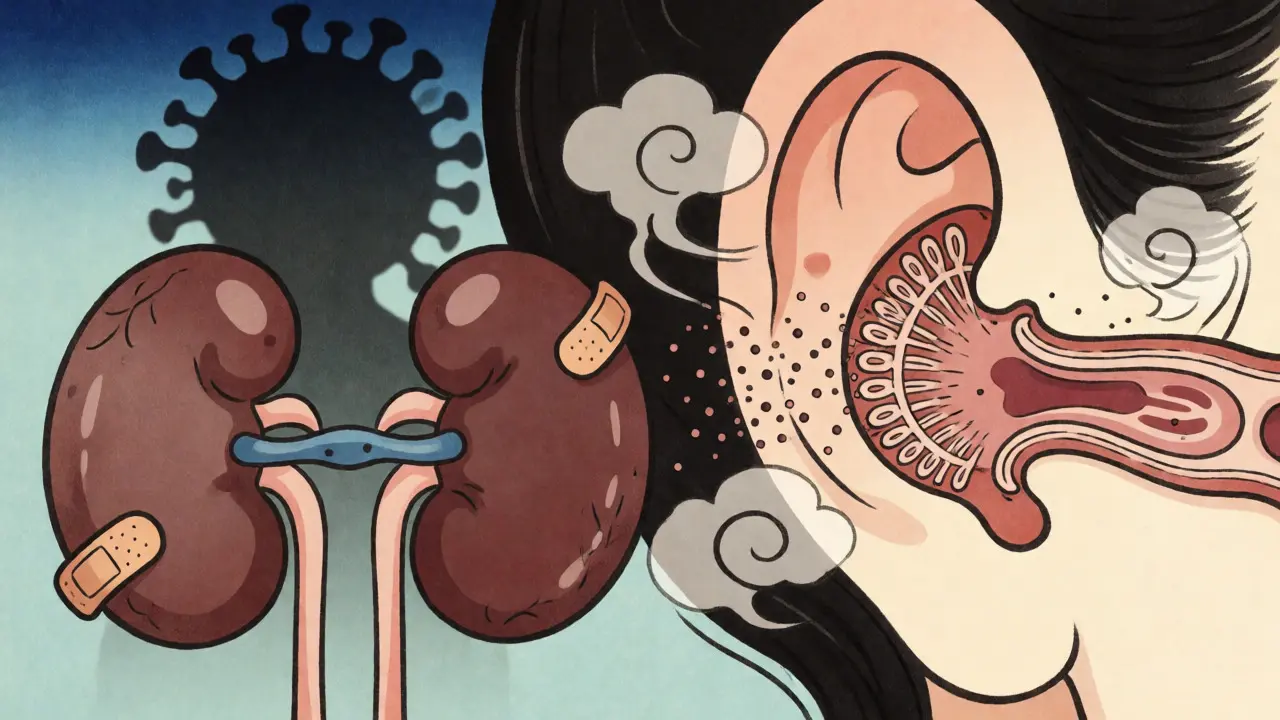
Nephrotoxicity vs. Ototoxicity: The Risk Matrix
How do you weigh these risks against each other? It comes down to frequency versus severity. Nephrotoxicity is frequent and manageable. Ototoxicity is rare and irreversible. Here’s a quick comparison to keep handy:
| Feature | Nephrotoxicity | Ototoxicity |
|---|---|---|
| Incidence | 5-30% (Higher with combo therapy) | 1-3% |
| Reversibility | Usually reversible upon discontinuation | Often permanent sensorineural loss |
| Primary Driver | Trough levels >15 mcg/mL, duration >7 days | Peak levels >40 mcg/mL, genetic susceptibility |
| Monitoring | Serum Creatinine every 48-72h | Audiometry (low compliance) |
| Cost Impact | Extended hospital stay (~3.2 days) | Lifetime hearing aids/rehab ($25k-$50k/yr) |
Stop Guessing Troughs: Use AUC Monitoring
For years, we chased trough levels-the lowest concentration of drug in the blood before the next dose. The old target was 15-20 mcg/mL. But recent guidelines from the American Society of Health-System Pharmacists (ASHP) suggest aiming lower, around 10-15 mcg/mL, for most infections. Why? Because efficacy plateaus around 10 mcg/mL, while kidney risk spikes sharply above 15.
Better yet, ditch the trough-only mindset. Area Under the Curve (AUC) monitoring gives a fuller picture of exposure over time. Hospitals using AUC-guided dosing report nephrotoxicity rates of 8.2%, compared to 14.7% with trough-only methods. It’s a massive drop. Tools like DoseMeRx or PrecisePK use pharmacokinetic modeling to predict safe doses based on real-time renal trends. If your institution hasn’t switched to AUC-based dosing, you’re likely over-dosing patients and risking their kidneys unnecessarily.

Who Needs Extra Caution?
Not all patients carry the same risk. Stratify them before you write the order. High-risk groups for nephrotoxicity include those with pre-existing chronic kidney disease, critical illness, or concurrent use of aminoglycosides or piperacillin-tazobactam. For these folks, consider alternative agents like daptomycin or ceftaroline if possible. IDSA guidelines note that while vancomycin remains first-line for MRSA, alternatives exist for specific scenarios.
For ototoxicity, look beyond renal function. Ask about prior hearing issues. Check family history of noise-induced hearing loss. Consider genetic testing if available, though it’s not standard yet. Older adults (>65) are also at higher risk. If a patient has multiple risk factors, a baseline audiogram isn’t just nice-to-have-it’s essential documentation if things go wrong later.
Practical Tips for Daily Management
- Review Concomitant Meds: Before starting vancomycin, scan the med list. If they’re on Zosyn, flag the increased AKI risk. Discuss switching to meropenem if appropriate.
- Hydrate Aggressively: Unless contraindicated, ensure adequate fluid intake to support renal clearance.
- Limit Duration: Try to keep courses under 7-10 days if clinically feasible. Longer exposure equals higher cumulative toxicity.
- Educate Patients: Tell them to report ringing in ears or difficulty hearing immediately. Don’t wait for discharge.
- Use Technology: Leverage EHR alerts for high troughs or dangerous combinations. Automated dosing calculators reduce human error.
Managing vancomycin isn’t about avoiding toxicity entirely-that’s impossible. It’s about minimizing preventable harm while ensuring bacterial kill. By shifting focus from crude trough targets to precise AUC monitoring, and by respecting the silent threat of ototoxicity, you protect both the patient’s health and your own clinical conscience.
Is vancomycin-induced kidney damage always permanent?
No, most cases are reversible. If caught early and the drug is stopped, serum creatinine levels typically return to baseline within days to weeks. Permanent dialysis-dependent failure is rare unless the patient had severe pre-existing renal disease or prolonged untreated toxicity.
Why is piperacillin-tazobactam combined with vancomycin risky?
Studies show this combination significantly increases the risk of acute kidney injury compared to vancomycin with other beta-lactams like meropenem. The exact mechanism isn't fully understood, but it may involve synergistic tubular toxicity. Clinicians should monitor renal function closely when using this pair.
Can hearing loss occur even if kidney function is normal?
Yes. While historically linked to renal impairment, recent case reports document ototoxicity in patients with normal renal function. Individual susceptibility, genetic factors, and peak serum concentrations play significant roles, meaning normal creatinine doesn't guarantee ear safety.
What is the current recommended trough level for vancomycin?
Current ASHP guidelines recommend targeting trough concentrations of 10-15 mcg/mL for most serious infections. Higher targets (15-20 mcg/mL) were previously used but are associated with increased nephrotoxicity without proven additional benefit for many indications.
How does AUC monitoring differ from trough monitoring?
Trough monitoring measures drug level just before the next dose. AUC (Area Under the Curve) measures total drug exposure over the dosing interval. AUC is considered more accurate for predicting efficacy and toxicity, allowing for safer, personalized dosing regimens.