
What Exactly Is Treatment-Resistant Depression?
Most people think if you take an antidepressant and don’t feel better right away, you just need to wait a bit longer. But for about 30-40% of people with major depression, that’s not the case. Even after trying two different antidepressants at full doses for at least six weeks each, symptoms stick around. That’s called treatment-resistant depression, or TRD.
This isn’t about being ‘weak’ or ‘not trying hard enough.’ TRD is a biological reality. The landmark STAR*D trial, which tracked over 2,800 patients between 2001 and 2006, showed that nearly half of people didn’t respond to their first antidepressant. By the time they’d tried two, a third were still stuck. These aren’t rare cases-they’re the majority of people who don’t get better with standard care.
And the cost? It’s huge. In the U.S. alone, TRD adds up to $210.5 billion a year in lost productivity, hospital visits, and missed work. In Europe, it’s €113.4 billion. This isn’t just a mental health issue-it’s a public health crisis.
Augmentation: Adding Something to Make Your Current Med Work Better
When antidepressants alone aren’t cutting it, doctors often turn to augmentation. That means adding another medication-not switching everything out, but layering something on top to boost the effect.
The FDA has approved a few options specifically for this:
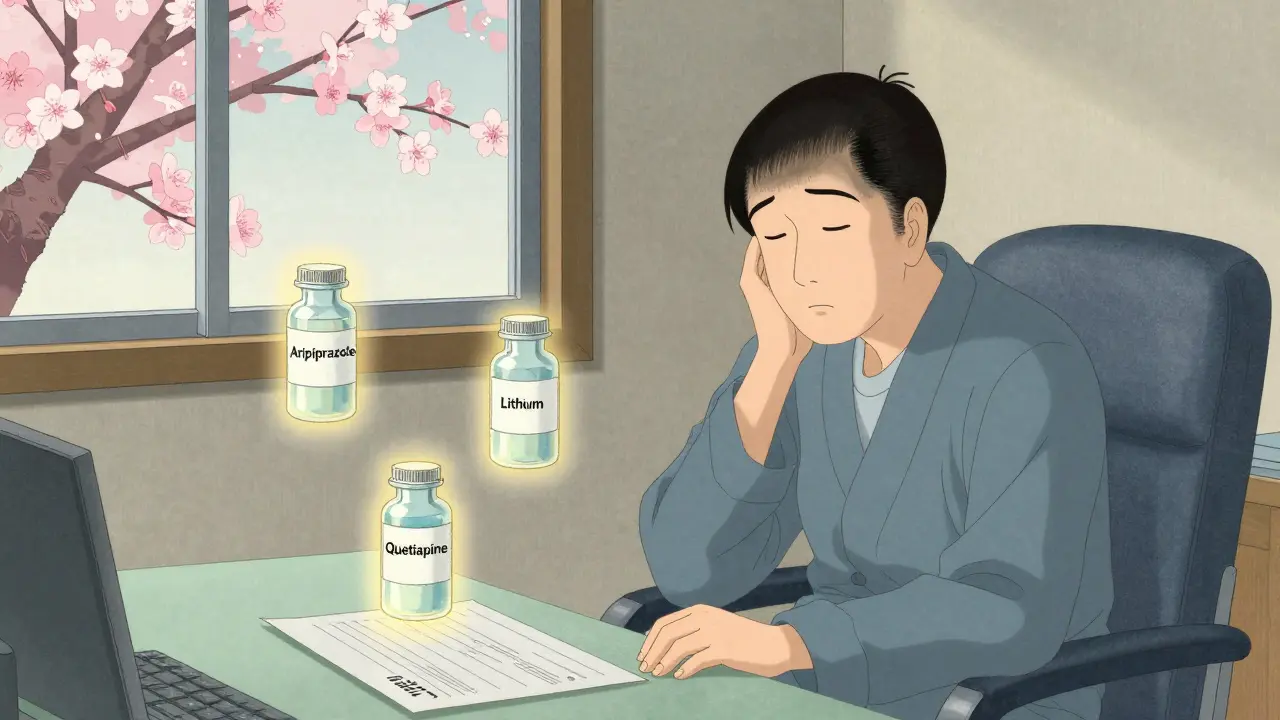
- Aripiprazole (Abilify): 2-15 mg/day. Works for about 25% of people in remission after two failed antidepressants.
- Brexpiprazole (Rexulti): 0.5-3 mg/day. Similar profile, slightly less sedating.
- Quetiapine XR (Seroquel XR): 150-300 mg/day. Can cause drowsiness and weight gain, but studies show up to 48% response rates when paired with SSRIs.
- Olanzapine-fluoxetine (Symbyax): A combo pill. Effective, but weight gain is common-up to 5-7% of body weight.
But these aren’t the only options. A 2022 network meta-analysis looked at 65 studies and found other agents with strong evidence:
- Lithium: Used for decades. Target blood level: 0.3-0.6 mEq/L. Needs regular blood tests. Works best for people with mood swings or family history of bipolar disorder.
- Liothyronine (T3): A thyroid hormone. Surprisingly effective-odds of response are nearly 3 times higher than placebo.
- Nortriptyline: An older tricyclic. Less used now, but still works well for some.
- Modafinil: A wakefulness agent. Helps with fatigue and brain fog, not just mood.
One of the most telling studies is the VAST-D trial. It compared three paths for TRD: switching to bupropion, switching to bupropion plus augmentation, or augmenting with aripiprazole. The aripiprazole group had the highest remission rate at 24.8%. Bupropion alone? Only 15.5%. That’s a big difference.
The Real Talk About Side Effects
Augmentation isn’t magic. It comes with trade-offs.
Aripiprazole can cause akathisia-that restless, can’t-sit-still feeling. About 15-25% of people feel it. Some stop taking it because of that. Quetiapine? Sedation. Up to 60% feel drowsy. Weight gain is common with olanzapine-fluoxetine. Lithium requires constant monitoring. Too much, and you risk kidney or thyroid damage.
Some agents, like ziprasidone and cariprazine, have higher dropout rates because side effects are hard to tolerate. But aripiprazole? It has the best balance of effectiveness and tolerability. That’s why it’s the most commonly used augmentation agent in clinics.
And then there’s bupropion. It’s not FDA-approved for augmentation, but it’s used all the time-especially for people who struggle with sexual side effects or low energy from SSRIs. The STAR*D trial showed a 21.3% remission rate with bupropion added. Not the highest, but it’s gentle and doesn’t cause weight gain.
When Augmentation Isn’t Enough: Advanced Therapies
For people who’ve tried two or three augmentation strategies and still feel stuck, it’s time to think bigger.
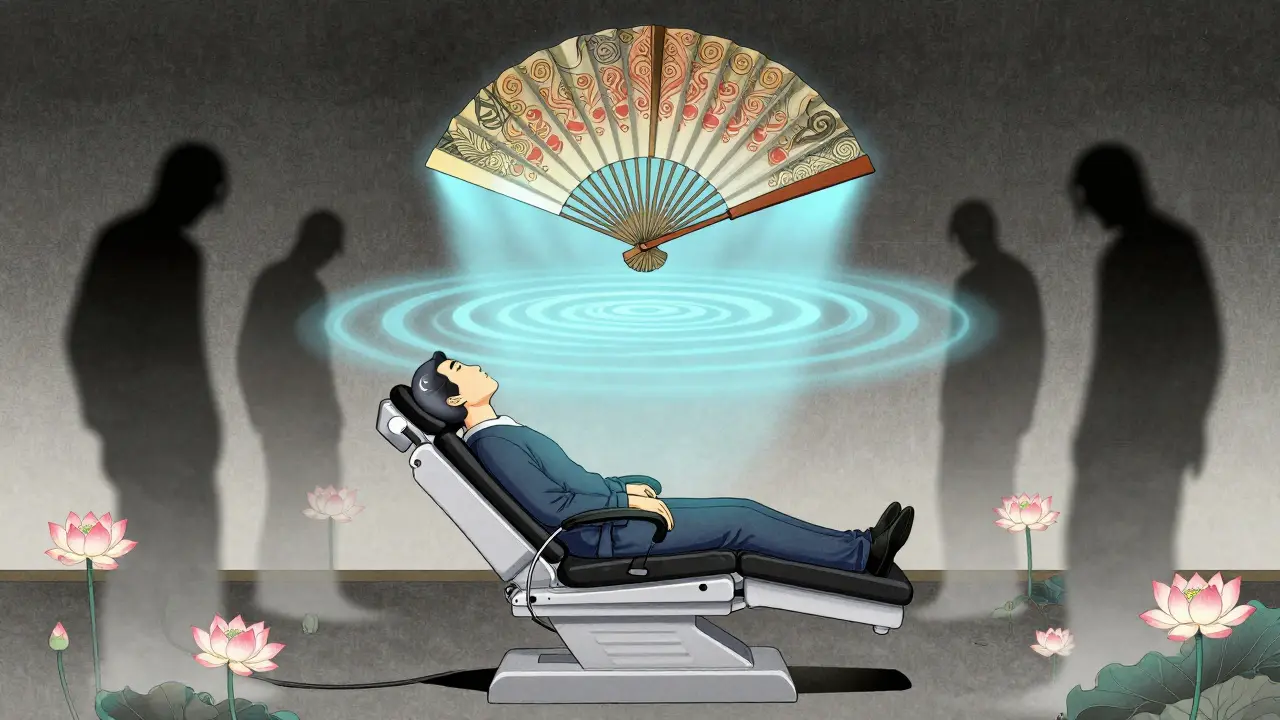
Repetitive Transcranial Magnetic Stimulation (rTMS) is the most proven non-drug option. Over 50 randomized trials, more than 10,000 patients. Response rates? 50-55%. Remission? 30-35%. No anesthesia. No memory loss. You sit in a chair, a magnetic coil clicks against your scalp, and you’re done in 20-40 minutes. Most people do it five days a week for four to six weeks.
Compared to electroconvulsive therapy (ECT), rTMS is gentler. ECT works better for severe cases with psychosis or catatonia, but it requires anesthesia and can cause temporary memory gaps. rTMS doesn’t. That’s why it’s become the go-to for people who want results without the stigma or risk.
Esketamine nasal spray (Spravato) is the newest kid on the block. Approved in 2019, it’s the first antidepressant that works in hours, not weeks. In the TRANSFORM-2 trial, 70% of patients responded at four weeks versus 47% on placebo. But here’s the catch: you have to take it in a certified clinic. Why? Because 59.5% of people experience dissociation-feeling detached from your body or surroundings. It’s not dangerous, but it’s intense. You sit in a recovery room for two hours after each dose.
And then there’s deep brain stimulation (DBS). Sounds sci-fi, right? A surgeon implants electrodes into a part of the brain called the subcallosal cingulate cortex. In a small 2017 study of six people, 92% responded after two years. But this is still experimental. Only done in research centers. Too invasive for most.
What’s Coming Next? The New Frontier
Science is moving fast. Two emerging treatments are getting serious attention.
Psilocybin-the active compound in magic mushrooms-showed a 71% response rate in a 2020 JAMA Psychiatry trial with just 24 people. That’s higher than any augmentation drug. The catch? It’s still illegal in most places. Clinical trials are underway, but it’s years away from being a prescription option.
Infliximab is even stranger. It’s a drug used for rheumatoid arthritis and Crohn’s disease. But a 2022 study found it helped TRD patients who had high inflammation levels (measured by hs-CRP). Those with inflammation saw a 30.5% remission rate versus 13.7% on placebo. This suggests depression isn’t just a ‘brain chemical’ problem-it can be tied to your immune system.
That’s the future: personalized treatment. Not just ‘try this med.’ But ‘your depression is linked to inflammation, so we’ll target that.’ Or ‘your brain’s reward circuit is underactive, so rTMS makes sense.’
What’s the Real Success Rate?
Here’s the hard truth: even with all these options, only about 28% of TRD patients achieve lasting remission, according to the EU-NEURD registry. That’s lower than most people expect.
And not all augmentation strategies hold up. A 2019 meta-analysis in the British Journal of Psychiatry argued that only aripiprazole had a clear, small benefit over placebo. Lithium? Antipsychotics? They didn’t show consistent results across studies.
So what’s the takeaway? Don’t give up-but don’t expect miracles either. The best approach is systematic:
- Confirm the diagnosis. Is it really depression? Or bipolar? Or something else?
- Make sure past treatments were adequate-dose, duration, adherence.
- Try one evidence-based augmentation (aripiprazole, lithium, or bupropion are good starters).
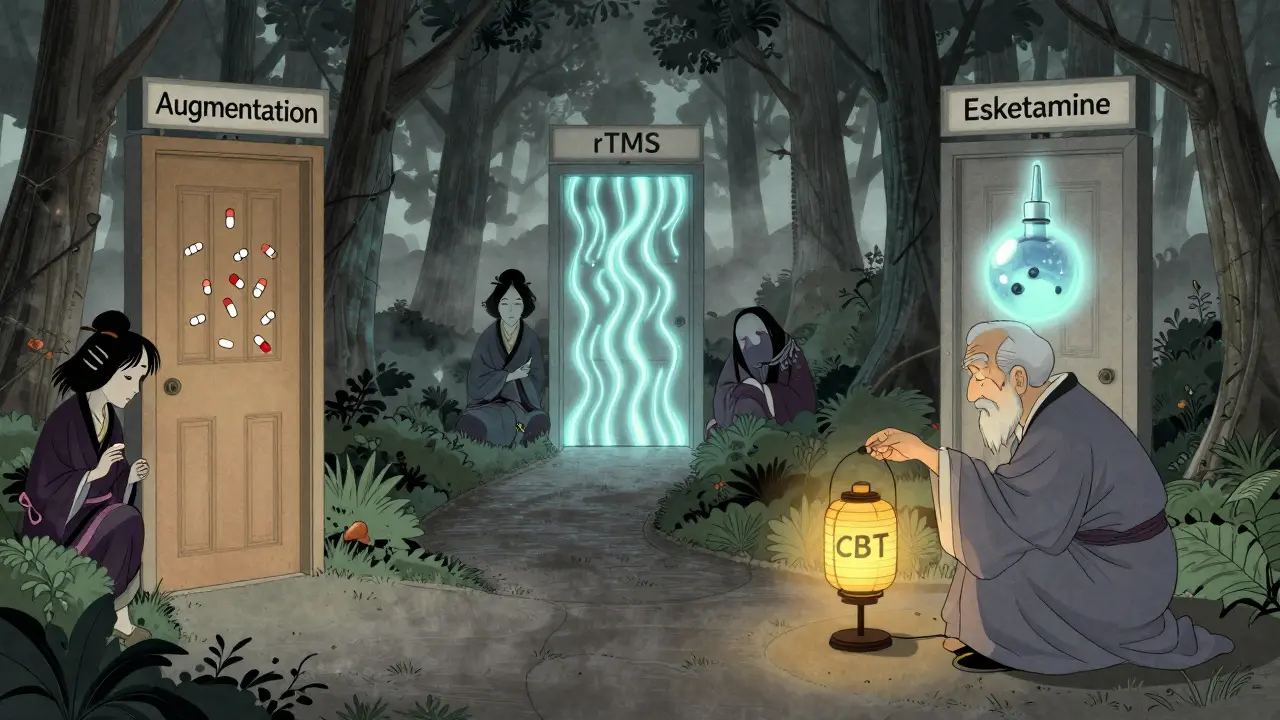
- If that fails, move to rTMS.
- If still stuck, consider esketamine under supervision.
And always, always include therapy. Cognitive behavioral therapy (CBT) has an effect size of 1.58 when added to meds-stronger than most drugs. Talking to a therapist isn’t ‘just talking.’ It rewires how you respond to stress, thoughts, and emotions.
How to Know If You’re in the Right Place
If you’ve tried two antidepressants and still feel hopeless, numb, or exhausted, you’re not broken. You’re in a group that needs a different path.
Ask your doctor:
- Have I had adequate trials? (Dose and duration matter.)
- Have I tried augmentation? Which ones have the best evidence for my symptoms?
- Could rTMS be an option? Is it covered by my insurance?
- Am I being monitored for side effects? (Blood tests for lithium, weight checks for antipsychotics.)
- Am I getting therapy alongside medication?
TRD is not a dead end. It’s a signal that your brain needs a different kind of help. The tools exist. They’re not perfect. But they’re better than ever.
What counts as an adequate trial for antidepressants?
An adequate trial means taking the medication at a therapeutic dose for at least six to eight weeks. Many people stop too early because they don’t feel better in two weeks. But antidepressants often take four to six weeks to show real effects. If you didn’t reach the recommended dose or quit before eight weeks, it doesn’t count as a true trial.
Can I try esketamine at home?
No. Esketamine (Spravato) must be administered in a certified clinic under medical supervision. You’ll need to stay for at least two hours after each dose because of the risk of dissociation or increased blood pressure. It’s not a take-home medication.
Is rTMS painful?
No. You’ll feel a tapping or clicking sensation on your scalp, and some people get mild headaches afterward. It’s not electric shock therapy. There’s no anesthesia, no memory loss, and no recovery time. Most people return to work or daily activities right after.
How long does it take for augmentation to work?
It varies. Aripiprazole or lithium may take two to four weeks to show effects. Quetiapine can work faster, sometimes within a week. Esketamine works in hours. But full benefit usually takes four to six weeks. Patience is key.
Are there natural supplements that help with TRD?
Some supplements like omega-3s, vitamin D, or SAM-e have been studied, but none have strong enough evidence to replace proven treatments. They might help a little as add-ons, but don’t rely on them alone. Always talk to your doctor-some supplements can interact with antidepressants.
10 Comments
Depression isn't a choice, but the system treats it like one. We medicate, we monitor, we measure - but no one asks what’s broken in the world that makes healing so damn hard. We need to stop pretending biology is the only player here. Trauma, poverty, isolation - these aren't just background noise. They're the fuel.
And yet, we celebrate a 24.8% remission rate like it’s a miracle. It’s not. It’s a failure of scale. We’re patching holes in a sinking ship while ignoring the ocean rising around us.
I’ve seen people on aripiprazole for years. Still crying at 3 a.m. Still skipping meals. Still afraid to answer the phone. The meds help a little - but they don’t bring back the person who used to laugh at dumb memes or dance in the kitchen.
Therapy? Sure. But if your therapist charges $200/hour and you’re working two jobs just to keep the lights on, what good is CBT? We need systemic change, not just pharmacological tweaks.
Psilocybin trials? Cool. But if it stays a luxury for the wealthy, we’ve just built a new kind of elite healing cult. The real breakthrough won’t be a drug - it’ll be a society that stops punishing people for being broken.
I’m not saying meds are useless. I’m saying they’re a bandage on a gunshot wound. And we’re running out of bandages.
Let’s talk about housing. Let’s talk about wages. Let’s talk about why we think a human being’s worth is tied to their productivity. That’s the real augmentation we need.
i read this whole thing and just cried. not because im depressed, but because i finally feel seen. thank you for writing this. i’ve been told i’m ‘just not trying hard enough’ so many times. it’s not true. it’s biology. and it’s real.
Modafinil for brain fog? Yes. Been on it for 8 months. Doesn’t fix the sadness, but makes it bearable to get out of bed. Also, lithium is a beast - blood tests every 3 weeks. But if you can tolerate it, it’s the only thing that stopped my suicidal thoughts cold.
Oh wow. So now we’re prescribing antipsychotics like they’re coffee creamer? And calling it ‘evidence-based’? Next they’ll be giving out ketamine at gas stations. Someone please tell me this isn’t real medicine.
rTMS is legit. did 30 sessions. no anesthesia, no memory loss. just a weird tapping on my head. felt like a robot getting serviced. but after week 4? I cried during a commercial. Not sad crying. Just… felt something. Didn’t know I’d forgotten how. Worth every minute.
Let me be perfectly clear: the FDA-approved augmentation protocols are the only legitimate path forward. Any suggestion that ‘natural supplements’ or ‘lifestyle changes’ can substitute for clinically validated pharmacological intervention is not only misleading-it is dangerously irresponsible. And psilocybin? Illegal. Unregulated. A joke. Until it passes Phase III trials with proper blinding and controls, it has no place in clinical discourse.
Furthermore, the assertion that ‘society’ is to blame for depression is a gross misrepresentation of psychiatric science. Depression is a neurochemical disorder. Not a political statement.
For those in TRD: your neuroplasticity is still intact - even if it feels like it’s not. rTMS isn’t just ‘stimulation’ - it’s neuromodulation. You’re literally rewiring maladaptive circuits. And esketamine? It’s not a ‘drug’ - it’s a neurochemical reset button. The dissociation? That’s your default mode network shutting off. That’s the space where healing begins.
Don’t confuse ‘slow’ with ‘ineffective.’ Lithium takes 3-4 weeks to reach therapeutic levels - but when it hits? It’s like someone turned off a fire alarm that’s been blaring for years.
And therapy? CBT isn’t ‘just talking.’ It’s cognitive restructuring. You’re training your brain to stop catastrophizing. That’s neuroplasticity in action. Pair it with pharmacotherapy? That’s the gold standard.
Stop looking for magic bullets. Look for synergistic protocols. That’s how you win.
you think this is bad? wait till you find out how many people are being given esketamine because their insurance won’t cover rTMS. and now they’re stuck in a clinic every week, dissociating for two hours, paying $1,000 a dose - and still no one checks if they’re being abused at home. no one asks if they’re safe. they just hand them the spray and say ‘come back next week.’
we’re not treating depression. we’re managing symptoms while ignoring trauma. and the system loves it. it’s profitable.
They’re hiding the truth. Why do you think they banned psilocybin? Because it works too well - and it’s free. Big Pharma can’t patent mushrooms. That’s why they’re pushing ketamine - patentable. Profitable. And if you think the ‘inflammation theory’ is new? Look up Dr. Robert Lustig’s work in 2014. They knew. They just didn’t want you to know.
And rTMS? It’s not ‘non-invasive.’ It’s just the quiet kind of brain control. They’re testing this on veterans. On kids. Who’s funding it? Who owns the patents? Who’s making money while you sit there with a coil on your head?
Don’t trust the system. They don’t want you healed. They want you medicated.
Let me be the first to say this: I’ve tried everything. Aripiprazole gave me akathisia so bad I once tried to climb out of my own skin. Quetiapine turned me into a zombie who napped through my daughter’s birthday. Lithium? I had to pee every 17 minutes. And then - miracle - esketamine. First dose? Felt like I was floating through a dream. Second? I remembered what my mother’s voice sounded like. Third? I cried in the shower for 45 minutes. Not because I was sad. Because I remembered how to feel.
Yes, it’s expensive. Yes, it’s weird. Yes, you sit there like a space alien waiting for your brain to reboot. But if you’ve been in the void for years? You’ll do anything to hear your own heartbeat again.
This isn’t medicine. It’s resurrection.