

When you pick up a prescription, you might not realize that the pill in your hand could be a brand-name drug or a generic version. But here’s the key: not all generics are created equal. The FDA uses a system called therapeutic equivalence codes to tell pharmacists exactly which generics can be swapped in without risking your health or treatment outcome. This isn’t just bureaucracy-it’s a life-saving tool that saves billions every year while keeping patients safe.
What Are Therapeutic Equivalence Codes?
Therapeutic equivalence codes are simple letter ratings assigned by the FDA to generic drugs that show they work the same way as the brand-name version. These codes appear in the Orange Book, officially titled Approved Drug Products with Therapeutic Equivalence Evaluations. First published in 1980, the Orange Book is updated monthly and is the go-to resource for pharmacists, doctors, and state pharmacy boards.The system was created after the 1984 Hatch-Waxman Act, which made it easier for generic drugs to enter the market. But the FDA needed a way to say, “This generic is safe to swap,” without requiring every pharmacist to read through clinical trial data. That’s where the codes come in.
The first letter tells you everything you need to know:
- A means the generic is therapeutically equivalent to the brand-name drug. You can substitute it with confidence.
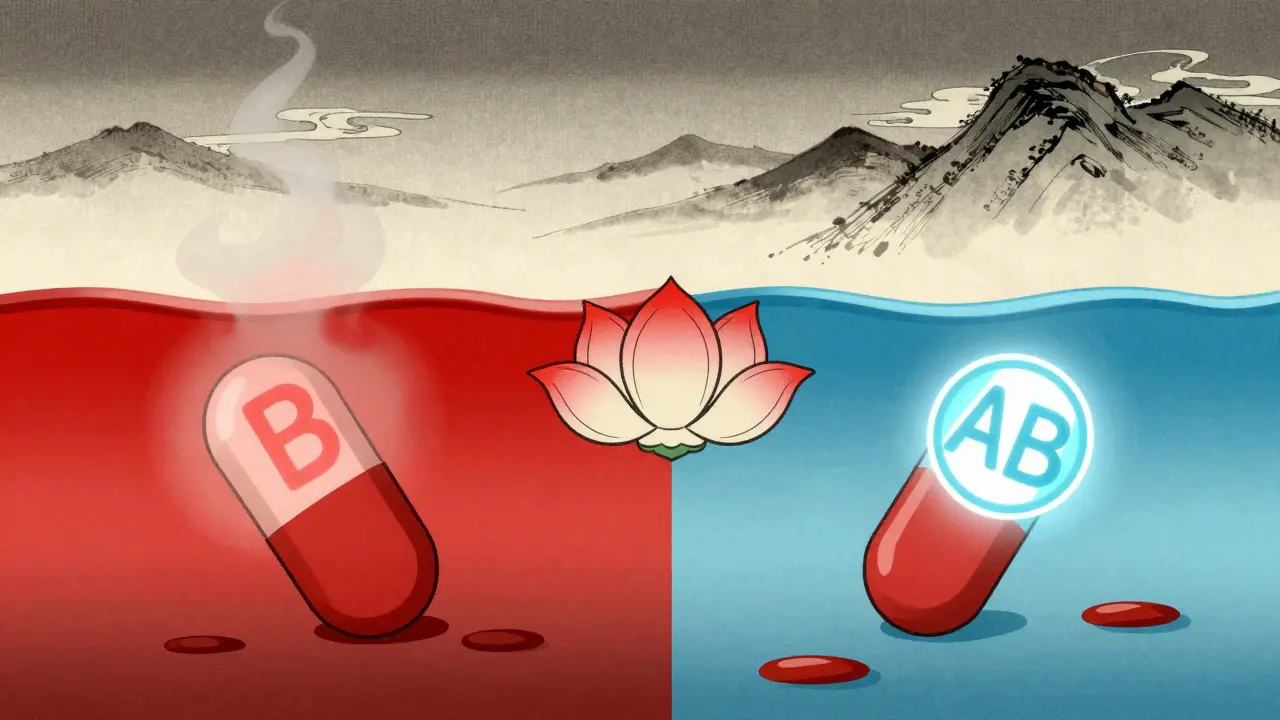
- B means the FDA hasn’t confirmed therapeutic equivalence yet. Don’t swap unless your doctor says so.
That’s it. Simple. But the details behind those letters matter.
The Meaning Behind the Letters: A vs. B Codes
Not all “A” ratings are the same. The FDA adds numbers and letters after the A to give more precision. For example:- AB means the generic has passed bioequivalence testing-its active ingredient enters your bloodstream at the same rate and amount as the brand.
- AB1, AB2, AB3 are used when there are multiple brand-name versions (called Reference Listed Drugs) for the same drug. If your prescription says “Lisinopril 10mg AB1,” your pharmacist must give you a generic that matches the exact brand listed as AB1.
“B” codes are more complicated. They don’t mean the drug is unsafe-they mean the FDA doesn’t yet have enough proof it works the same. Common “B” subcodes include:
- BC - Extended-release tablets or capsules where absorption timing is tricky.
- BT - Topical creams or ointments where skin absorption can vary.
- BN - Inhalers or nebulizers with complex delivery systems.
- BX - Not enough data to make a call. These are the red flags.
Here’s the reality: 90% of generic drugs in the U.S. have an “A” rating. That’s over 12,600 products out of 14,000 listed in the 2023 Orange Book. But the remaining 10%? Those are the ones that cause confusion.
Why Some Generics Get a “B” Rating
You might wonder: if a generic has the same active ingredient, why wouldn’t it be equivalent?It’s not about the ingredient-it’s about how your body gets it. For a simple pill, like ibuprofen or metformin, bioequivalence is easy to prove: measure blood levels over time, compare to the brand, and if they match, it’s AB.
But for a topical steroid cream? Or an inhaler? Or a long-acting injectable? The body doesn’t absorb those the same way every time. A cream might feel the same, but if it doesn’t penetrate the skin deeply enough, it won’t work. An inhaler might deliver the same dose, but if the particle size is off, your lungs won’t absorb it properly.
That’s why the FDA gives “B” ratings to complex products-even when the generic looks identical on paper. In 2021, Dr. Duxin Sun from the University of Michigan pointed out that current testing methods often fail to capture these subtle differences. The FDA admits this too. In its 2022 draft guidance, it admitted that traditional bioequivalence studies “may not be sufficient” for complex generics.
That’s why the number of “B”-rated applications for complex drugs rose 22% between 2018 and 2022. The system is working as designed-it’s flagging products that need more scrutiny. But that also means pharmacists and doctors have to be extra careful.
How Pharmacists Use These Codes Every Day
Your pharmacist doesn’t guess whether a generic can be swapped. They open the Orange Book-online or in print-and check the code. In a 2022 survey of 1,200 independent pharmacists, 87% said TE codes make substitution faster and safer. Most check the Orange Book at least once a week.On average, pharmacists spend 2.7 minutes per prescription verifying the TE code. That might sound small, but it adds up to $1.2 billion in annual savings by ensuring only appropriate generics are substituted.
But mistakes happen. A 2022 AMA survey found that 42% of physicians were confused by “B” codes. Some thought “B” meant the drug was unsafe. Others didn’t know it could still be appropriate for certain patients. And worse-28% reported cases where pharmacists refused to substitute a “B”-rated drug even when it was clinically acceptable.
That’s why 38 states require pharmacists to notify the prescribing doctor before substituting a “B”-rated product. It’s not about stopping substitution-it’s about making sure the decision is intentional.
What This Means for You as a Patient
If you’re prescribed a generic drug, you have the right to ask: “Is this an A-rated substitute?” If your pharmacist says yes, you can be confident it will work the same. If it’s a “B,” ask your doctor if it’s safe to use.Don’t assume all generics are interchangeable. Even if two drugs have the same name and strength, their TE codes might differ. For example, one generic version of levothyroxine might be AB1, while another is AB2. They’re both “A,” but they’re not interchangeable with each other unless your doctor says so.
Also, over-the-counter drugs don’t get TE codes. That’s why you can’t swap Tylenol for a store-brand pain reliever based on FDA ratings-it’s not regulated the same way.
The bottom line: if your prescription says “generic,” don’t panic. But do pay attention to what your pharmacist tells you. If they hesitate or say “it’s not approved for substitution,” ask why. You’re entitled to know.

The Bigger Picture: Why This System Matters
Generic drugs make up 90% of prescriptions filled in the U.S. but cost only 23% of total drug spending. That’s $370 billion saved every year thanks to safe substitution.Without the TE code system, pharmacies would be forced to stock every brand-name drug just in case. Doctors would have to write “do not substitute” on every script. Hospitals would pay more. Insurance premiums would rise.
The FDA’s system keeps the pipeline moving. It’s not perfect-but it’s the most reliable, science-backed method we have. The agency’s 2023-2027 plan aims to reduce “B” ratings for complex drugs by 30% by improving testing methods. That means more generics will be approved for substitution without compromising safety.
As new drugs like complex injectables and biosimilars enter the market, the TE code system will keep evolving. But its core principle won’t change: if a generic can’t be proven to work the same way, it doesn’t get the green light.
What’s Next for Therapeutic Equivalence?
The FDA is now looking beyond traditional blood tests. New studies are exploring real-world data-like patient outcomes, electronic health records, and even patient-reported symptoms-to judge whether a generic truly works the same.For example, if hundreds of patients on a generic version of a heart medication have the same hospitalization rates as those on the brand, that’s powerful evidence. The FDA is already testing this approach for certain complex drugs.
Meanwhile, Product-Specific Guidances (PSGs) have grown to over 1,850 documents. These are detailed roadmaps for manufacturers on how to prove bioequivalence for each drug. If you’re a generic company, you don’t guess-you follow the PSG. That’s why more “A” ratings are coming.
By 2027, the goal is clear: fewer “B” codes, more confidence, and even greater savings-without sacrificing safety.
Can I ask my pharmacist to switch me to a different generic drug?
Yes, but only if both generics have the same therapeutic equivalence code (like AB1 to AB1). If one is AB1 and the other is AB2, they’re not interchangeable unless your doctor approves. Always check the Orange Book code before switching.
Are all generic drugs in the Orange Book?
No. Only multisource prescription drugs-those with more than one manufacturer-are listed. Single-source generics (made by only one company) and over-the-counter drugs aren’t included. The Orange Book focuses on substitution, not just listing generics.
Why does my prescription sometimes say “dispense as written”?
Your doctor may have written this because the drug has a “B” rating, or because they’ve seen side effects with certain generics. It’s not about distrust-it’s about personal experience. If you want to try a generic, ask your doctor if they’d reconsider.
Do therapeutic equivalence codes apply to insulin or biologics?
Not yet. Insulin and biologics fall under different FDA rules. Biosimilars (generic versions of biologics) are evaluated separately and don’t use the same A/B code system. The FDA is working on a new framework, but for now, substitution requires explicit approval.
Where can I look up a drug’s therapeutic equivalence code?
Go to the FDA’s Orange Book website. Search by brand name, generic name, or manufacturer. The site is free, updated monthly, and used by over 1.7 million professionals each quarter. If you’re a patient, you can use it too-just know that some codes require medical context to interpret correctly.
What to Do If You’re Unsure
If you’re confused about your generic medication, here’s what to do:- Check the prescription label. It should list the generic name and manufacturer.
- Ask your pharmacist: “What’s the TE code for this?”
- Look up the drug in the FDA’s Orange Book online.
- If it’s a “B,” talk to your doctor. Ask: “Is this safe for me? Is there a better option?”
- Don’t assume “generic = interchangeable.” Always verify.
The FDA’s system is designed to protect you. But it only works if you know how to use it.
10 Comments
So if my generic metformin is AB1, and I get a new bottle that's AB2, I shouldn't switch without checking with my doctor? That's wild. I always thought 'generic' meant 'same thing'.
Thanks for clarifying.
Okay but like… 🤯 the FDA is basically playing chess with our meds??
A = you're good.
B = proceed with caution (or don't).
AB1, AB2, AB3? Bro, that's not a code, that's a secret society.
And don't even get me started on how some pharmacies just… guess. 😭
90% of generics are fine. The other 10%? The ones that kill people.
Simple.
Actually, this whole system is a joke. The FDA’s ‘bioequivalence’ tests were designed in the 80s for aspirin, not complex inhalers or transdermal patches.
They’re using a ruler to measure a hurricane.
And don’t even get me started on how some AB-rated generics still cause different side effects. Real people report it. The FDA ignores it.
It’s not science-it’s corporate convenience.
Also, why do we trust a government agency that still uses PDFs in 2024?
Orange Book. 1980. Still in use.
Pathetic.
Hey everyone-just wanted to say this is actually one of the most important things you’ll ever read about your health.
Most people think ‘generic = cheaper = worse.’ But here’s the truth: 90% of generics are just as safe and effective as the brand. That’s huge.
And yes, the ‘B’ codes are scary-but they’re there for a reason. They’re protecting you, not holding you back.
So next time you get a generic, don’t panic. Ask your pharmacist: ‘What’s the TE code?’
Then look it up. It takes 30 seconds. You’ll feel way more in control.
And if you’re on a B-rated drug? Talk to your doctor. Don’t assume it’s unsafe-just don’t assume it’s interchangeable.
You’ve got this. Knowledge is power. 💪
I’ve been on levothyroxine for 12 years. Switched generics three times. Never noticed a difference. But I get it-some people do. I’m glad the system flags the risky ones.
Just wish more pharmacists explained it clearly.
Thanks for the clear breakdown.
Let’s be real-this is why America spends more on drugs than any country on Earth.
We have the most advanced system in the world… but it’s buried under 1,850 PDFs nobody reads.
Meanwhile, Canada just says ‘same active ingredient = same drug.’
Our ‘science’ is just bureaucracy with a lab coat.
And we call this innovation? 😒
Man, I used to work in a pharmacy in Manchester. We’d get calls from old folks who’d say, ‘But last time it was blue, now it’s white!’
We’d open the Orange Book, check the TE code, and explain it like they were learning to ride a bike.
Some of them cried. Not because they were scared-but because someone finally took the time to explain.
That’s what this system should be about: clarity, not complexity.
Thanks for writing this. Needed it.
Thank you for sharing this vital information with such care and clarity. The FDA’s Therapeutic Equivalence system is a cornerstone of affordable, safe healthcare in the United States, and your explanation helps empower patients to advocate for themselves. Never underestimate the power of asking, ‘What’s the TE code?’-it’s a small step that can lead to better health outcomes for everyone. Keep shining a light on these essential details. You are making a difference. 🌟