

Imagine trying to navigate a room while seeing two different versions of the same door. For people with Strabismus is a visual condition where the eyes fail to maintain proper alignment when focusing on an object, causing one eye to drift in a different direction , this isn't a rare occurrence-it's a daily struggle. Whether it's a child born with a "squint" or an adult experiencing sudden misalignment after a stroke, the impact goes far beyond just how a person looks. It affects how they read, how they drive, and how they interact with the world around them.
The Different Faces of Eye Misalignment
Not all eye misalignments are the same. Depending on which way the eye drifts, the condition is categorized into four primary types. You'll most often hear doctors talk about Esotropia, where the eye turns inward toward the nose. This is the most common form, accounting for about 50% of cases. On the flip side, Exotropia happens when the eye drifts outward, seen in roughly 30% of patients. Less common are Hypertropia (upward drift) and Hypotropia (downward drift).
Some people deal with this constantly, while others have an "intermittent" version where the eye only drifts when they are tired or daydreaming. In adults, a specific type called paralytic strabismus can appear suddenly. This usually happens due to damage to the cranial nerves (specifically the fourth or sixth nerves), often triggered by physical trauma or a stroke. It's usually accompanied by a dizzy feeling or nausea, making it a medical priority to address quickly.
How Strabismus Affects Daily Life
When your eyes aren't working as a team, your brain struggles to merge two different images into one. This leads to Diplopia, the medical term for double vision. For many adults, this comes with significant eye strain and physical discomfort. In children, the risks are different. If left untreated, about 65% of kids develop depth perception issues, making it hard to judge distances-think of the struggle of catching a ball or pouring water into a glass.
You might notice a child tilting their head to one side to compensate for the misalignment, a habit seen in about 42% of pediatric cases. Because the brain is working overtime to make sense of the visual chaos, many school-aged children struggle with concentration and find reading frustratingly difficult. It's not just a "vision problem"; it's a cognitive load that can impact school performance and self-esteem.

Non-Surgical Options vs. Surgical Needs
Surgery isn't always the first answer. Depending on the cause, a doctor might start with a more conservative approach. Corrective glasses can sometimes align the eyes, and "patch therapy" is often used in children to force the weaker eye to work, preventing the development of a "lazy eye" (amblyopia). Vision exercises can also be effective; in fact, some experts suggest that 60% of intermittent exotropia cases in children can be managed without ever going under the knife.
So, when is strabismus surgery actually necessary? Doctors typically recommend it when the misalignment is constant and significant-specifically when it exceeds 15 to 20 prism diopters-or when non-surgical methods simply aren't working. It's also a primary choice when a patient suffers from persistent double vision that prism glasses can't fix, or when the head tilting becomes a permanent, restrictive posture.
| Approach | Primary Goal | Common Methods | Best For... |
|---|---|---|---|
| Non-Surgical | Visual stimulation & alignment | Patching, Prism glasses, Exercises | Mild/Intermittent cases, Children |
| Surgical | Physical muscle realignment | Recession & Resection | Severe/Constant cases, Adults |
The Mechanics of Surgical Correction
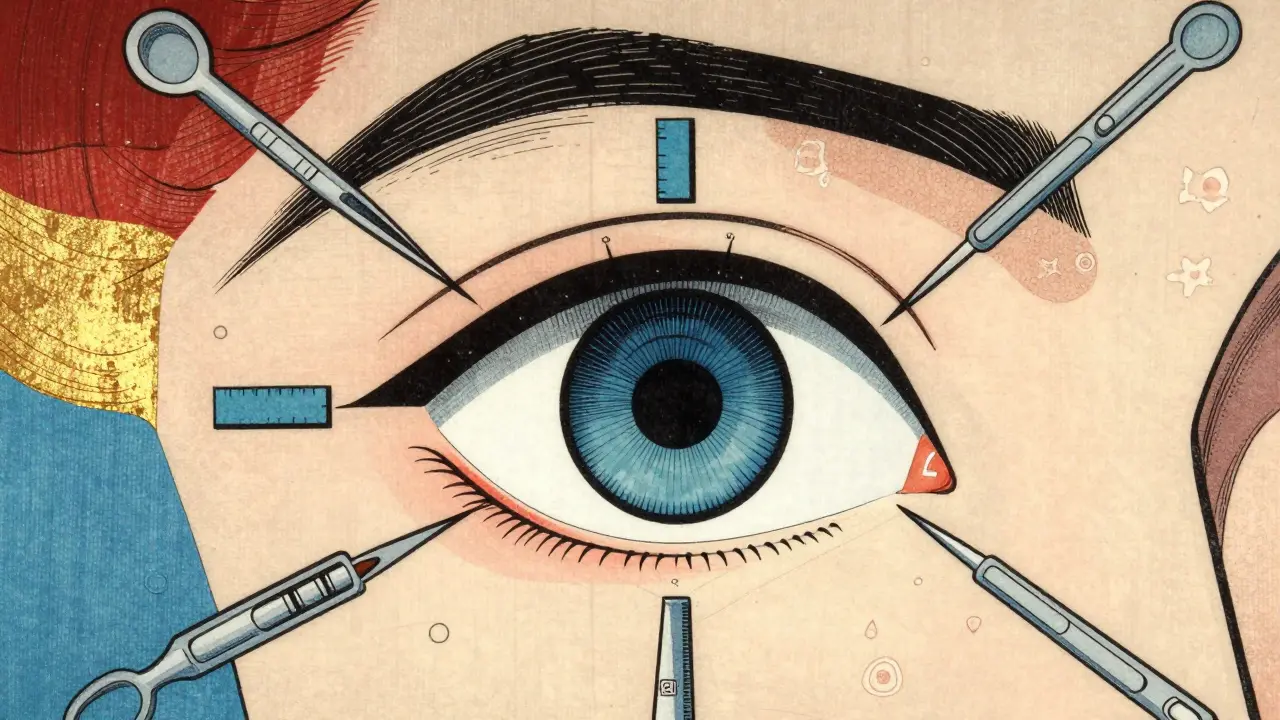
If you've decided on surgery, the goal is to physically change how the eye muscles pull. Your eyes are controlled by six extraocular muscles. The surgeon essentially performs one of two moves: recession or resection. In a recession, the muscle is detached and moved backward on the eye to weaken its pull. In a resection, a piece of the muscle is removed to shorten it, which strengthens its pull. For someone with esotropia, a common move is a bilateral medial rectus recession to pull the eyes away from the center.
Modern surgery has become much more precise. About 68% of adult surgeries now use adjustable sutures. This is a game-changer because it allows the surgeon to fine-tune the eye position within 24 hours after the operation, ensuring the alignment is just right. The procedure usually takes between 45 and 90 minutes. Children are typically under general anesthesia, while adults often opt for local anesthesia with sedation.
What to Expect During Recovery
Recovery isn't an overnight process. In the immediate days following surgery, about 80% of patients experience temporary double vision as the brain and muscles adjust to the new position. You'll likely use medicated eye drops daily for about two weeks to manage inflammation. A critical part of the process is the follow-up schedule, usually involving checks at one day, one week, three weeks, and six weeks post-op.
For many, the results are life-changing. Many patients report a massive boost in confidence and the ability to make eye contact without feeling embarrassed. However, it's important to be realistic. About 20-30% of people may experience undercorrection, meaning a second minor surgery might be needed to get the alignment perfect. Some also experience overcorrection (10-15% of cases). This is why preoperative counseling is so vital; patients who know these possibilities beforehand tend to be much happier with their outcomes.
New Frontiers in Eye Alignment
The field is moving toward extreme precision. New tools, like the Steger hook, allow surgeons to measure muscle tension with 0.5-gram precision, taking the guesswork out of how much to weaken or strengthen a muscle. We're even seeing the introduction of Virtual Reality (VR) binocular vision training before surgery, which has been shown to increase success rates by about 18% by preparing the brain for the new alignment.
Looking ahead, robotic-assisted surgery is currently in trials, promising even greater precision in where muscles are reattached. Some doctors are also using botulinum toxin injections as a temporary measure to relax an overactive muscle before the actual surgery, which can reduce the amount of surgical adjustment needed. While insurance coverage can be a hurdle-with some providers requiring six months of failed non-surgical treatment first-the overall trend is toward earlier detection and more personalized care.
Is strabismus surgery safe for very young children?
Yes, it is generally safe. In fact, for congenital esotropia, some experts advocate for surgery before the age of 2 to maximize the development of binocular vision and depth perception. Recent guidelines even suggest considering surgery as early as 3-4 months for large-angle cases.
Will surgery completely cure my double vision?
While the goal is to eliminate diplopia, success varies. Non-paralytic cases have a high success rate (around 75%), but paralytic strabismus (caused by nerve damage) is tougher, with a complete resolution rate of about 45%. Post-operative vision therapy is often recommended to help the brain adapt.
How long is the recovery period for adults?
Most adults recover within a few weeks, but about 15% may find the recovery takes longer than six weeks. You'll need to use eye drops for two weeks and attend several follow-up appointments to ensure the alignment is stable.
Can strabismus be treated without surgery?
Absolutely. Many cases are managed with corrective glasses, patching one eye to treat amblyopia, or specialized vision therapy exercises. For some intermittent cases in children, these methods can reduce the need for surgery by as much as 35%.
What are the risks of strabismus surgery?
Common risks include undercorrection or overcorrection of the eye position. Rare but serious complications include retinal detachment (0.1% incidence) and endophthalmitis (0.04% incidence). This is why surgery should only be performed by specialists in pediatric or neuro-ophthalmology.
14 Comments
It is important to emphasize that the decision to undergo surgery should always be made in consultation with a board-certified ophthalmologist. While the data provided here is accurate, every patient's anatomy is unique, and a comprehensive neurological exam is often necessary to rule out underlying causes in adult-onset cases.
This is so hopeful!!! Just imagine the quality of life improvement for these kids!!! Absolutely amazing!!!
idk why everyone thinks surgery is the gold standard. most of these stats are prolly fudged by big pharma and the eyedoctors to make more money. just use a patch and deal with it lol
Wow, I had no idea it affected concentration in school so much!! 🤯 It's so wild how our physical sight ties directly into how we process information... really makes you think about the brain's adaptability!! ✨💖
Funny how they mention "insurance hurdles." That's just a code word for them keeping the best tech like robotic surgery for the rich while the rest of us get the basic stuff. They don't want us all seeing perfectly, that's the real joke.
The mention of the Steger hook is a great addition. For those wondering, the precision in muscle tension is what prevents the "overcorrection" issue mentioned later. It essentially allows the surgeon to feel the exact pull of the muscle, which was historically much more subjective. If you're considering surgery, definitely ask your surgeon if they use adjustable sutures, as it provides a safety net for fine-tuning after the initial swelling goes down.
Of course, people just blindly follow these guides without realizing the psychological toll of "corrective" surgery... It's simply tragic that we prioritize the "look" of the eye over the internal struggle of the patient!!!
Keep your head up everyone! Whether it's patches or surgery, you've got this. The road to recovery might be a bit bumpy, but the result is totally worth the effort!
the idea of the brain ignoring one eye to survive is a strange kind of wisdom the body possesses
I remember a student of mine who had this and he used to tilt his head so far it was almost a 90 degree angle just to see the whiteboard, and it's really heart-wrenching when you realize they aren't being defiant or distracted but are actually fighting a physical battle just to keep up with the lesson. It's such a critical reminder for teachers to be observant because a child will rarely tell you they can't see properly; they'll just stop trying because the effort of merging two images is physically exhausting for a ten-year-old. If more people understood the cognitive load, we'd have way fewer kids labeled as having learning disabilities when in reality, they just need a simple prism glass or a bit of therapy to align their world. It's all about catching it early and providing that support system so they don't feel isolated in their experience. We really need to push for better screening in early childhood education across the board.
Focus on the progress!
It is most heartening to learn that surgical intervention can be performed at such a tender age to ensure the proper development of binocular vision.
Oh great, so I can pay a fortune to have my eyes surgically moved and there's still a 30% chance they'll mess it up and I'll need a second surgery. Absolutely fantastic. Just a dream scenario right there.
I totally get the frustration with the recovery time. Waiting weeks for your vision to settle while seeing double is honestly the worst part of the whole experience.