
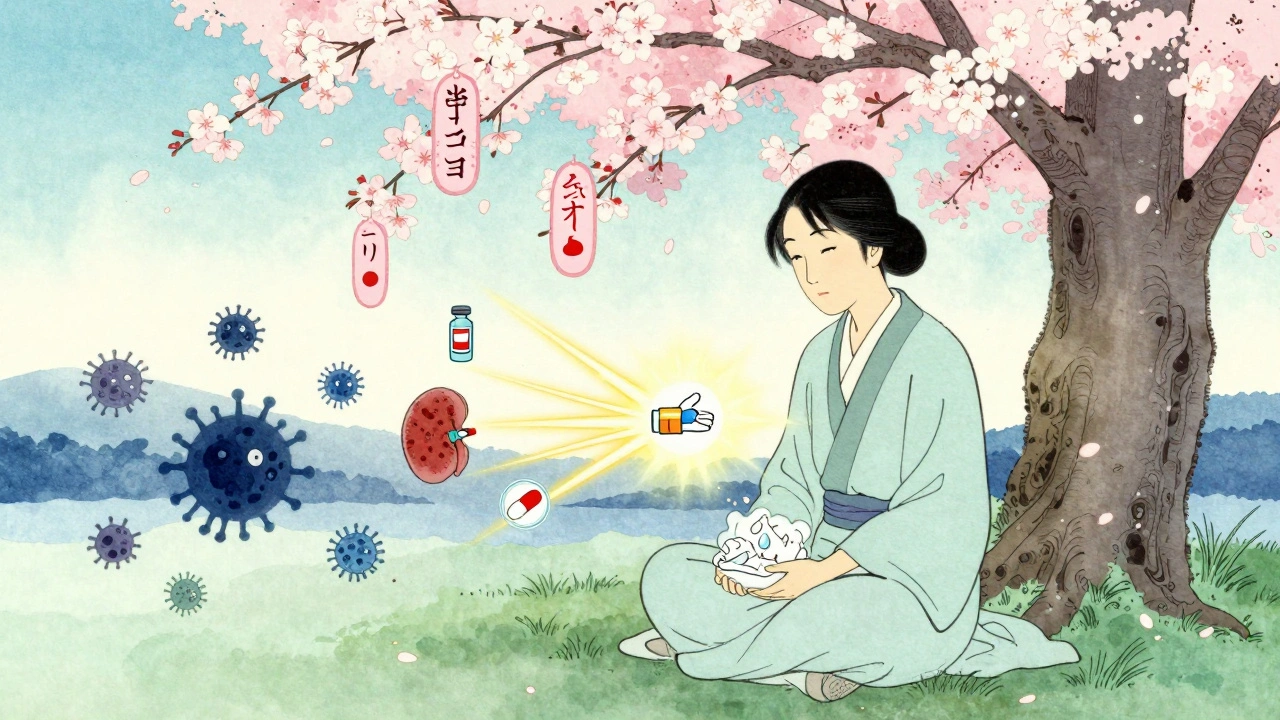
After a kidney transplant, your new organ works hard to keep you alive-but your body is fighting a quiet war against infections. The very drugs that stop your immune system from rejecting the kidney also leave you wide open to bacteria, viruses, and fungi that a healthy body would shrug off. Infections are one of the top reasons people end up back in the hospital after transplant, and sometimes, they can cost you the graft-or worse. The good news? You’re not powerless. With the right prevention, timing, and monitoring, you can slash your risk dramatically.
Why Infections Happen After Transplant
Your immune system doesn’t just wake up one day and decide to attack your new kidney. It’s trained over years to recognize foreign tissue as dangerous. To stop that, you take immunosuppressants-drugs like tacrolimus, mycophenolate, or prednisone. These drugs lower your body’s defenses, but they don’t pick and choose. They knock down everything: your ability to fight off the flu, a cut on your finger, or a mold spore in the air. The biggest risks come in three waves. First, in the first month after surgery, you’re most vulnerable to infections from the hospital itself-things like surgical site infections or central line bloodstream infections. Then, between 1 and 6 months, your body is still heavily suppressed, and you’re at risk for viruses like CMV, EBV, and fungi like Aspergillus. After 6 months, your immunosuppression is usually lowered, but now you’re back in the real world-exposed to colds, foodborne bugs, and community viruses that can still hit hard because your immune system is still playing catch-up.Preventive Medicines: The First Line of Defense
You won’t be left to guess what to take. Your transplant team will give you a clear, timed plan for antimicrobial prophylaxis. It’s not random-it’s based on your blood type, donor match, and past medical history. For example, if you’re at high risk for cytomegalovirus (CMV)-which happens when the donor is positive and you’re negative (D+/R−)-you’ll likely get valganciclovir for 3 to 6 months. This isn’t optional. CMV doesn’t just cause fever and fatigue. It can trigger rejection, damage your new kidney, and even lead to death. Studies show that without prophylaxis, up to 34% of high-risk patients develop serious CMV disease. You’ll also get antivirals like acyclovir or valacyclovir for 1 to 3 months to block herpes simplex and varicella-zoster viruses. These can cause painful sores or shingles if left unchecked. For fungal infections, especially if you had a complicated surgery or were in the ICU, you might get fluconazole or voriconazole. And if you’re at risk for Pneumocystis jirovecii pneumonia (PCP), you’ll take trimethoprim-sulfamethoxazole daily for at least 6 months. Central lines? They’re a major infection gateway. To cut risk, nurses will clean the catheter site with chlorhexidine every day, change dressings every 5-7 days, and remove the line as soon as it’s no longer needed. Studies show chlorhexidine-impregnated dressings reduce bloodstream infections by up to 22% in transplant units.Vaccines: Timing Is Everything
Vaccines are your shield-but only if you get them at the right time. Live vaccines (like MMR, varicella, or nasal flu) are off-limits after transplant. They contain weakened viruses that could make you sick when your immune system is down. That’s why the best time to get vaccinated is before your transplant. If you haven’t had your tetanus, pneumococcal, hepatitis B, or flu shots yet, your team will schedule them months ahead. Family members should also be up to date-especially on flu and whooping cough. This “cocooning” strategy keeps germs away from you at home. After transplant, you can get killed (inactivated) vaccines starting around 6 months. That includes the yearly flu shot, pneumococcal vaccines (Prevnar 20 and Pneumovax 23), and the COVID-19 booster. Hepatitis B vaccine is often given in a double-dose series because your immune system responds slower. Don’t skip them. One study found transplant patients who skipped the pneumococcal vaccine were 3 times more likely to get pneumonia requiring hospitalization.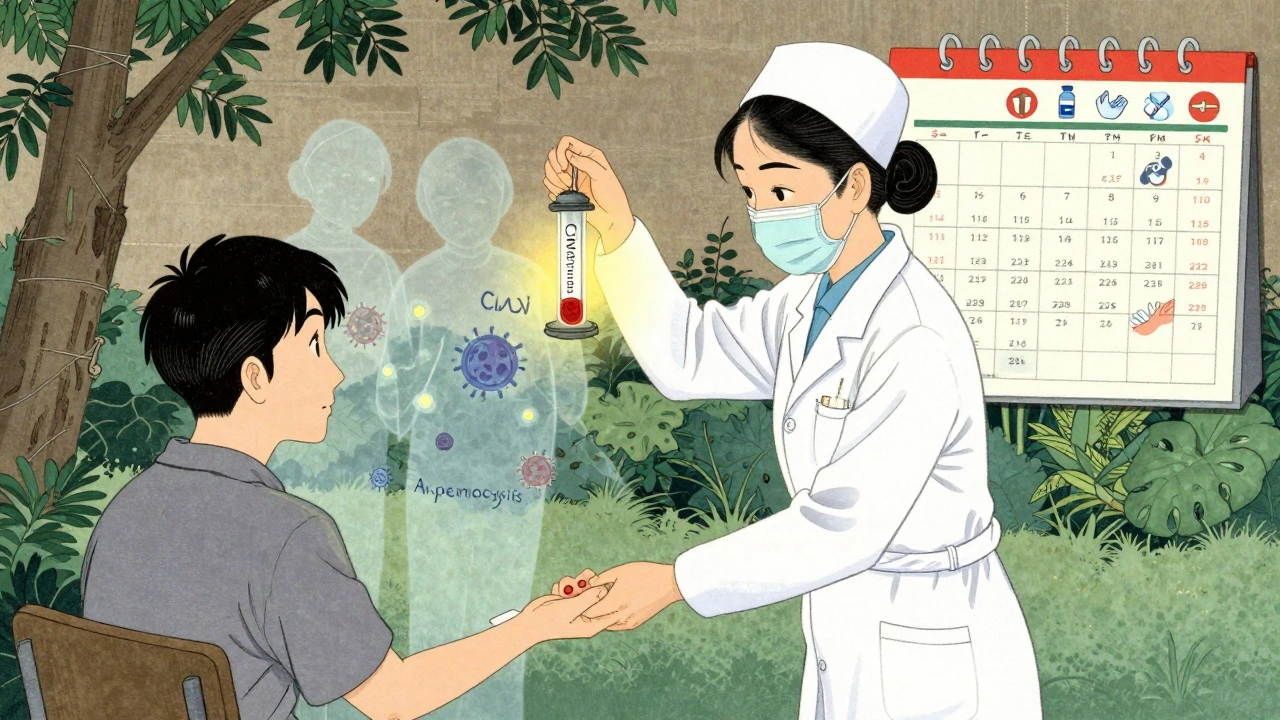
Monitoring: Catching Infections Before They Spread
You can’t wait until you’re feverish and miserable. That’s too late. Monitoring is routine, not optional. For CMV, you’ll get a blood test every 1-2 weeks for the first 3 months, then monthly until 6 months. This isn’t a simple check-it’s a quantitative PCR test that measures how much CMV DNA is in your blood. If it starts rising, even without symptoms, your doctor will start antivirals early. This preemptive approach cuts CMV disease by over 70% compared to waiting for symptoms. For fungal infections, especially if you’re on high-dose steroids or had a lung transplant, your team may check for galactomannan or beta-D-glucan in your blood. These are markers that tell them if Aspergillus or other fungi are hiding in your body. And if you’ve had repeated UTIs or are colonized with drug-resistant bacteria like ESBL-producing E. coli, you might get regular stool or urine cultures. Some transplant centers screen weekly for carbapenem-resistant organisms if they’re common in your region. Finding them early lets doctors stop them before they cause a full-blown infection.Lifestyle Changes: What You Do Every Day Matters
Medicines and tests help-but your daily choices are just as powerful. Food safety is huge. Avoid raw seafood, undercooked eggs, and unpasteurized cheeses. Listeria from deli meats or soft cheeses can cause meningitis in transplant patients. Cook meat to 165°F. Wash fruits and veggies even if they’re labeled “ready to eat.” Don’t eat from salad bars or buffets-those are germ hotspots. Handwashing isn’t just advice-it’s survival. Use soap and water for at least 20 seconds. Alcohol-based gel works when soap isn’t available. Wash before eating, after using the bathroom, and after touching pets or public surfaces. Pets? They’re not off-limits, but they need rules. Don’t clean litter boxes or bird cages. Avoid reptiles, amphibians, and young animals-they carry Salmonella and other bugs. Wash your hands after petting your dog or cat. Keep your pet’s vaccines current and take them to the vet if they’re sick. Avoid gardening or digging in soil, especially in places like Ohio or the Midwest where histoplasmosis is common. If you must, wear a mask and gloves. Stay away from construction sites, compost piles, and crowded indoor spaces during flu season. Wear a mask in airports, hospitals, and public transit.
14 Comments
so like... i just got my transplant 3 months ago and honestly i thought the meds were just for rejection but wow the infection stuff is wild. i didnt even know my dog could be a threat. now i wash my hands like i'm decontaminating after a biohazard
they say avoid raw seafood but no one tells you how hard it is to give up sushi after years of it. i cried the first time i ordered cooked tuna. worth it though. my kidney thanks me.
let me tell you something-this whole transplant system is a corporate scam. they push these drugs because they make billions, not because they care. you think CMV prophylaxis is about saving lives? no. it’s about keeping you dependent. the FDA is in bed with Big Pharma. they don’t want you healthy-they want you medicated. and don’t even get me started on vaccines-they’re just Trojan horses for tracking chips. i know people who went off everything and their kidneys are better than ever. they just never told you the truth.
the part about handwashing being survival-not advice-hit me hard. i used to think i was being paranoid until i saw my cousin get hospitalized from a simple cut. now i scrub for 20 seconds every time. no exceptions. it’s not about fear, it’s about respect-for your body, your new organ, your second chance.
life after transplant is like playing chess with death and you just got a new queen but the board is full of traps 🤡
keep going. you got this.
as someone who works in global health, i’ve seen how transplant care varies wildly across countries. the level of detail in this post-especially around CMV monitoring and fungal markers-is what we strive for in low-resource settings. the fact that this is standard in the US? that’s progress. but we need to make it global. not everyone has access to PCR tests or chlorhexidine dressings. this knowledge should be a human right, not a privilege.
the claim that ‘up to 34% of high-risk patients develop serious CMV disease’ without prophylaxis is misleading. that statistic comes from a 2012 retrospective cohort with small sample size and selection bias. newer meta-analyses (2021, JAMA Transplant) show the real risk is closer to 18-22%. also, valganciclovir isn’t always necessary-some centers use preemptive therapy only. don’t let fear-mongering replace clinical judgment.
so... you’re telling me I can’t have a nice cheese plate anymore? no brie? no camembert? what is this, a prison? i’m not eating a salad bar? i’m not touching my cat? i’m supposed to live like a monk now? this is ridiculous. i’m not a lab rat. i’m a person. i’ve earned the right to eat a sandwich without fear.
they say avoid gardening... but what if you live in a city with no yard? what if your only peace is digging in the dirt? what if your therapist says it helps your anxiety? they don’t tell you that. they just say ‘no soil.’ but what if i wear a mask? what if i use gloves? what if i wash my hands? what if i’m careful? they never answer that.
Who wrote this? A transplant nurse? A doctor? Or just someone who read a PubMed abstract? The tone is condescending. You talk about ‘you’re not powerless’ like we’re children. We’re not. We’ve lived with dialysis. We’ve lost friends. We know the risks. Stop patronizing us. And stop using ‘you’ like you’re our mom. We’re adults. We don’t need you to tell us to wash our hands. We’ve been doing it for years.
just got my flu shot yesterday 🤗 and i cried because i realized i haven’t had one since 2018. now i’m going to get the pneumococcal one next week. i’m not scared anymore. i’m ready. 🙌
i remember the first time i saw my creatinine drop below 1.5 after transplant. i sat in the parking lot and just breathed. not because i was cured-but because i was alive. this post didn’t just give me facts-it gave me permission to be gentle with myself. i don’t have to be perfect. i just have to be consistent. one handwash. one vaccine. one appointment at a time. that’s how we win. not with bravery. with patience.
they’re lying about the vaccines. the mRNA ones are nanobots. they’re tracking you through your kidney. the ‘PCR tests’? they’re not measuring CMV-they’re measuring your DNA being uploaded to a government server. i know someone who stopped all meds and now his kidney works better than ever. they don’t want you to know this. the system is rigged.