
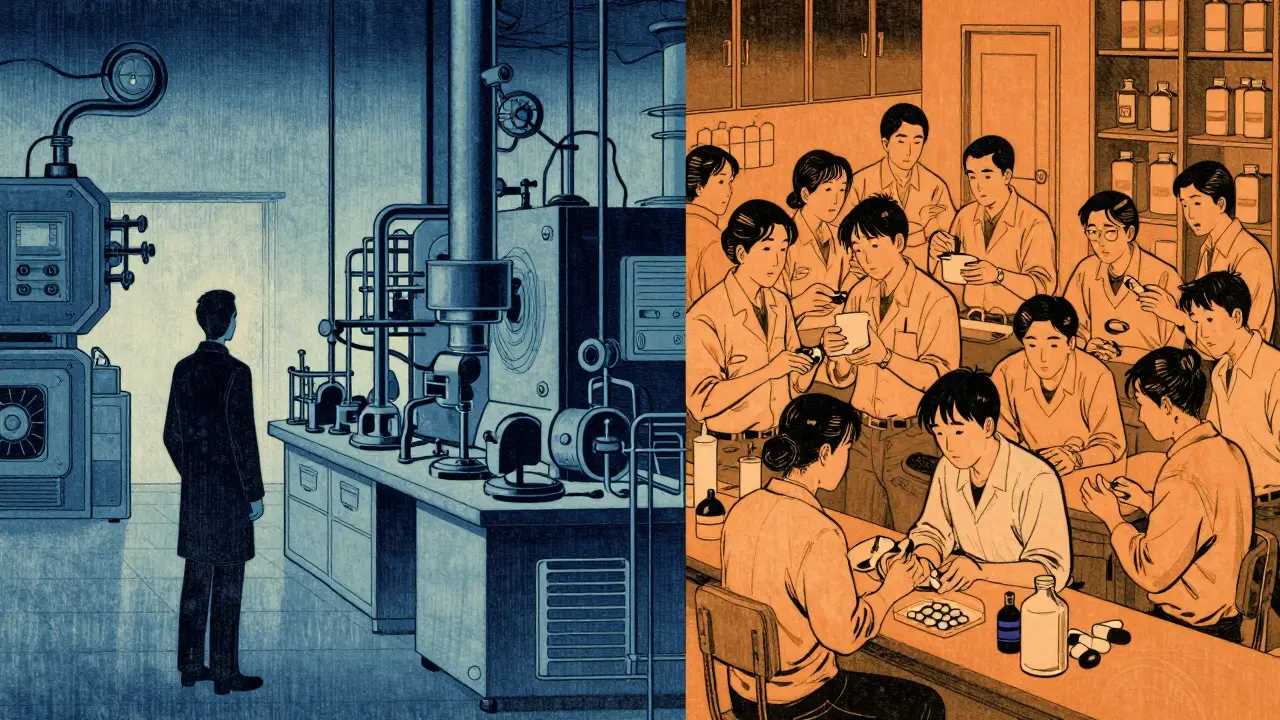
When you walk into a pharmacy, the price tag on a generic pill often looks like a discount compared to its brand-name counterpart. You might see a $5 price tag next to a $50 one for the exact same medication. But have you ever wondered where that money actually goes? The answer isn't just about marketing budgets. It comes down to the complex machinery of manufacturing, and specifically, the human hands that run it. Understanding the labor cost differences between generic and brand production reveals a lot about how our healthcare system is built.
While the active ingredients are often identical, the economic engines driving their creation are fundamentally different. Brand-name drugs carry the weight of massive upfront investments, while generic manufacturers operate on razor-thin margins driven by volume. This distinction shapes how much labor is required, where that labor is located, and how much it costs per unit. Let's break down the actual numbers and the hidden factors that drive these costs.
The Core Cost Structure: Where Does the Money Go?
To understand labor, you first need to see the whole picture of drug pricing. A 2023 analysis by Prosperous America breaks down the economics of generic drugs in a way that is hard to ignore. Out of every $100 spent on generics, only $36 actually goes toward production and manufacturing. Within that slice, $18 covers direct production costs like raw materials and packaging, and another $18 is retained as gross profit to cover overhead, litigation, and compliance.
Brand-Name Drug Production operates under a completely different financial model. These companies must recoup the cost of discovery. The FDA notes that developing a new molecular entity costs approximately $2.6 billion on average and takes 10 to 15 years. This creates a massive upfront cost that generic manufacturers avoid entirely. Because brand manufacturers need to recover this investment, their pricing is 80-85% higher than generics, even when the production costs for the active ingredients are similar.
This pricing disparity means labor is just one part of the equation, but it is a significant one. In the initial production phases for brand-name drugs, labor typically constitutes 30-40% of total manufacturing costs. For generic drugs, that number drops significantly. Generic manufacturers allocate labor costs to approximately 15-25% of total manufacturing costs. This 10-15 percentage point gap is where the real economic story lies.
Quality Control: The Hidden Labor Sink
Many people assume that because generics are cheaper, they skip safety steps. That is not the case. In fact, quality control (QC) is a massive labor-intensive component for generic producers. DrugPatentWatch's 2023 analysis reveals that quality control processes alone account for more than 20% of total generic drug production costs.
This isn't just about testing the final pill. It involves rigorous testing of raw materials, in-process materials, and final products. It also requires meticulous documentation for batch traceability. Every batch must be tracked from the factory floor to the pharmacy shelf. This creates a heavy regulatory compliance burden. According to a 2017 FDA analysis, medium-sized firms (20-500 employees) spend approximately $184,000 annually just to maintain compliance systems. Add to that $1.9 million annually for program participation and $320,000 per new drug application.
The "Cost of Quality" (COQ) methodology helps explain this. It divides quality-related expenses into prevention costs (training, quality planning), appraisal costs (inspection, testing), internal failure costs (rework, scrap), and external failure costs (warranty, returns). Prevention and appraisal costs represent the labor-intensive aspects that can account for 20% or more of production expenses. Generic manufacturers cannot cut corners here without risking their license to operate.

Geography and Outsourcing Strategies
Where a drug is made changes the labor bill dramatically. Geographic production strategies significantly impact labor cost differentials. Prosperous America's 2023 analysis shows that Active Pharmaceutical Ingredient (API) production in India and China is approximately 42% cheaper than in U.S. facilities. This cost advantage applies to the 36% production slice of total generic drug costs.
However, the HHS Office of the Assistant Secretary for Planning and Evaluation documented in their 2021 report that these international cost advantages do not necessarily reflect greater efficiency. Instead, they often reflect subsidies, lax labor and environmental standards, and scale dominance that artificially depress costs. This creates structural distortions in the market that directly impact labor cost comparisons.
Within the U.S., generic manufacturers are also shifting their labor models. The industry is increasingly relying on Contract Manufacturing Organizations (CMOs). BCG's 2019 study noted that biosimilar business units spend 42% of Cost of Goods Sold (COGS) on CMOs compared to 28% for small-molecule units. This strategic shift transforms fixed labor costs into variable expenses. Instead of hiring a permanent workforce that needs paying during slow periods, manufacturers can optimize labor utilization based on demand fluctuations.
| Cost Component | Generic Production | Brand-Name Production |
|---|---|---|
| Labor Cost % of Manufacturing | 15-25% | 30-40% |
| Quality Control Cost Share | 20%+ of production costs | Variable (often lower % of total due to higher price) |
| R&D Recovery Burden | None | High ($2.6 billion avg per drug) |
| External Manufacturing (CMOs) | Increasing (up to 42% for biosimilars) | Lower reliance |
Economies of Scale and Labor Efficiency
Volume is the great equalizer in generic manufacturing. Market dynamics reveal that nine out of 10 prescriptions filled in the U.S. are for generic drugs. This enormous production volume drives down per-unit labor costs through economies of scale. BCG's 2019 benchmark study documented that generics manufacturers achieve a 27% unit cost reduction every time volume per manufacturing site doubles.
This is significantly higher than the 17% reduction seen in biopharma companies. This indicates substantial economies of scale that directly impact labor efficiency metrics. When you produce millions of units of the same drug, the time spent per unit by a worker drops. The BCG study also revealed that volume per Stock-Keeping Unit (SKU) dramatically affects unit costs. Generics producers see unit costs drop 45% every time the number of units doubled, compared to 29% for biopharma manufacturers.
This scaling effect means that labor productivity in generic manufacturing scales exceptionally well with production volume. A single production line running at full capacity for a generic drug requires less labor per pill than a brand-name line running at lower capacity. This is why competition among generic manufacturers reduces prices much below what buyers would pay for the brand, creating intense pressure on all cost components including labor.
The Price Pressure Trap
There is a downside to these low costs. The FDA's 2023 report on generic competition acknowledges increasing attention on whether the lower cost of generic drugs may place pressure on companies to adopt strategies that lower the cost of manufacturing. This can lead to supply disruptions and shortages.
When prices drop too low, manufacturers may be forced to reduce staffing levels or hire less experienced personnel to save money. The PMC's 2021 article on the evolution of supply and demand confirms that generic drugs are generally inexpensive to produce, and competition reduces prices significantly. However, if the price is cut below the cost of quality production, the system breaks.
Expert analysis from the FDA's Center for Drug Evaluation and Research demonstrates that the relationship between generic competition and drug prices is well-established. Studies using both average manufacturer prices and invoice-based wholesale prices show that generic drug prices decline with additional competition. However, most of the difference is attributable to wholesaler markups. This pricing pressure directly impacts generic manufacturers' ability to maintain labor costs.
Despite these pressures, the BCG study documented significant efficiency opportunities within generic manufacturing. A manufacturer that invests in prevention and can consistently produce high-quality batches with fewer deviations, less rework, and faster QC release times will have a significantly lower total cost of production. This suggests that strategic labor investment in quality control can yield substantial long-term cost savings despite higher initial labor expenses.
Future Trends in Manufacturing Labor
As we move forward, the labor landscape will continue to shift. The FDA's analysis of 2021 generic drug approvals estimated significant consumer savings from the 633 generic drug applications fully approved that year. This continues a trend documented since 2018 where competition among generic manufacturers consistently delivers lower prices.
However, the ASPE report cautions that settlement agreements between brand and generic companies can redistribute producer surplus from the brand company to the generic company. This potentially creates barriers to price reduction that indirectly affect labor cost structures by limiting competitive pressures. Current industry trends show that generic drug manufacturers increasingly rely on contract manufacturing organizations.
The labor cost differential between generic and brand production remains a critical but complex component of the broader cost structure. Generic manufacturers leverage higher production volumes, geographic arbitrage, simplified formulations, and strategic outsourcing to maintain labor costs at approximately 60-70% of the proportional burden seen in brand-name drug manufacturing during their initial production phases. While they face intense pricing pressures that continuously drive labor cost optimization efforts, the focus must remain on maintaining the quality standards that keep patients safe.
Why are generic drugs cheaper than brand-name drugs?
Generic drugs are cheaper primarily because manufacturers do not have to recoup the massive research and development costs associated with creating a new drug. Brand-name drugs cost an average of $2.6 billion to develop, while generics use existing formulas. Additionally, generics benefit from higher production volumes and lower labor cost percentages.
What percentage of manufacturing costs is labor for generics?
Labor constitutes approximately 15-25% of total manufacturing costs for generic drugs. This is substantially lower than the 30-40% range typical for brand-name drugs during their initial production phases, due to economies of scale and streamlined processes.
Does lower cost mean lower quality for generics?
Not necessarily. Quality control processes account for more than 20% of total generic drug production costs. While price pressure exists, manufacturers must meet strict FDA regulations. However, extreme cost-cutting can lead to supply disruptions if staffing levels drop too low.
How does location affect drug production costs?
API production in India and China is approximately 42% cheaper than U.S. facilities. This is due to lower labor standards, subsidies, and scale dominance. This geographic arbitrage significantly lowers the overall cost of generic drugs at the pharmacy counter.
What are Contract Manufacturing Organizations (CMOs)?
CMOs are third-party companies that manufacture drugs for other pharmaceutical companies. Generic manufacturers increasingly use them to transform fixed labor costs into variable expenses, allowing them to optimize labor utilization based on demand fluctuations.
12 Comments
they dont want you to know the real numbers behind this pharmaceutical industrial complex. the labor cost manipulation is just another layer of the matrix keeping us dependent on their overpriced products. generic drugs are cheaper because they exploit workers in developing nations while brand companies hide their research costs in offshore accounts. the FDA compliance costs are a sham designed to protect corporate interests not patient safety. when you see those price differences its not about efficiency its about control. they want you thinking its legitimate competition when its actually a rigged system. the quality control percentages they quote are inflated to make generic manufacturing look more expensive than it really is. this is all part of the larger healthcare conspiracy where insurance companies and pharma work together to maximize profits. we need to wake up and see through their carefully constructed narrative about labor costs and manufacturing expenses. the real story is about who controls the supply chain and who gets to set the prices. stop believing everything they tell you about pharmaceutical economics. the system is designed to keep you sick and dependent on their products forever. they use complex jargon to confuse people about where the money actually goes. its all about power and control not about helping patients get affordable medication. the labor arbitrage they mention is just exploitation of workers in poor countries. we should demand transparency and real competition not this fake market they created.
This is such an important topic and I really appreciate you sharing this information! 💊📊 Understanding how these costs work helps us make better decisions about our healthcare. The breakdown of labor percentages between generic and brand drugs is eye opening. I think more people need to see this kind of analysis. 👍
interesting read. i did not know labor costs were such a big factor in the price difference. the quality control part makes sense though since you cant cut corners on medicine. glad to see someone breaking this down clearly.
stop pretending generics are just cheap versions of the same thing. they cut corners everywhere and you know it. the labor savings come from paying workers less and using worse facilities. dont let these corporate statistics fool you into thinking quality is the same. american workers should be making these drugs not some overseas factory. the whole system is rigged against us and we keep falling for it. wake up people.
I find this analysis quite illuminating regarding pharmaceutical manufacturing economics. The data presented demonstrates how economies of scale significantly impact labor cost structures across different production models. It would be valuable for policymakers to consider these factors when developing healthcare legislation. The geographic production strategies mentioned offer interesting insights into global supply chain optimization. I believe understanding these dynamics helps consumers make more informed choices about their medication options. The quality control investment percentages are particularly noteworthy from a regulatory perspective. This type of transparent cost breakdown should become standard practice in pharmaceutical industry reporting.
why do we buy drugs from other countries when we can make them here. american workers deserve these jobs. the cheap foreign labor is killing our economy. bring manufacturing back home now.
the tapestry of pharmaceutical economics weaves through labor markets like a colorful thread through canvas. generic manufacturers dance to the rhythm of volume while brand companies waltz with their research investments. its a fascinating ballet of cost structures and production strategies. the geographic choreography of API manufacturing creates its own unique patterns across global supply chains. quality control becomes the spotlight performer demanding its share of the budget. each cost component plays its instrument in this complex pharmaceutical orchestra. the economies of scale sing their melody of efficiency while price pressure adds its dissonant notes. contract manufacturing organizations introduce new instruments to the ensemble. its like watching paint dry but with much more financial complexity. the labor cost differential paints a picture of strategic positioning and market dynamics. regulatory compliance adds texture to the overall composition like brushstrokes on a canvas. ultimately the final artwork reveals how healthcare economics truly function in practice.
the nature of pharmaceutical labor costs reveals deeper truths about modern society. we live in a world where human hands create medicine yet remain invisible in the final price tag. the economic structures we build reflect our collective values and priorities. generic production represents efficiency while brand production embodies innovation. both serve different purposes in the healthcare ecosystem. the question becomes what we value more as a society. immediate affordability or long term research investment. the labor market responds to these values through wage structures and employment patterns. perhaps the real cost is not measured in dollars but in human potential. we must consider what kind of future we are building through these economic choices.
Oh, absolutely! The pharmaceutical industry loves to tell us that labor costs are the main difference! 😂 As if we dont know the real reason generic drugs are cheaper is because they dont have to pay for all the failed research! The brand companies just want to keep us paying for their mistakes! And dont get me started on the FDA regulations that supposedly protect us! Theyre just another layer of bureaucracy designed to keep prices high! The whole system is a scam from top to bottom! Generic manufacturers are the real heroes here! Theyre the ones actually helping people afford medicine! The brand companies are just greedy corporations trying to exploit sick people! We should all be boycotting brand name drugs until they lower their prices! Its time to take back control of our healthcare! The labor cost argument is just another distraction from the real issues! Wake up people! 👀👀👀
I must respectfully disagree with several premises presented in this analysis. The labor cost differential between generic and brand production is not as straightforward as the article suggests. Quality control costs for generics are often understated in these analyses. The regulatory compliance burden varies significantly depending on the specific therapeutic area. Furthermore, the geographic cost advantages cited do not account for quality variances in international manufacturing facilities. The economies of scale argument overlooks the complexity of maintaining consistent quality across high volume production runs. Brand manufacturers often invest more in process optimization which reduces long term labor requirements. The contract manufacturing trend is not unique to generics and brand companies are increasingly utilizing similar strategies. The price pressure trap argument fails to consider that generic competition actually improves overall market efficiency. Consumers should not be misled by oversimplified cost breakdowns that ignore the full picture of pharmaceutical economics.
This is an excellent breakdown of pharmaceutical manufacturing economics! The data from Prosperous America and BCG studies provides solid evidence for the labor cost differences. I would add that the quality control investment in generic manufacturing is actually higher percentage-wise because the margins are thinner. The FDA compliance costs are significant and often overlooked in these discussions. Geographic arbitrage does play a major role but quality standards must be maintained regardless of location. The economies of scale effect is real and well documented in manufacturing literature. Contract manufacturing organizations provide flexibility but also introduce supply chain risks. The price pressure concern is valid and has led to some supply disruptions in recent years. Overall this is a comprehensive analysis that should be required reading for healthcare policy makers. The table summary is particularly helpful for quick reference.
the real story is about how we value human life in our economic system. labor costs reflect what society is willing to pay for keeping people healthy. generic drugs show we can make medicine affordable if we remove the profit barriers. brand drugs remind us innovation needs funding but the current model is broken. both systems have merit but we need balance. the future should focus on patient access not corporate profits. healthcare is a human right not a business opportunity. we can build better systems that serve everyone.