
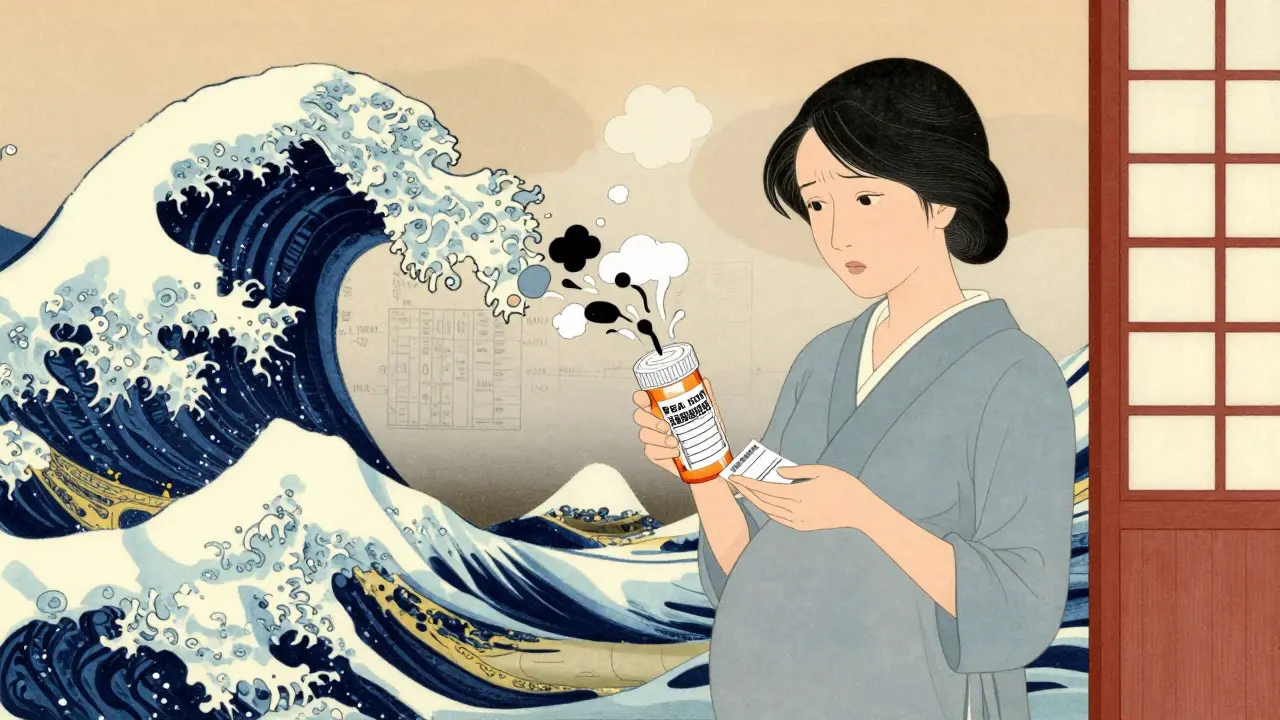
You pick up a prescription for your anxiety or your blood pressure. You’re expecting, or maybe you just started breastfeeding. Your eyes scan the paper insert looking for that familiar letter-A, B, C, D, or X. It’s not there anymore. Instead, you’re staring at pages of dense text titled Pregnancy and Lactation Labeling Rule (PLLR). It feels like decoding a foreign language.
If you’ve ever felt confused by modern drug labels while pregnant or nursing, you aren’t alone. The U.S. Food and Drug Administration (FDA) completely overhauled how medications are labeled for women in 2015. They ditched the simple letter grades because they were misleading. Now, the goal is clarity, but it requires a bit more effort to understand. This guide will walk you through exactly what to look for, how to interpret the risks, and where to find the answers when the label doesn't seem clear enough.
Why the Old Letter Categories Disappeared
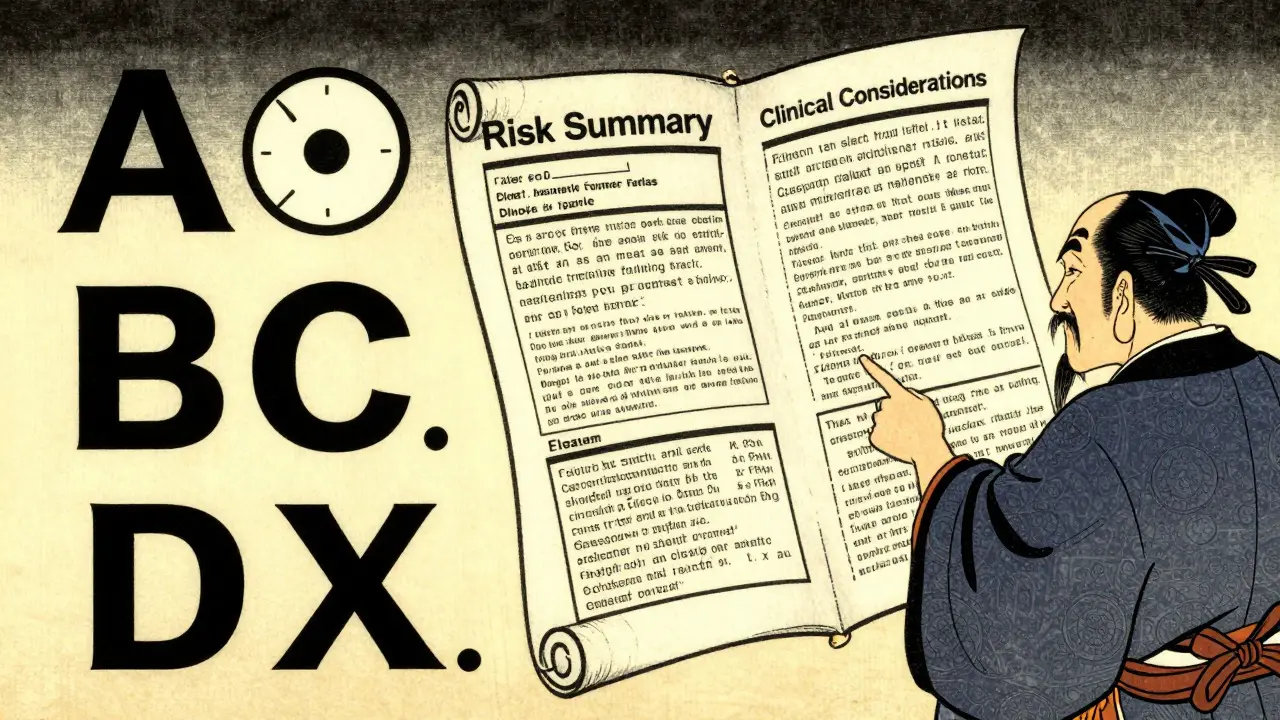
To understand the new system, you have to look at why the old one failed. For decades, from 1979 until 2015, drugs were assigned a single letter grade:
- Category A: Safe based on human studies (rare, less than 2% of drugs).
- Category B: No risk seen in animal studies (about 15%).
- Category C: Risk cannot be ruled out (the vast majority, around 70%).
- Category D: Positive evidence of human risk (about 10%).
- Category X: Contraindicated; risks outweigh benefits (less than 1%).
The problem? People treated these letters like school grades. If a drug was a "C," many doctors and patients assumed it was "bad" or "dangerous." In reality, a Category C often just meant "we don't have enough data yet," not that the drug causes harm. Conversely, a Category B might sound safe, but it could still carry significant unknown risks.
Sandra Kweder, M.D., Deputy Director of the Office of New Drugs at the FDA, noted that the old system gave an "over-simplified view of the product risk." So, on June 30, 2015, the FDA implemented the Pregnancy and Lactation Labeling Rule (PLLR), replacing those letters with detailed narrative sections designed to provide context rather than judgment.
Navigating Section 8: The Three Key Subsections
Under the PLLR, all prescription drug labels must include a specific section called Section 8: Use in Specific Populations. This is where you’ll find everything you need to know. It is divided into three mandatory subsections. Here is how to read each one.
8.1 Pregnancy
This subsection replaces the old pregnancy category. It contains three required headings: Risk Summary, Clinical Considerations, and Data.
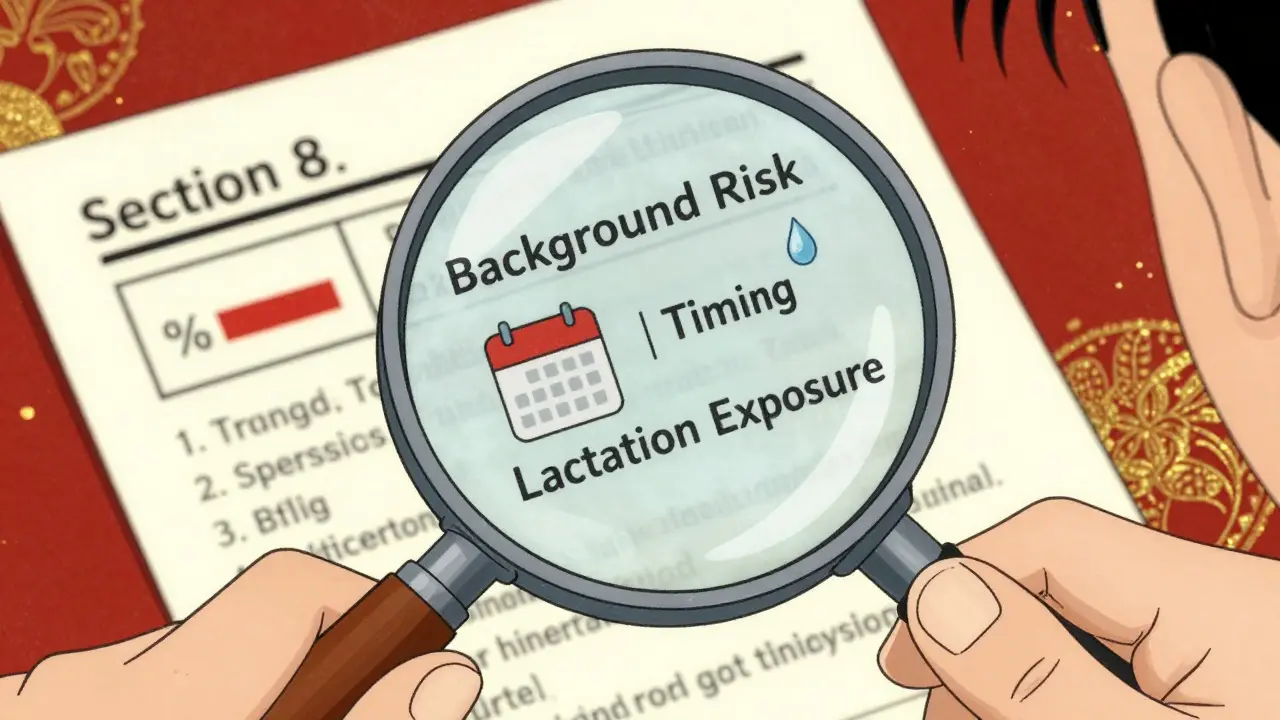
Risk Summary: This is the headline. It tells you if there is a known risk of birth defects or miscarriage. Crucially, it also provides context. You will often see statements about "background risk." For example, it might say, "The background risk of major birth defects in the U.S. general population is 2-4%." This helps you understand that some risk exists in every pregnancy, regardless of medication. If the drug increases this risk, it will state the magnitude clearly, such as "a 1.5-fold increased risk of neural tube defects."
Clinical Considerations: This part offers actionable advice. It might tell you to monitor fetal growth every four weeks or avoid use during the first trimester. Look for timing specifics here, as exposure during different stages of pregnancy can have vastly different outcomes.
Data: This section details the studies behind the summary. It explains whether the data comes from human trials, animal studies, or observational registries. If human data is limited, this section will explicitly state that limitation.
8.2 Lactation
Breastfeeding labeling used to be vague, often just saying "use caution." The PLLR changed this significantly. The Lactation subsection now requires specific data on how much drug passes into breast milk.
Look for the phrase "Infant Exposure as a Percentage of Maternal Dose." For instance, a label might state, "Infant exposure is less than 10% of the maternal weight-adjusted dose." This quantifiable metric allows you and your doctor to weigh the benefit of breastfeeding against the potential exposure. The section also outlines potential adverse reactions in the breastfed infant, such as drowsiness or decreased weight gain, so you know exactly what symptoms to watch for.
8.3 Females and Males of Reproductive Potential
This subsection addresses fertility and contraception. It includes evidence-based recommendations for pregnancy testing before starting treatment and specifies contraception requirements. If a drug can cause infertility, this section will detail the likelihood and reversibility. It also lists the failure rates of different contraceptive methods, helping you choose the most effective protection if you need to avoid pregnancy while taking the medication.
Understanding Risk: Relative vs. Absolute
One of the biggest challenges with the new narrative labels is interpreting statistical risk. Numbers can be scary if you don't know how to read them. Here is a quick cheat sheet:
| Term | What It Means | Example Scenario |
|---|---|---|
| Background Risk | The baseline chance of a defect without any drug exposure. | 2-4% of all pregnancies result in major birth defects naturally. |
| Relative Risk | How much more likely an event is compared to the baseline. | A "2-fold increase" sounds huge, but if the baseline is 1%, the new risk is only 2%. |
| Absolute Risk | The actual probability of the event happening. | An absolute risk increase of 1% means 1 extra case per 100 pregnancies. |
| Confidence Interval | The range within which the true value likely falls. | A 95% confidence interval of 1.2-1.9 suggests the estimate is precise. |
When you see a label mention a "significant association," ask yourself: Is this a small increase in a rare event, or a large increase in a common one? The Data section usually provides the numbers needed to make this calculation. If the label cites a "prospective cohort study of 1,200 pregnancies," you know the data is robust. If it relies on "case reports," the evidence is weaker.
Practical Tips for Patients and Providers
Reading these labels takes time. A 2018 study found that 62% of obstetricians initially struggled with the new format. You are not expected to be an expert statistician. Here is how to navigate the process effectively:
- Don't Panic at "Risk Cannot Be Ruled Out": This phrase is common. It often means data is scarce, not that the drug is toxic. Context matters.
- Check for Registries: Many labels now list active Pregnancy Exposure Registries. As of 2023, there are 47 such registries tracking outcomes for drugs like antiepileptics and antidepressants. Participating in a registry can provide peace of mind and contribute to better science.
- Use Trusted Resources: If the label is confusing, consult specialized databases. MotherToBaby and TERIS (Teratology Information Service) offer plain-language summaries of drug risks during pregnancy and breastfeeding. These services are staffed by experts who can interpret the PLLR data for you.
- Ask About Timing: Risks vary by trimester. First-trimester exposure affects organ formation, while third-trimester exposure might affect newborn behavior. Ask your provider specifically about the timing of your current pregnancy stage.
Pharmacists are also a vital resource. A 2021 survey showed that pharmacists spend an additional 5-7 minutes counseling patients on pregnancy risks under the new rules. Don't hesitate to ask them to explain the Clinical Considerations section in plain English.
Current Challenges and Future Updates
While the PLLR is a massive improvement, it isn't perfect. Some critics argue that the labels are too long, averaging 300-500 additional words per drug, which can lead to information overload. Additionally, there are gaps in the data. A 2023 Government Accountability Office report found that 63% of psychiatric medication labels lacked specific gestational timing information, even though critical windows of exposure exist.
Diversity is another issue. Current pregnancy registries underrepresent racial minorities, with only 15% of participants identifying as Black or Hispanic, despite these groups representing 30% of U.S. pregnancies. This means the data may not fully reflect risks for all populations.
The FDA is aware of these issues. Their 2021-2025 Strategic Plan for Maternal Health aims to update 100% of pregnancy-related labeling by 2025. Recent initiatives include proposals for visual risk icons to complement the text, making the information easier to digest quickly. For now, however, the narrative text remains the gold standard for accurate, nuanced risk communication.
Summary Checklist for Reading Drug Labels
- Locate Section 8: Find "Use in Specific Populations" in the package insert.
- Read 8.1 Pregnancy: Check the Risk Summary for background risk comparisons and specific defect risks.
- Review 8.2 Lactation: Look for the percentage of maternal dose transferred to breast milk.
- Consult 8.3 Reproductive Potential: Note contraception requirements and fertility impacts.
- Verify Data Sources: Check if data comes from human studies or animal models.
- Seek Expert Interpretation: Use MotherToBaby or talk to a pharmacist if the statistics are unclear.
Where can I find the pregnancy and lactation labeling for my medication?
You can find this information in the package insert included with your prescription, or online via the FDA's DailyMed website or the manufacturer's official site. Look specifically for "Section 8: Use in Specific Populations." Electronic health records (EHRs) in many clinics also display this information, though integration varies.
Are over-the-counter (OTC) drugs subject to the same PLLR rules?
No. The Pregnancy and Lactation Labeling Rule (PLLR) applies primarily to prescription drugs. Over-the-counter medications follow different labeling guidelines, often using simpler warnings like "Ask a doctor before use if you are pregnant." However, the principles of checking for specific risks remain the same.
What does "Background Risk" mean in a drug label?
Background risk refers to the natural probability of a birth defect or miscarriage occurring in any pregnancy, regardless of medication use. For example, the background risk of major birth defects is approximately 2-4%. Labels include this to help you contextualize whether a drug significantly increases that baseline risk.
How do I know if a drug is safe for breastfeeding?
Check Section 8.2 Lactation in the drug label. Look for the "Infant Exposure" percentage. Generally, lower percentages indicate less drug transfer. Also review the "Adverse Reactions" subsection for reported effects on breastfed infants. If the label is unclear, consult resources like MotherToBaby or your pharmacist for a risk-benefit analysis.
Why did the FDA remove the A, B, C, D, X categories?
The old letter categories were often misinterpreted as a grading system (like school grades), leading to oversimplified decisions. Category C, for instance, was frequently viewed as "dangerous" when it often just meant "data is limited." The new narrative format provides more nuanced, clinically relevant information to support better decision-making.