

When you’re making a generic product-whether it’s a pill, a medical device, or a health supplement-the place where it’s made matters more than most people realize. It’s not just about price. It’s about timing, control, risk, and even your customers’ trust. For years, companies chased the lowest cost by sending production overseas. But after supply chain meltdowns during the pandemic, rising tariffs, and growing consumer demand for transparency, many are asking: Is domestic manufacturing the smarter choice now?
Cost Isn’t What It Used to Be
The old story was simple: make it in China or Vietnam, save 50%. That’s still true on paper. A unit made in Mexico might cost $2.10, while the same thing made in Ohio runs $8.75. But that’s only the sticker price. When you add in shipping delays, inspection fees, customs paperwork, and the cost of fixing defective batches, the gap shrinks. According to Trison Wells (2025), the real cost advantage for overseas production has dropped from 30% to just 12-15% for many products once hidden expenses are counted.Take quality control. Overseas manufacturers often rely on third-party inspectors. Each inspection costs $300-$500. And if something goes wrong? You’re waiting weeks for photos, samples, and corrections. One Reddit user lost $48,000 on a batch with a 37% defect rate-even after paying for inspection. Meanwhile, domestic factories let you walk onto the floor, check the machines, and fix a problem in hours, not days.
Time Is Money-And It’s Running Out
If you need 500 units in 30 days, overseas manufacturing won’t work. The average lead time for overseas production is 90 days: 45-60 days to make it, then another 30-45 days to ship and clear customs. Domestic production? 45-60 days total, and often faster if you’re working with a local partner who’s used to small runs.That matters for seasonal products, promotional items, or emergency restocks. A fashion startup in 2023 saved 52% by making their line in Vietnam-but missed the entire Q4 holiday rush because their shipment got stuck in port. They lost $187,000 in sales. Meanwhile, companies that make promotional health products like branded water bottles or first-aid kits rely on domestic production because they need to respond fast to events, campaigns, or outbreaks.
Quality Control: Hands-On vs. Hand-Off
You can’t inspect quality from 8,000 miles away. Domestic manufacturers let you see the raw materials, watch the assembly line, and test samples before shipping. Overseas, you get photos, reports, and hope. Trustpilot data from 2024 shows domestic manufacturers average 4.3/5 stars, with customers praising responsiveness and quality. Overseas manufacturers average 3.8/5, with 68% of complaints about communication delays.Some argue that overseas factories have better quality on high-tech items. But that’s usually because they’re making millions of the same unit for big brands like Apple or Samsung. For small-batch generic products? The consistency drops. One manufacturer told us they saw 40% more variation in tablet weight and coating thickness from their Chinese supplier than from their Ohio partner-even with the same formula.
Intellectual Property and Risk
If your product has a unique shape, formula, or packaging, you’re risking theft. In 2023, Ouui Love’s industry analysis found that product replication risks are 37% higher in major Asian manufacturing hubs compared to the U.S. That’s not speculation-it’s documented. There are cases where generic drug manufacturers in India or China reverse-engineered a U.S. product and started selling it under a different name before the original even launched.Domestic production gives you legal recourse. If someone copies your design, you can sue in U.S. courts. Overseas? You’re dealing with different laws, language barriers, and sometimes, local protectionism. One company lost $200,000 after their custom pill mold was copied and sold by a factory that refused to return the tooling.
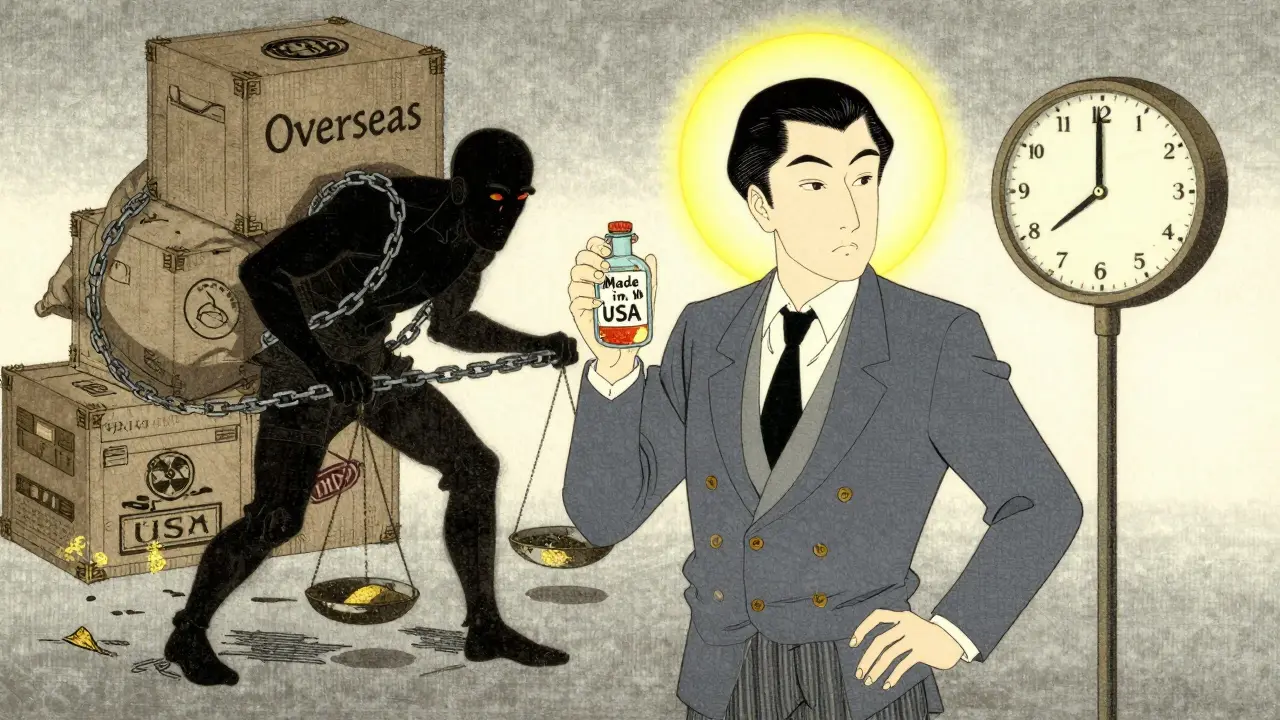
Hidden Costs You Can’t Ignore
The $2.10 unit price? It doesn’t include:- Shipping insurance for ocean freight
- Customs brokerage fees ($150-$300 per shipment)
- Harmonized System (HS) code errors that trigger inspections
- Incoterms confusion that leaves you paying for delivery you didn’t agree to
- Inventory carrying costs from holding 5,000 units because your MOQ is too high
Domestic manufacturers often accept orders as small as 100-500 units. Overseas? Minimums are usually 1,000-5,000. That means you’re tying up cash for months before you even sell a single item. For startups or small health brands, that’s a dealbreaker.
Reshoring Is Real-And It’s Growing
Since 2010, over 356,000 manufacturing jobs have returned to the U.S. The pandemic exposed how dangerous it is to rely on one country. The U.S. added 544,000 manufacturing jobs between 2021 and 2024. The Inflation Reduction Act and CHIPS Act are pouring billions into domestic production. Companies aren’t just reacting-they’re planning for the long term.And consumers notice. NielsenIQ found in early 2024 that 68% of shoppers are willing to pay 5-12% more for products made in the U.S. That’s not just patriotism-it’s trust. When you say “Made in USA” on a generic supplement or medical device, people believe you’re holding yourself to higher standards.
The Hybrid Model Is Winning
You don’t have to choose one or the other. The smartest companies are using a hybrid approach:- Make core components or high-risk items domestically
- Outsource bulk, low-risk, non-customizable parts overseas
That’s what 44% of mid-sized manufacturers are doing in 2024. For example, a company making a generic inhaler might produce the plastic casing and valve in Ohio (where quality and speed matter) but source the outer packaging from Vietnam (where printing and labeling are cheaper). This cuts costs without sacrificing control.

Where Should You Start?
Ask yourself these questions:- Do I need to respond quickly to market changes or emergencies?
- Is my product sensitive to timing (e.g., seasonal, promotional, or health-related)?
- Do I have proprietary design, formula, or packaging?
- Can I afford to wait 3 months for a shipment-or lose sales because I’m out of stock?
- Am I willing to pay extra for trust, transparency, and control?
If you answered yes to most of these, domestic manufacturing is likely your best bet. If you’re making a simple, high-volume item with no IP risk and long lead times are fine, overseas might still work.
What About Mexico?
Mexico is becoming the sweet spot for many U.S. companies. Labor costs are 12-15% of U.S. rates, but shipping takes only 7-10 days-not 45. That’s why companies like Ford, General Motors, and dozens of medical device makers are moving production to northern Mexico. It’s close, fast, and cheaper than the U.S.-without the long wait and communication headaches of Asia.Final Thought: It’s Not About Cost Anymore
The game has changed. It’s not “cheaper overseas” anymore. It’s “what’s worth the risk?” The companies winning today aren’t the ones paying the least-they’re the ones managing the most. They know that a 15% cost saving isn’t worth a 6-week delay, a 30% defect rate, or a lawsuit over stolen IP.Choose domestic if you value speed, control, and trust. Choose overseas if you’re making a commodity product in massive volumes and can afford the wait. But don’t assume one is better. Evaluate based on your product, your customers, and your risk tolerance. Because in manufacturing today, the best choice isn’t the cheapest-it’s the smartest.
Is overseas manufacturing always cheaper than domestic?
No. While labor costs overseas are lower, hidden expenses like shipping, customs, inspections, inventory holding, and quality control often erase the savings. For many products, the real cost difference is now only 12-15%, not the 30-60% it used to be.
How long does it take to get products from overseas vs. domestic?
Overseas manufacturing typically takes 90 days total: 45-60 days to produce, plus 30-45 days for shipping and customs. Domestic production averages 45-60 days total, and sometimes as little as 30 days for small batches.
What’s the minimum order quantity for domestic manufacturers?
Most domestic manufacturers accept orders as small as 100-500 units. Overseas factories usually require 1,000-5,000 units minimum, which ties up capital and increases inventory risk.
Can I trust quality from overseas manufacturers?
It’s possible, but risky. Third-party inspections add cost and don’t catch everything. Defect rates are higher overseas, and fixing issues takes weeks. Domestic production allows direct oversight, which leads to more consistent quality and faster corrections.
Is Mexico a good alternative to China for manufacturing?
Yes. Mexican manufacturing costs about 12-15% of U.S. rates but ships in 7-10 days. It’s becoming a top choice for U.S. companies that want lower costs without the long delays and communication issues of Asian suppliers.
What’s the biggest mistake companies make when choosing overseas manufacturing?
Assuming lower price equals better value. Many companies don’t account for delays, defective batches, IP theft, or administrative costs. The first overseas order often costs more in lost time and reputation than it saves in materials.
Should I make everything domestically if I care about sustainability?
Domestic production cuts shipping emissions by 62% compared to overseas. But some overseas facilities, especially in Vietnam, now meet ISO 14001 standards, reducing the gap to 28%. Still, for environmental impact, domestic is generally better-especially if you’re shipping small volumes.
Are tariffs still a big factor in choosing where to manufacture?
Yes. Section 301 tariffs on Chinese goods add 7.5-25% to the cost of many products. That’s wiped out the price advantage for items like electronics, medical devices, and certain plastics. Tariffs make domestic or nearshore options more competitive than ever.
8 Comments
Let me tell you something - I’ve been burned twice by overseas suppliers. First time I lost $42k on a batch of supplements with mold in the capsules. Second time? My custom pill mold got copied and sold as a ‘new brand’ on Amazon. Domestic? I walk in, shake hands, and know exactly what’s going on. No more guessing. No more ‘sorry, it’s a cultural difference’ excuses.
Look I get it cost is important but you gotta think about the whole picture like yeah maybe you save a dollar per unit overseas but then you got shipping delays customs fees inspections quality control nightmares inventory sitting in a warehouse for months tying up cash that could be used for marketing or R&D and then when something goes wrong you’re stuck waiting weeks for a photo of a defective batch while your customers are screaming for their product and your brand reputation is crumbling like a stale gummy bear
USA ONLY. If you’re making anything medical or health-related and you’re outsourcing overseas you’re literally betraying your own country and your own customers. This isn’t about money it’s about pride. If you’re not making it here you’re part of the problem. Buy American or get out.
They’re not telling you the whole truth. Did you know the FDA has inspectors in China? Yeah but they’re paid by the Chinese government. The ‘quality control’ is a joke. Every single ‘certified’ factory has a backroom where they dump the rejects. And the ‘inspections’? They’re scheduled. They know when to clean up. The real defect rates? 40-60%. They just don’t ship those batches. They repackage them as ‘export surplus’ and send them to Africa or South America. This whole ‘Made in USA’ thing? It’s the only way to avoid being poisoned.
Man I used to think cheap was king until I saw a friend’s startup go under because they outsourced their inhaler valves to Vietnam and got a batch with 30% leak rate. Took 11 weeks to fix. Lost their entire launch window. Now they make the core parts in Ohio and outsource the packaging to Mexico. Smart hybrid. It’s not about being pure it’s about being wise. You don’t have to choose black or white. You can have both. Just know your risks. And hey if you’re reading this and you’re a small biz owner - you got this 💪
Anyone who still thinks overseas is cheaper is either lying to themselves or getting kickbacks from a factory owner. I’ve seen the invoices. I’ve seen the emails. I’ve seen the lawsuits. You’re not saving money you’re buying a time bomb. And if you’re not making it in America you’re a traitor to public health. Period.
Stop overthinking. If you need it fast reliable and safe - make it here. If you’re making 100k units of a plain water bottle? Fine go overseas. But if your product touches someone’s body? Domestic. No debate. I’ve seen what happens when you cut corners. It’s not worth it. Get off the fence. Choose speed. Choose trust. Choose America.
Bro in India we make cheap generics for the world but we don’t lie about it. We say it’s made here. You say it’s made in USA. Both are honest. The real issue? You’re scared of competition. We don’t need your tariffs or your fear. We make good stuff. You make expensive stuff. Let the market decide. No drama. No nationalism. Just good product. And if you think your ‘domestic quality’ is perfect? You haven’t seen what happens when your own factory skips a QC step. We’ve all been there.