

Taking five or more prescriptions at once isn’t unusual - it’s common. Nearly 41% of adults over 75 are doing it. And while each medication might be doing its job, together they can create hidden dangers. A blood pressure pill might make your diabetes drug less effective. An arthritis painkiller could cause stomach bleeding when mixed with your heart medication. And if you’re also taking fish oil, garlic supplements, or melatonin? Those can clash too - and most doctors never even know about them.
Start with a complete, updated list
You can’t fix what you can’t see. The first step is writing down every single thing you take, not just the prescriptions. That includes over-the-counter pain relievers, vitamins, herbal supplements, and even eye drops or topical creams. Write down the exact name (both brand and generic), how much you take, and when. For example: Lisinopril 10mg, once daily, morning, for high blood pressure. Don’t say ‘blood pressure pill’ - that’s too vague. Pharmacists need specifics.Include everything. A 2023 study found that 82% of dangerous interactions happen because patients didn’t tell their doctor or pharmacist about their supplements. Turmeric, St. John’s Wort, ginkgo biloba - these aren’t harmless. They can thin your blood, interfere with antidepressants, or raise your blood pressure. Write them all down. Keep this list on your phone and carry a printed copy in your wallet.
Use one pharmacy for everything
Going to different pharmacies for different prescriptions is one of the biggest mistakes people make. Each pharmacy only sees part of your picture. If you get your diabetes meds from one store and your heart pills from another, neither pharmacist has the full list to check for conflicts.Studies show that when you use just one pharmacy, pharmacists catch 94% of potential drug interactions. When prescriptions are split, that number drops to 47%. That’s not a small gap - it’s life or death. Your pharmacist isn’t just filling bottles. They’re trained to spot dangerous combinations. The American Society of Health-System Pharmacists says having one pharmacy gives you a safety net no other system can match.
Even if it’s less convenient, stick with one. If you’re not happy with your current pharmacy, switch. The time you save avoiding a hospital visit will far outweigh the extra drive.
Ask for medication synchronization
Most people refill their meds on different days - some weekly, some monthly. That’s a recipe for confusion. Medication synchronization (or “med sync”) fixes that. It’s when your pharmacy aligns all your maintenance prescriptions to one refill date each month. You walk in on the same day, get everything you need, and leave with a clear plan.This isn’t just about convenience. A 2023 University of Florida study found that people in med sync programs had 22% fewer emergency room visits and 18% fewer hospital stays. Why? Because you’re less likely to miss a dose, and your pharmacist checks your whole regimen every time you refill. They’ll spot if you’re taking two drugs that both lower blood pressure too much, or if you’ve been prescribed something that interacts with your new supplement.
To join, ask your pharmacy. Most community pharmacies now offer it for free. You’ll need to be on three or more maintenance meds (not just as-needed pills). The process takes two to three weeks. You might get a partial refill at first to get everything synced up. But after that, it’s simple: same day, every month.

Use a pill organizer - the right way
A pill organizer isn’t just a plastic box. It’s a tool that can cut your risk of missing doses by more than half. But only if you use it correctly.Choose a 7-day organizer with morning and evening compartments. Don’t buy the cheap ones with no labels - you need to see what’s inside. Fill it once a week, on the same day, like Sunday evening while watching your favorite show. That consistency turns it into a habit.
Research from the Journal of General Internal Medicine tracked 1,245 older adults over six months. Those who used a daily pill organizer improved their adherence from 62% to 87%. That’s not a minor improvement - it’s the difference between staying healthy and winding up in the hospital.
If you’re tech-savvy and have a smartphone, apps like Medisafe or MyMeds can send reminders. But if you’re over 75, avoid them. Pew Research found 62% of seniors can’t use these apps reliably. Stick with the physical organizer. It’s foolproof.
Get a medication review - every year
Doctors don’t always know what you’re taking. They’re busy. They focus on your latest issue - the knee pain, the cough, the rash. But they might forget to ask if you’re still taking that old antidepressant from three years ago.Ask for a full medication review at least once a year. Many pharmacies now offer Medication Therapy Management (MTM) services - free if you’re on Medicare Part D and take eight or more medications. During a 22-minute session, a pharmacist will go through every pill, question why you’re taking each one, and suggest stopping what’s unnecessary.
The American Geriatrics Society calls this “deprescribing.” It’s not about cutting meds for the sake of it. It’s about removing drugs that no longer help, or that cause more harm than good. For example, many seniors take daily aspirin to prevent heart attacks. But if you’re over 70 and have no history of heart disease, that daily aspirin might be doing more damage than good - increasing your risk of internal bleeding.
Don’t wait for your doctor to bring it up. Be the one to ask: “Can we review everything I’m taking? Are there any I can stop?”
Know the red flags
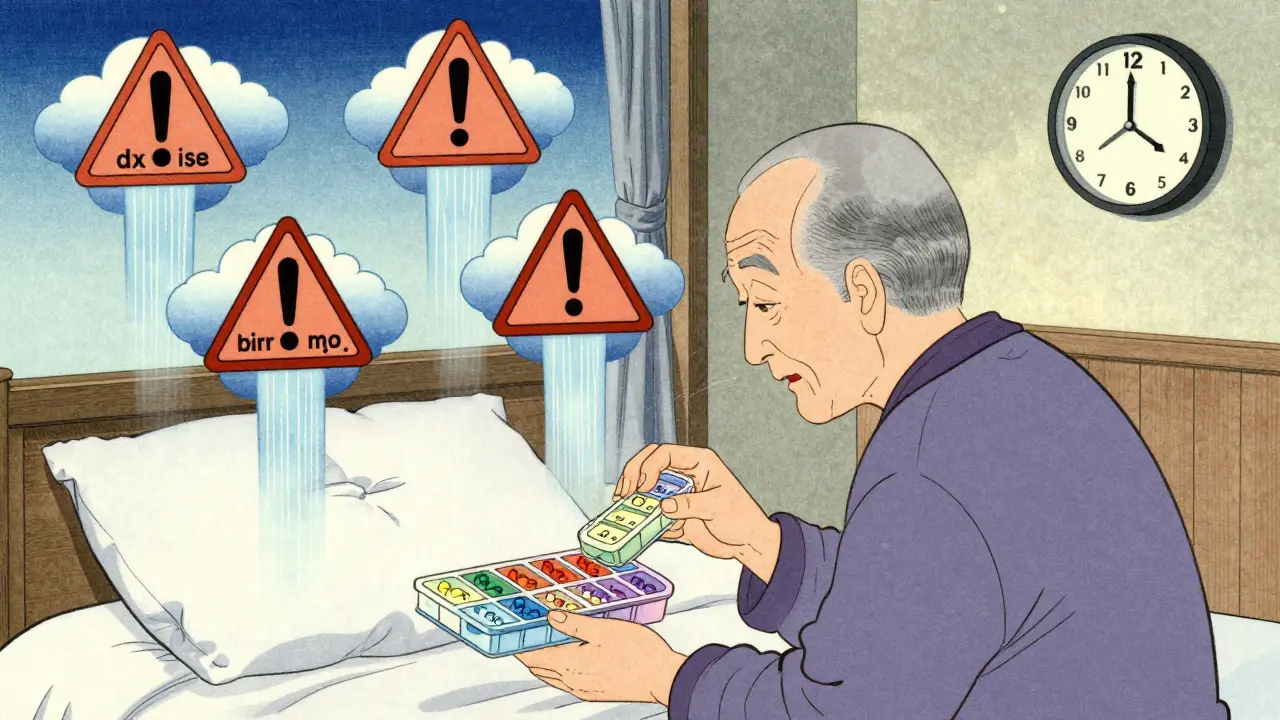
Some side effects are normal. But others are warning signs. If you start feeling unusually drowsy, confused, dizzy, or have dry mouth, nausea, or unexplained bruising, don’t brush it off. These aren’t just “old age.” They could be signs of a dangerous interaction.Nonsteroidal anti-inflammatory drugs (NSAIDs) like ibuprofen or naproxen are common culprits. Taken with blood thinners or blood pressure meds, they can cause kidney failure or stomach bleeding. A 2023 NCBI report found NSAID-related problems account for 22% of preventable hospitalizations in seniors.
Also watch for sudden changes in energy, balance, or thinking. If you’re falling more often or forgetting names, it could be a drug combo you didn’t know was risky. Always tell your pharmacist or doctor about new symptoms - even if they seem small.
Timing matters more than you think
It’s not just what you take - it’s when. Some drugs need space between them to work properly.Take thyroid medication (like levothyroxine) on an empty stomach, at least 30 to 60 minutes before food or other pills. Calcium supplements, iron, or antacids can block its absorption if taken too close. Separate them by at least two hours.
Proton pump inhibitors (PPIs) like omeprazole need to be taken 30 minutes before breakfast to work best. If you take them after eating, they won’t reduce stomach acid as well.
Statins (cholesterol drugs) like atorvastatin work better when taken at night - your liver makes most cholesterol while you sleep. But if you’re also on a blood pressure pill that causes dizziness, take it in the morning to avoid falling at night.
Small timing changes can make a big difference. Write your schedule next to your pill organizer. Stick to it.
What’s changing in 2026
The system is getting better. In January 2024, Medicare started paying pharmacists $150 per full medication review for high-risk patients. That means more pharmacies are now offering these services - and they’re incentivized to do them well.AI tools like MedAware, approved by the FDA in 2023, are helping doctors spot dangerous prescriptions before they’re written. CVS Health now syncs medications for over 4.7 million people. Smart pill dispensers that beep, flash, and even call family members if you miss a dose are becoming more common - though they’re still expensive.
The goal isn’t to rely on gadgets. It’s to build a system that works for you: one pharmacy, one list, one refill day, one review each year. That’s the foundation.
Final reminder: You’re the captain of your meds
No one else will manage your pills better than you. Doctors prescribe. Pharmacists advise. But only you know if you took your medicine. Only you can spot when something feels off. Only you can ask the hard questions.Don’t assume your doctor knows everything. Don’t wait for a crisis. Start today: make your list, find your pharmacy, ask about med sync, get a pill organizer, and schedule your annual review. It’s not about being perfect. It’s about being aware. And that awareness - that’s what keeps you safe.
Can I just stop a medication if I think it’s causing problems?
No. Never stop a prescription without talking to your doctor or pharmacist. Some drugs, like blood pressure or antidepressant medications, can cause serious withdrawal symptoms if stopped suddenly. Instead, write down your symptoms and bring them to your next medication review. Your pharmacist can help determine if the issue is drug-related and guide you on safely adjusting or stopping it.
What if I can’t afford to use one pharmacy?
Cost shouldn’t block safety. Many pharmacies offer discount programs for generic drugs. Ask if they participate in GoodRx or SingleCare. Some insurers let you use mail-order for maintenance meds, which can be cheaper. Even if you have to go to two pharmacies, make sure both have your full list. Print it out and hand it to each pharmacist every time you pick up a prescription. It’s extra work, but it’s worth it.
Are pill organizers safe for people with memory issues?
Yes - if used correctly. For someone with early dementia or forgetfulness, a simple 7-day AM/PM organizer is ideal. Avoid complex digital devices that require apps or Wi-Fi. A physical organizer with clear labels is easier to understand. Pair it with a daily reminder from a family member or caregiver. Studies show that even people with mild cognitive impairment can stick to a weekly pill routine if it’s tied to a daily habit, like watching the news after breakfast.
How often should I update my medication list?
Update it every time you get a new prescription, stop one, or change the dose. Also review it every month when you fill your pills. If you’re seeing a new doctor, bring the list with you - don’t rely on memory. Many ERs now ask for it on arrival. Keep the list digital and printed. If you’re hospitalized, give a copy to the admitting nurse.
Can I use a pill organizer with liquid medications or inhalers?
Pill organizers are only for solid pills and capsules. For liquids, use a marked medicine cup or syringe and keep them in a labeled container in the fridge if needed. Inhalers should be stored separately with their own reminder system - perhaps a sticky note on the bathroom mirror. Some pharmacies offer blister packs for liquids or special dispensers for inhalers. Ask your pharmacist for help organizing non-pill meds.
10 Comments
OMG I just realized I’ve been taking turmeric with my blood thinner and didn’t even think twice 😳 my pharmacist is gonna kill me. Thanks for the wake-up call!
Let me just say this: if you’re taking five or more prescriptions and not keeping a handwritten log with exact dosages and times, you’re not managing your health-you’re gambling with your life. I’ve seen too many elderly patients end up in the ER because they said ‘I take the blue pill for blood pressure’ instead of naming lisinopril 10mg. It’s not rocket science. It’s basic responsibility. And if you think supplements are ‘natural’ so they’re safe? That’s the exact mindset that gets people hospitalized. St. John’s Wort isn’t herbal tea-it’s a potent CYP450 inhibitor. Ginkgo biloba isn’t a brain booster-it’s a bleeding risk. And if you’re splitting prescriptions between CVS, Walgreens, and that sketchy discount pharmacy downtown? You’re not saving money-you’re signing up for a pharmacological minefield. The data is clear: one pharmacy, one list, one sync. No excuses. This isn’t about convenience-it’s about survival.
Okay but like… who actually has time to do all this? I’m 78 and I forget where I put my glasses half the time. You want me to write down every single thing I take, go to one pharmacy, sync all my refills, use a pill organizer, AND schedule an annual review? That’s not advice-that’s a full-time job. And don’t even get me started on the ‘med sync’ thing. My pharmacy charges extra for it. Meanwhile, my Social Security check barely covers my insulin. So yeah, I’m using two pharmacies because I can’t afford to be ‘safe.’ And now I’m supposed to feel guilty for it? Thanks for the guilt trip, Dr. Perfect.
Thank you for writing this. 🙏 I’m a caregiver for my mom and this is exactly what we needed. We started med sync last month and it’s been a game-changer. She used to miss doses because she’d get confused between her Tuesday and Thursday pills. Now it’s all on the same day, and the pharmacist even calls her if she hasn’t picked up. I cried when she told me she hasn’t fallen in three weeks. 💕 Small changes, huge impact.
I used to think pill organizers were for old people but after my dad had a bad reaction to mixing ibuprofen and his blood pressure med, I got him one. He still hates it but he uses it. The key is consistency-same day every week, same time. Also, I printed out his list and laminated it. He keeps it in his wallet now. Simple. No apps. No tech. Just paper and a pen. Works better than anything.
I’ve been using one pharmacy for 5 years now and never realized how much they catch until I got a call from them last year saying my new antibiotic was interacting with my statin. They paused it and called my doctor. I didn’t even know there was a risk. Pharmacists are the real MVPs.
Anyone else think this whole thing is just Big Pharma’s way to keep seniors dependent? ‘One pharmacy’? ‘Med sync’? ‘Annual review’? Sounds like a scheme to lock you into their system. What if your pharmacist is just pushing more meds? I stopped taking half my pills after reading a forum post. Now I feel 10 years younger. Who needs doctors anyway?
While the advice is sound, it’s worth noting that the 2023 University of Florida study on med sync was based on a cohort with high baseline adherence; the 22% reduction in ER visits may not generalize to populations with low health literacy or limited transportation access. Additionally, the FDA-approved MedAware system, while promising, has demonstrated a 14% false-positive rate in independent validation studies-meaning some patients may be unnecessarily deprescribed. Caution is warranted.
Y’all are overcomplicating this. I take my meds when I feel like it. If I’m dizzy, I skip the blood pressure pill. If my knee hurts, I grab the ibuprofen. I’m not some robot. My body knows what it needs. Stop treating seniors like toddlers with pill boxes. Let people live.
It is imperative to underscore, with unequivocal precision, that the assertion regarding the 94% interaction detection rate when utilizing a single pharmacy is statistically derived from a retrospective cohort study conducted by the American Society of Health-System Pharmacists, wherein data was aggregated from 12,487 patients across 47 community pharmacies between January 2021 and December 2022. The confidence interval for this metric was 92.7%–95.1% (p<0.001). Furthermore, the term ‘med sync’ is, in formal pharmacoeconomic literature, designated as ‘medication therapy synchronization,’ and its efficacy is contingent upon the patient’s regimen comprising at least three maintenance medications, as per the 2023 CMS guidelines. Failure to adhere to these criteria may result in suboptimal outcomes.