

Ever wonder why you can swap a brand-name medication for a generic one and feel exactly the same effect? It isn't luck. Before a generic drug hits the pharmacy shelf, it must pass a rigorous test called a bioequivalence study is a systematic investigation designed to prove that a generic drug delivers the same amount of active ingredient into the bloodstream at the same rate as the original brand-name version. If the generic doesn't mirror the brand-name's performance, it doesn't get approved. This process ensures that your cheaper alternative is just as safe and effective as the expensive one.
The Ground Rules: What Is Bioequivalence?
To understand the process, we first need to look at the goals. Regulatory bodies like the FDA in the US and the EMA in Europe don't require generic makers to repeat massive clinical trials on thousands of people. Instead, they use a shortcut called the Abbreviated New Drug Application (ANDA) pathway. The goal here is to show that the generic is "therapeutically equivalent."
In plain English, this means the drug needs to hit the blood at the right speed and stay there long enough to work. If the brand-name drug reaches its peak concentration in two hours, the generic should do the same. If it's too fast, it could be toxic; too slow, and it won't treat the condition. This is why these studies focus on pharmacokinetics-how the body handles the drug.
Phase 1: Designing the Study and Picking the Batch
You can't just grab any pill off the shelf. The process starts with selecting the Reference Listed Drug (RLD), which is the original brand-name product. Researchers typically use a single batch of this drug to keep the baseline steady. On the flip side, the test product (the generic) must be made at a commercial scale-usually at least 1/10th of a full production run-to ensure the study reflects what patients will actually take.
Most studies use a "two-period, two-sequence crossover design." Here is how that works: a group of healthy volunteers (usually 24 to 32 people) is split into two groups. Group A takes the brand-name drug first, then the generic. Group B takes the generic first, then the brand-name. This crossover removes individual biological quirks-like how one person might naturally metabolize drugs faster than another-because each person acts as their own control.
| Design Type | Who it's for | Key Characteristic | Regulatory Preference |
|---|---|---|---|
| Crossover | Most systemic drugs | Subjects take both test and reference | Gold Standard |
| Parallel | Drugs with very long half-lives (>2 weeks) | Two separate groups of subjects | Secondary |
| Replicate | Highly variable drugs | Multiple doses of the same product | Used for high variability |
Phase 2: The Dosing and The "Washout"
Once the volunteers are in, the dosing begins. But there's a catch: you can't give a person the second drug immediately after the first. If you did, the first drug would still be in their system, ruining the data. This is where the Washout Period comes in. Researchers wait for at least five elimination half-lives-the time it takes for the drug concentration to drop to almost zero-before starting the next phase.
Missing the mark here is a common and expensive mistake. Some labs have lost hundreds of thousands of dollars because they underestimated a drug's half-life, forcing them to restart the entire study. It's a high-stakes game of timing.

Phase 3: Sampling and Bioanalysis
After the dose, the clock starts. Nurses draw blood at specific intervals to map out the drug's journey. They don't just take one or two samples; they need a full curve. This usually involves at least seven time points, including the pre-dose baseline, the peak concentration point, and several points as the drug leaves the system.
These samples are then sent to a lab for analysis, typically using LC-MS/MS (Liquid Chromatography-Tandem Mass Spectrometry). This technology is incredibly sensitive and can detect tiny amounts of the drug in the plasma. To be valid, the method must be precise within ±15%-meaning there's very little room for error.
Phase 4: Measuring the Magic Numbers (Cmax and AUC)
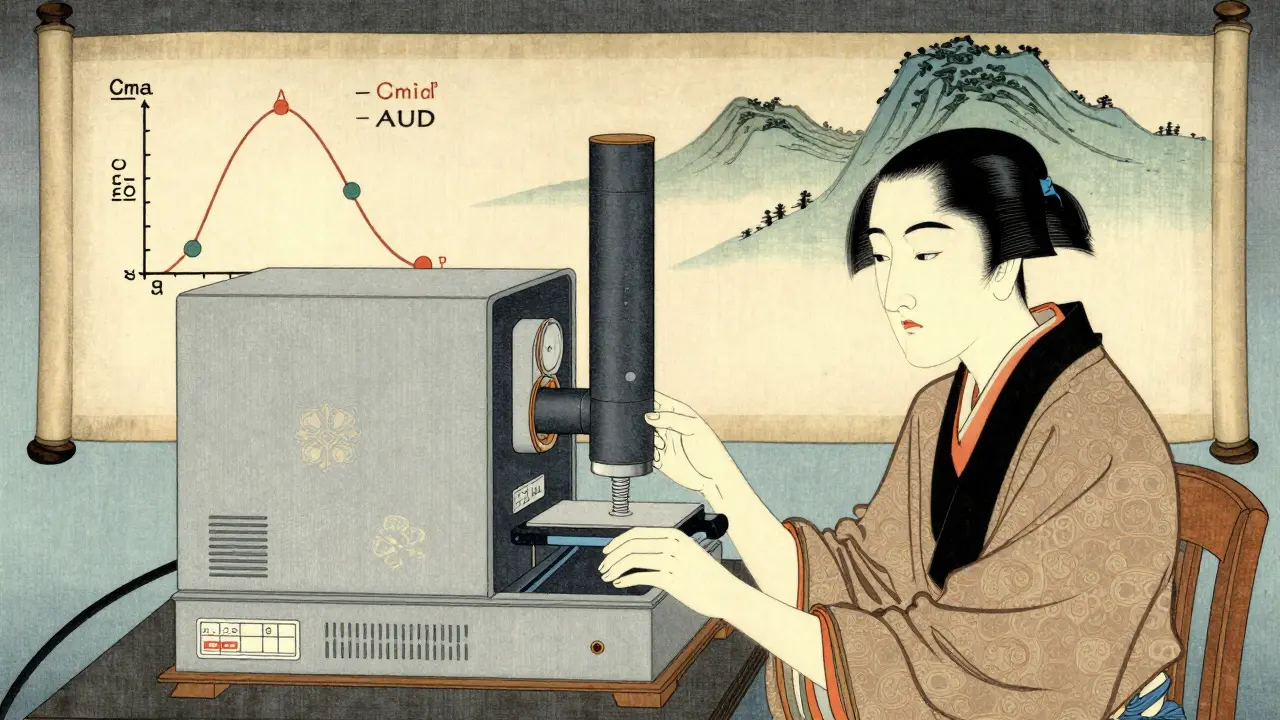
The lab results are plotted on a graph, and researchers look for two primary Pharmacokinetic Parameters:
- Cmax: The maximum concentration of the drug in the blood. This tells us about the speed of absorption and the potential for side effects.
- AUC (Area Under the Curve): This represents the total exposure of the body to the drug over time. Essentially, it's the total amount of medicine that actually reached the bloodstream.
If the Cmax and AUC of the generic are nearly identical to the brand-name, the drug is likely bioequivalent. But "nearly identical" has a very specific mathematical definition.
Phase 5: Statistical Validation and Approval
This is where the biostatisticians take over. They don't just compare averages; they use a "90% Confidence Interval" (CI). For a drug to be approved, the ratio of the generic's average to the brand-name's average must fall between 80.00% and 125.00%.
Why this range? It's a scientifically agreed-upon window that ensures the difference is clinically insignificant. If the drug is a "Narrow Therapeutic Index" drug-where a tiny change in dose can be dangerous-the window is even tighter (usually 90% to 111.11%). If the numbers fall outside this range, the study fails, and the company must either reformulate the drug or try a different study design.
Common Pitfalls and Success Secrets
Not every study is a success. In fact, many fail due to simple operational errors. About 45% of deficient studies fail because of inadequate washout periods, and 30% struggle with poor sampling schedules. It's not always the chemistry that's the problem; often, it's the logistics.
The most successful companies use "pilot studies." These are small-scale runs that help researchers understand how much the drug varies from person to person. By doing this, they can pick the right number of volunteers for the final study, reducing the risk of failure from 35% down to less than 10%.
Do healthy volunteers always take part in these studies?
In most cases, yes. Healthy volunteers are used because they don't have other medications or diseases that could interfere with the drug's absorption. However, for some drugs-like those that only work in the presence of a specific disease-patients may be required.
What happens if a drug is "highly variable"?
If a drug's concentration varies wildly between different people, a standard crossover study might not be enough. Regulators may require a "replicate design," where subjects receive the same drug multiple times to better understand the internal variability before comparing it to the reference drug.
Is it possible to get a bioequivalence waiver?
Yes. For certain drugs (often BCS Class I), if the manufacturer can prove through "in vitro dissolution testing" (testing how the pill dissolves in a lab beaker) that the drug dissolves quickly and is highly absorbable, the FDA or EMA may grant a biowaiver, skipping the human study entirely.
How long does it take for the FDA to review these studies?
The median review time for first-cycle approvals is roughly 10.2 months, though this can vary based on the complexity of the drug and the quality of the data submitted.
What is the difference between bioequivalence and therapeutic equivalence?
Bioequivalence is the measurement of the drug's movement into the blood (PK). Therapeutic equivalence is the broader conclusion that the generic drug will produce the same clinical effect and safety profile as the brand-name drug, based on that bioequivalence data.
Next Steps for Drug Developers
If you're moving toward a submission, the path forward depends on your drug's profile. For standard systemic drugs, prioritize a well-powered crossover study with a conservative washout period. For complex generics-like inhalers or topical creams-you'll need to look beyond blood levels and explore pharmacodynamic studies or clinical endpoints, as blood concentrations don't always tell the whole story for locally acting drugs.