

When a child eats a peanut butter sandwich and breaks out in hives within minutes, or an adult develops swelling in their throat after eating shrimp, something in their immune system has gone terribly wrong. This isn’t just a bad reaction - it’s an IgE-mediated food allergy, a rapid and potentially deadly response triggered by the body’s own antibodies. Unlike digestive upset or food intolerance, these reactions are immune-driven, predictable, and can escalate to anaphylaxis - a full-body crisis that demands immediate action.
How IgE Reactions Work: The Body’s Mistaken Alarm System
Your immune system is designed to fight off viruses and bacteria. But in food allergies, it misreads harmless food proteins - like those in peanuts, milk, or eggs - as invaders. The first time you’re exposed to one of these proteins, your body doesn’t react much. Instead, it makes a decision: this is dangerous. Special immune cells called dendritic cells present the food protein to T cells, which then signal B cells to produce IgE antibodies specific to that allergen.
These IgE antibodies don’t float around freely. They attach themselves to mast cells and basophils, kind of like arming landmines. The next time you eat that food, the protein binds to the IgE on these cells, triggering them to explode with histamine, leukotrienes, and other inflammatory chemicals. Within minutes, you might get:
- Hives or swelling (skin)
- Wheezing or trouble breathing (lungs)
- Nausea, vomiting, or diarrhea (gut)
- Dizziness, rapid pulse, or low blood pressure (heart and circulation)
This is anaphylaxis - and it can kill in under an hour if untreated. The scary part? You don’t need to eat much. Some people react to less than 1 milligram of peanut protein - the amount that might cling to a spoon or a shared surface. That’s why cross-contamination is just as dangerous as the food itself.
The Rise of Food Allergies: Why Now?
Food allergies weren’t always this common. In the 1990s, about 3% of U.S. children had them. Today, it’s nearly 8%. The same trend is seen across Europe, Canada, and Australia. Why? Scientists don’t have one single answer, but several factors are clear.
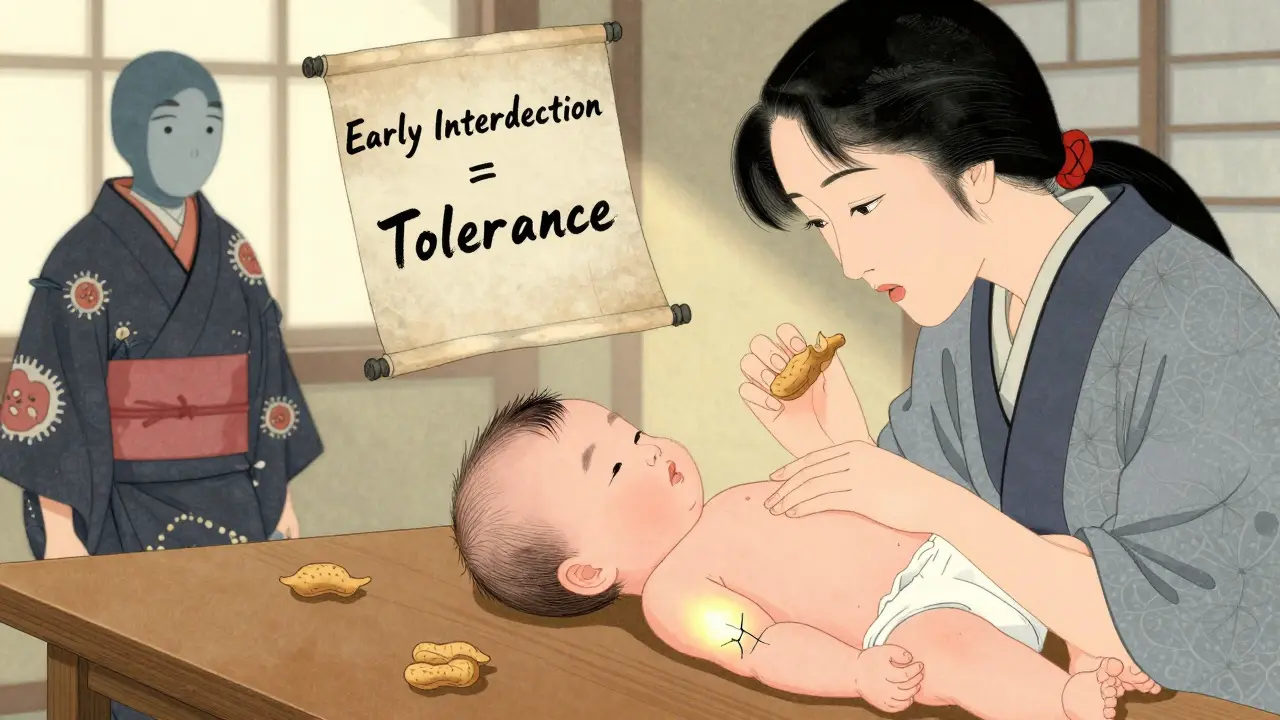
One major theory is the dual-allergen-exposure hypothesis. If a baby with eczema has a broken skin barrier, food proteins from lotions, dust, or even breast milk can enter through the skin. The immune system sees this as an invasion - and builds IgE against it. But if that same baby eats peanut or egg early, the gut learns to tolerate it. Skin exposure = sensitization. Oral exposure = tolerance.
Studies confirm this. The landmark LEAP trial in 2015 showed that high-risk infants who ate peanut-containing foods between 4 and 11 months had an 81% lower chance of developing peanut allergy by age 5. That changed everything. Before LEAP, doctors told parents to avoid peanuts until age 3. Now, guidelines say: introduce peanut early, even if your child has eczema or egg allergy.
Prevention: What Actually Works
Prevention isn’t about avoiding food - it’s about introducing it at the right time, the right way.
For high-risk babies (those with severe eczema or egg allergy):
- See an allergist between 4-6 months for testing or evaluation.
- If cleared, introduce peanut in a safe form - like peanut butter thinned with water or a peanut puff - at home or in a clinic.
- Give 2-3 grams of peanut protein 3 times a week.
For moderate-risk babies (mild eczema):
- Introduce peanut around 6 months, after other solid foods are tolerated.
For low-risk babies: No special timing needed. Just follow normal feeding practices.
It’s not just peanuts. The EAT study showed that introducing cooked egg at 3 months - instead of 6 - cut egg allergy risk by 44%. The same logic applies to milk, tree nuts, and fish. Early, regular exposure is key.
But prevention isn’t only about food. Skin health matters too. The BEEP trial found that applying petroleum jelly daily from birth reduced food allergy risk by half in high-risk infants. Keeping skin moisturized blocks allergens from sneaking in through cracks.
And vitamin D? Babies with levels above 30 ng/mL have more regulatory T cells - the immune system’s peacekeepers. While we can’t say supplements prevent allergies yet, low vitamin D is linked to higher allergy rates. Many pediatricians now recommend 400 IU daily for infants.
Diagnosis: More Than Just a Skin Test
Not every positive test means a real allergy. Skin prick tests and blood IgE tests can give false positives. A child might test positive for peanut but never react to it. That’s why diagnosis needs context.
A good allergist will look at:
- History: When did symptoms start? How long after eating?
- Test results: Skin wheal size, IgE levels in kU/L
- Component testing: Is the IgE targeting Ara h 2 (a strong predictor of severe reaction) or just Ara h 8 (a cross-reactive protein that rarely causes symptoms)?
The gold standard? The oral food challenge. A child eats increasing amounts of the suspected food under medical supervision. About 15% will have a reaction - but that’s better than guessing. Many parents fear this test. But done right, it’s safe and life-changing. It can confirm a real allergy… or rule one out.
Anaphylaxis Prevention: Survival Starts With a Shot
If you have a food allergy, your most important tool isn’t a diet plan - it’s an epinephrine auto-injector. Epinephrine is the only treatment that stops anaphylaxis. Antihistamines like Benadryl don’t. They help with itching, but they won’t save your airway or blood pressure.
Yet, studies show only half of people with prescriptions carry their injector. And 40% use it wrong during a real emergency - injecting into the thigh too slowly, holding it too briefly, or not calling 999 immediately after.
Here’s what you need to do:
- Carry two injectors at all times. One can fail. One can be left at school.
- Know the signs: skin rash + breathing trouble = emergency. Don’t wait for vomiting or collapse.
- Inject into the outer thigh - through clothing if needed. Hold for 3 seconds.
- Call 999 immediately. Even if you feel better after the shot, you need to go to the hospital. Biphasic reactions - where symptoms return hours later - happen in 20% of cases.
For kids in school, make sure staff are trained. States with food allergy policies see 32% fewer ER visits. Teachers, lunch aides, and coaches need to know where the injectors are and how to use them.
Treatment Beyond Avoidance: Immunotherapy and New Hope
Avoidance is necessary - but it’s not enough. Living in fear of every meal takes a toll. That’s why treatments like oral immunotherapy (OIT) are changing lives.
Palforzia, the FDA-approved peanut powder, helps children build tolerance. After a year of daily doses, two-thirds could eat the equivalent of two peanuts without a reaction. It doesn’t cure the allergy - but it reduces the risk of severe reactions from accidental exposure.
Sublingual immunotherapy (SLIT) - drops under the tongue - is another option, though less effective. Omalizumab (Xolair), a drug that blocks IgE, is now used alongside OIT to make it safer and faster. In trials, it cut reaction rates during dose increases by half.
And the future? Researchers are testing nanoparticles that deliver peanut protein without triggering IgE, and TLR9 agonists that retrain the immune system. One trial showed 80% of patients became desensitized. These aren’t cures yet - but they’re moving us closer.
What You Can Outgrow - And What You Can’t
Not all food allergies last forever. About 80% of kids outgrow milk and egg allergies by age 16. But only 20% outgrow peanut allergy, and just 10% outgrow tree nut allergy.
There’s a clue in what you can tolerate. If your child can eat baked goods with milk or egg - like muffins or cookies - they’re much more likely to outgrow the allergy. Baking changes the protein structure, making it less reactive. Tolerance to baked forms predicts future tolerance.
Component testing helps here too. Kids with IgE to Gal d 1 (a heat-sensitive egg protein) are more likely to outgrow egg allergy than those with IgE to Gal d 2 (a heat-stable one). The same applies to peanut: IgE to Ara h 2 is linked to lifelong allergy.

Accidental Exposures Are Inevitable - But Manageable
Even the most careful families have accidents. Studies show that 50-80% of children with peanut allergy experience at least one accidental exposure over five years. In 25-35% of those cases, epinephrine is needed.
Most exposures happen at school, restaurants, or friends’ houses. Labels aren’t always reliable. “May contain traces” isn’t regulated - so you can’t assume safety. Cross-contact in kitchens is the biggest risk.
That’s why education matters. Teach your child to ask: “What’s in this?” “Was it made with peanuts?” “Was the same fryer used?” Role-play what to say. Empower them. They’re not being rude - they’re protecting their life.
What’s Next? The Big Studies on the Horizon
Science is moving fast. The PREPARE trial is testing whether giving moms 4,400 IU of vitamin D during pregnancy reduces allergy risk in babies. The EAT2 study is asking: What if we introduce milk, egg, peanut, sesame, fish, and wheat all at 3 months? Could that cut allergies even further?
And what about probiotics? Early studies said yes. The Cochrane Review in 2020 said no. The evidence is mixed. For now, don’t rely on probiotics alone.
One thing is clear: early introduction works. Skin care helps. Epinephrine saves lives. And new treatments are on the way. The goal isn’t perfection - it’s preparedness.
Can you outgrow a peanut allergy?
Only about 20% of children outgrow peanut allergy by adulthood. Most people with peanut allergy will have it for life. But tolerance to baked peanut products or lower IgE levels to certain proteins (like Ara h 2) can indicate a better chance of outgrowing it. Regular follow-up with an allergist and food challenges can help determine if tolerance has developed.
Is epinephrine safe to use if you’re not sure it’s anaphylaxis?
Yes. Epinephrine is very safe when used correctly. The risks of not using it during a true anaphylactic reaction far outweigh any side effects like a racing heart or shaking. If you see two or more symptoms - skin rash plus breathing trouble, vomiting, dizziness - give epinephrine immediately. It’s better to use it unnecessarily than to wait and regret it.
Should I avoid allergens during pregnancy or breastfeeding?
No. Major health organizations no longer recommend avoiding allergens during pregnancy or breastfeeding to prevent food allergies in babies. In fact, eating a varied diet including peanuts, eggs, and dairy may help reduce allergy risk. The focus should be on introducing allergens early to the baby - not avoiding them during pregnancy.
What’s the difference between a food allergy and food intolerance?
A food allergy involves the immune system and can be life-threatening, with symptoms like hives, swelling, or trouble breathing appearing within minutes to two hours. Food intolerance - like lactose intolerance - doesn’t involve IgE or the immune system. It causes digestive upset like bloating or diarrhea, usually hours after eating, and isn’t dangerous. Testing and diagnosis can tell the difference.
Can food allergies develop in adulthood?
Yes. While most food allergies start in childhood, shellfish, tree nuts, and fish allergies often begin in adulthood. Some adults develop allergies to foods they’ve eaten safely for years. The reasons aren’t fully understood, but changes in the immune system, gut health, or even cross-reactivity with pollen (like birch pollen and apples) may play a role.
Are there any new technologies to detect food allergens at home?
Yes. New molecular test strips can detect allergens like peanuts or milk in food at levels as low as 2.5 parts per million - enough to trigger a reaction in sensitive people. Some handheld devices are already available for consumers, and others are being tested in restaurants. These tools can help verify safety when labels are unclear or cross-contact is suspected.
Final Takeaway: Knowledge Is Your Shield
Food allergies aren’t going away. But we now know how to prevent them in babies, how to treat them safely, and how to survive them. The key isn’t fear - it’s action. Introduce allergens early. Keep skin healthy. Carry epinephrine. Train everyone around you. And stay updated - science keeps changing.
If you or your child has a food allergy, you’re not alone. And you’re not powerless. With the right tools and knowledge, you can live fully - and safely - in a world full of food.
8 Comments
Oh great, another 5,000-word manifesto on how to not die from peanut butter. Meanwhile, in the UK, we’ve been giving babies peanuts since the Stone Age and somehow nobody’s dropping dead at nursery. Guess the real allergy is to overthinking food.
I love how science keeps flipping the script on this. My mom was told to keep peanuts away from me until I was 5. Now my kid gets peanut butter at 6 months. It’s wild to think we used to fear what might save lives. The body’s smarter than we give it credit for - if we just let it learn instead of panic.
Just carried my kid’s epipen to the playground today. 😅 It’s weird to think a tiny plastic pen could be the difference between a snack and a nightmare. But honestly? I’d rather look like a paranoid parent than a grieving one. 🙏 #BetterSafeThanSorry
Remember when we used to think allergies were just a modern luxury problem? Like, ‘oh no, my toddler can’t have cheese, how tragic’? Nah. This isn’t about organic kale or gluten-free cupcakes. This is about immune systems screaming because we’ve sanitized the world too much - no dirt, no microbes, no chance to learn what’s real. Skin barriers cracked from baby lotion, no early exposure, then boom - IgE goes full alarm bell. We’re not raising kids. We’re raising lab rats in sterile bubbles. And now we’re surprised they freak out at a peanut?
But here’s the beautiful part: we’re fixing it. Early peanut. Moisturized skin. Vitamin D. It’s not magic. It’s biology. And it’s working. My niece ate peanut butter at 5 months. Now she’s 3, loves trail mix, and her skin’s clearer than mine. That’s not luck. That’s science with heart.
Also - yes, carry two epipens. And yes, use them even if you’re ‘not sure’. I’ve seen a mom use hers on a kid who just had a rash. Turned out it was anaphylaxis. Kid’s fine. Mom’s a hero. No regrets. Ever.
And to the folks still avoiding allergens during pregnancy? Please. Eat the damn eggs. The peanut butter. The shrimp. Your baby’s gut doesn’t need a quarantine. It needs a party.
It is imperative to underscore that IgE-mediated hypersensitivity responses are not merely clinical curiosities but rather paradigmatic manifestations of dysregulated Th2 immunopathology. The dual-allergen exposure hypothesis, as elucidated by Lack et al. (2015), posits a critical ontogenetic window wherein percutaneous antigen presentation in the context of epithelial barrier dysfunction induces TSLP-driven dendritic cell activation, thereby skewing naïve CD4+ T cells toward an IL-4/IL-13-secreting phenotype - a molecular cascade that culminates in B-cell class-switching to IgE. This mechanistic framework necessitates a paradigm shift in preventive immunology, wherein early oral tolerance induction is not merely an option but a bioethical imperative.
Furthermore, the LEAP trial’s statistical power (p < 0.001) and the subsequent NIAID guidelines represent not merely evidence-based medicine but a moral reckoning with decades of misguided clinical dogma. The failure to implement early allergen introduction constitutes a form of preventable iatrogenesis - a systemic negligence that has, regrettably, resulted in an epidemic of lifelong anaphylactic vulnerability.
Component-resolved diagnostics, particularly the quantification of Ara h 2-specific IgE, must be universally adopted as a diagnostic standard, as opposed to the outdated and non-specific total IgE assays still in use in many primary care settings. The economic burden of uncontrolled food allergy - estimated at $25 billion annually in the U.S. alone - further underscores the urgency of policy reform.
It is not merely prudent; it is a professional obligation to advocate for these interventions. To delay is to endanger.
My cousin’s kid had a reaction at a birthday party. No one knew what to do. Now she carries two epipens in her backpack. Always.
So let me get this straight - we spent 20 years telling parents to avoid peanuts, and now we’re saying ‘just feed it to them before they can walk’? Classic. I love how science circles back and says ‘lol, we were wrong’. But hey, at least now we’re not just guessing. Also, if you’re not carrying two epipens, you’re not parenting - you’re just winging it. 🙃
My mom used to say ‘if it’s not in your house, it won’t hurt you’. Turns out, that’s the exact opposite of what we should’ve been doing. I’m glad we’re learning now. My niece got peanut butter at 6 months - no issues. She’s 2 and eats everything. Good job, science.