
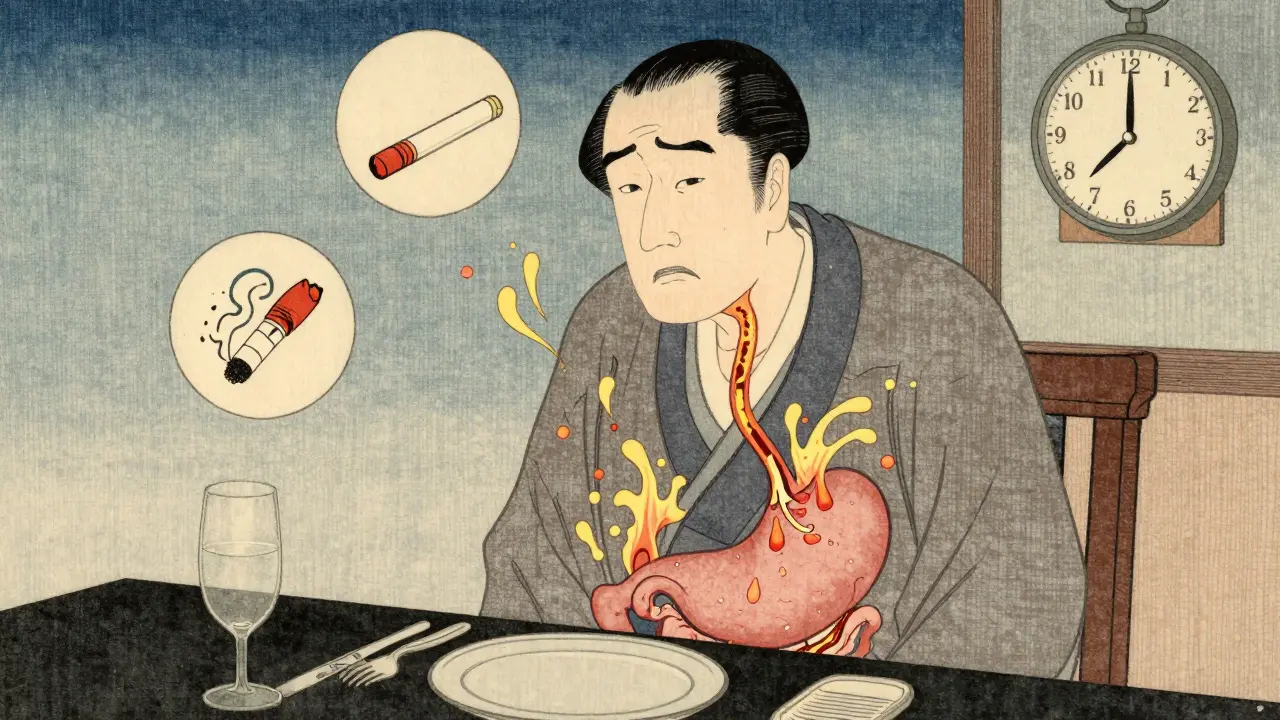
Chronic acid reflux isn't just a nuisance. If you’ve had heartburn for five years or more, especially if you’re a man over 50, overweight, or a smoker, you’re not just dealing with discomfort-you might be on a path toward esophageal cancer. It sounds scary, but here’s the truth: esophageal cancer is rare for most people, but for those with long-term GERD, the risk jumps dramatically. And the worst part? Most people don’t realize they’re in danger until it’s too late.
How GERD Turns Into Cancer
Your esophagus is designed to move food down to your stomach. It’s not meant to handle stomach acid. When you have chronic GERD, that acid keeps splashing up, burning the lining over and over. Your body tries to protect itself by changing the cells in that area. Instead of the normal squamous cells, they start looking more like stomach lining. That’s called Barrett’s esophagus a condition where the esophageal lining changes due to long-term acid exposure, becoming a precancerous state. It’s the only known step between GERD and esophageal adenocarcinoma-the most common type of esophageal cancer today.
This isn’t instant. It takes years. Studies show that people with GERD for five or more years are five times more likely to develop Barrett’s esophagus than those without it. And once Barrett’s is there, the cancer risk isn’t high-only about 0.2% to 0.5% of people with Barrett’s develop cancer each year. But when you add in other risk factors, that number climbs.
The Real Risk Factors: More Than Just Heartburn
Not everyone with GERD gets Barrett’s. Only 10-15% do. So what makes some people more vulnerable? It’s not just how long you’ve had acid reflux-it’s who you are.
- Men are 3 to 4 times more likely than women to develop esophageal cancer.
- Age over 50 is critical. Over 90% of cases happen in people 55 or older.
- White non-Hispanic individuals have three times the rate of adenocarcinoma compared to Black Americans.
- Obesity (BMI ≥30) increases your risk 2 to 3 times. Extra belly fat pushes stomach contents upward.
- Smoking doubles or triples your risk-even if you quit years ago.
- Family history of esophageal cancer raises your odds, even if you’re otherwise low-risk.
Here’s the kicker: if you’re a white male over 50 with GERD for 10+ years, and you’re also overweight and a smoker? Your risk isn’t just higher-it’s in the danger zone. The BE MAPPED a risk calculator that uses age, sex, BMI, smoking, GERD duration, family history, and race to estimate Barrett’s esophagus risk with 85% accuracy tool can help doctors spot who needs screening.
Red Flags: When to Act Now
Most people with esophageal cancer don’t feel anything until it’s advanced. But there are warning signs that can’t be ignored. If you have even one of these, get checked-today.
- Dysphagia: Food feels stuck in your chest or throat. Starts with solids, then moves to liquids.
- Unexplained weight loss: Losing 10 pounds or more in six months without trying.
- Heartburn that won’t quit: More than twice a week for five+ years. Even if it’s "mild."
- Food impaction: You feel like something’s lodged in your chest after eating.
- Chronic hoarseness or cough: Lasting over two weeks, especially if you don’t smoke.
These aren’t "maybe" signs. Eighty percent of people diagnosed with esophageal cancer already had dysphagia. Sixty to seventy percent had unexplained weight loss. And 90% had long-term GERD. Yet most dismiss these as "just aging" or "indigestion." That’s why 75% of cases are found at late stages-when survival rates drop below 20%.
What You Can Do: Prevention Is Possible
Here’s the good news: you can stop this before it starts.
Quit smoking. Your risk drops by 50% within 10 years of quitting. Even if you’ve smoked for decades, it’s never too late.
Lose weight. Shedding just 5-10% of your body weight cuts GERD symptoms by 40%. That’s not just about appearance-it’s about protecting your esophagus.
Limit alcohol. One drink a day for women, two for men. Heavy drinking doesn’t raise adenocarcinoma risk much, but it spikes squamous cell cancer-a different type. Better safe than sorry.
Treat GERD properly. Proton pump inhibitors (PPIs) like omeprazole aren’t just for relief. If you have Barrett’s esophagus and take PPIs daily for five+ years, your cancer risk drops by 70%. But don’t just pop pills. Talk to your doctor about whether you need an endoscopy.
Get screened. The American College of Gastroenterology a medical organization that recommends upper endoscopy for white men over 50 with chronic GERD (≥5 years) and two additional risk factors says: if you’re a white man over 50 with GERD for five years and two other risks (like obesity or smoking), you should get an endoscopy. Yet only 13% of high-risk people do. That’s a gap that’s costing lives.
The Bigger Picture: Why This Is Getting Worse
Since 1975, esophageal adenocarcinoma has gone up by 850%. Why? Obesity rates have tripled. GERD is now common in 1 in 5 Americans. The same forces pushing up diabetes and heart disease are fueling this cancer. It’s not rare-it’s becoming more frequent, and we’re not catching it early enough.
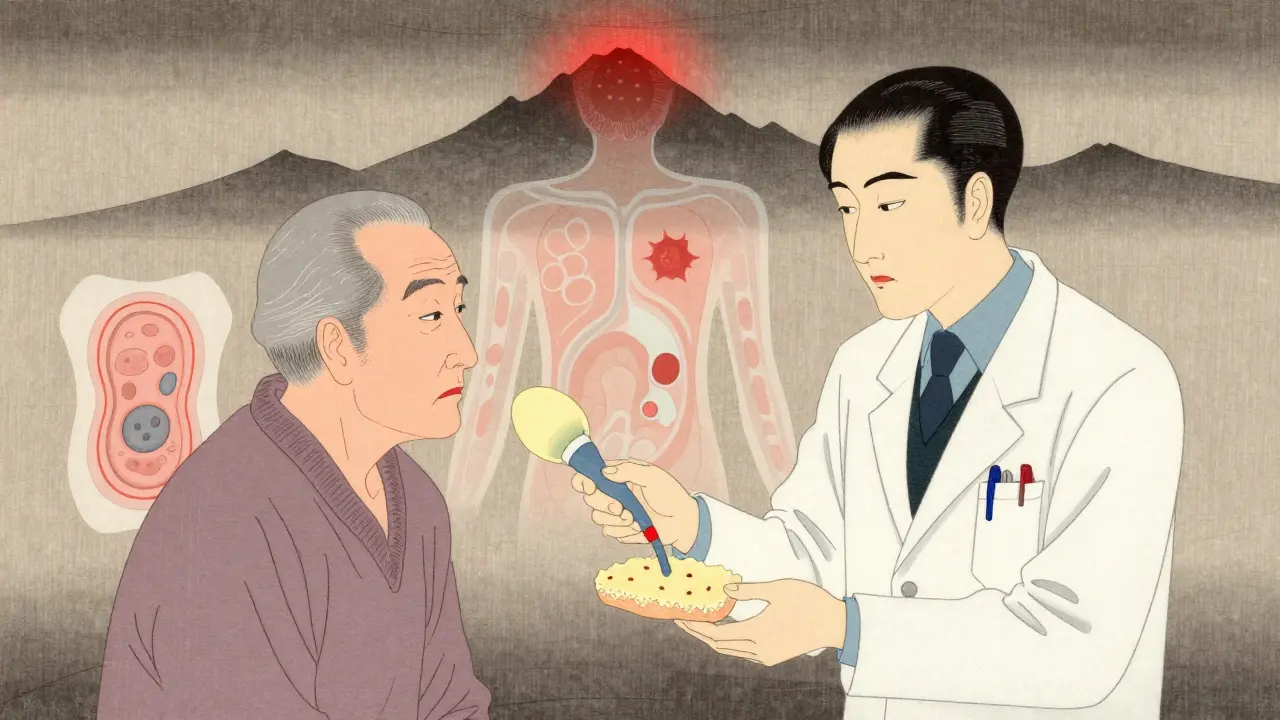
But here’s what’s hopeful: if caught early, the 5-year survival rate jumps from 21% to 50-60%. That’s not a cure, but it’s a real chance. And new tools are helping. The Cytosponge a pill-sized sponge on a string that collects esophageal cells for cancer screening, showing 79.9% sensitivity in detecting Barrett’s esophagus test, for example, lets doctors screen without a full endoscopy. It’s not everywhere yet, but it’s coming.
And research is moving fast. Scientists are now looking at genetic markers-like changes in the CRTC1 gene-that can tell us who’s most likely to progress from GERD to Barrett’s. Personalized risk assessment is the next frontier.
Bottom Line: Don’t Wait for Symptoms
If you’ve had heartburn for five years or more, especially if you’re male, over 50, overweight, or a smoker-don’t wait until you can’t swallow. Talk to your doctor. Ask if you need an endoscopy. Don’t assume it’s "just acid reflux." Your esophagus is changing. And if you catch it early, you can stop cancer before it starts.
Can GERD cause esophageal cancer even if I take medication?
Yes. Medication like PPIs reduces acid, but they don’t reverse existing damage. If you’ve had GERD for five or more years, even with medication, you still have a higher risk of Barrett’s esophagus and cancer. The key is duration-not whether you’re on treatment.
Is esophageal cancer hereditary?
Family history is a risk factor, but it’s not the main driver. Most cases aren’t inherited. However, if a close relative had esophageal cancer, your risk increases, especially if you also have GERD, obesity, or smoke. Genetic testing isn’t routine yet, but research is ongoing.
Do I need an endoscopy if I have GERD but no symptoms?
Not necessarily. Endoscopy is recommended for people with long-term GERD (5+ years) who also have other risk factors-like being male, over 50, overweight, or a smoker. If you have no symptoms but fit that profile, talk to your doctor. If you have no risk factors beyond GERD, screening isn’t usually needed.
Can losing weight reverse Barrett’s esophagus?
Losing weight doesn’t reverse Barrett’s, but it can stop it from getting worse. Weight loss reduces pressure on the stomach, cuts acid reflux, and lowers inflammation. Studies show it reduces Barrett’s progression risk by up to 40% in obese patients.
Is the Cytosponge test available in the UK?
Yes. The Cytosponge test is now being used in NHS pilot programs in England and Wales. It’s not yet standard everywhere, but it’s approved for use in high-risk patients who can’t or won’t undergo endoscopy. Ask your GP if you’re eligible.
What to Do Next
If you’re in the high-risk group-male, over 50, GERD for 5+ years, overweight or smoker-schedule a conversation with your doctor. Don’t wait for symptoms. Ask: "Should I get an endoscopy?" or "Could I have Barrett’s esophagus?"
If you’re not in that group but have persistent heartburn, start managing it now. Quit smoking. Lose weight. Limit alcohol. Take your PPIs as prescribed. And if symptoms don’t improve in 4-6 weeks, get evaluated.
Esophageal cancer is preventable. But only if you act before it’s too late.
13 Comments
I had GERD for 12 years and thought it was just part of being a dad who eats too much pizza. Then I started choking on my own food. Turns out, I had Barrett’s. Got the endoscopy last year. No cancer. Just a scary wake-up call. Quit smoking. Lost 30 lbs. Now I drink water like it’s my job. If you’re reading this and have heartburn longer than your Netflix subscription-do something. Now.
Thank you for this comprehensive and clinically accurate overview. As a Canadian healthcare professional, I appreciate the emphasis on evidence-based screening criteria. The Cytosponge data from NHS trials is particularly compelling, and I’ve begun recommending it to high-risk patients who express anxiety about traditional endoscopy. Prevention remains vastly underprioritized in primary care.
I’m from South Africa and we don’t even have access to half the screening tools mentioned here. My uncle died of this in 2020. No endoscopy. No Cytosponge. Just ‘take antacids and rest.’ This post is spot-on, but it’s useless if your country can’t afford to act on it. Why is this a ‘rich man’s cancer’? That’s the real red flag.
OMG I JUST REALIZED 😱 I’ve had heartburn since 2018… that’s 6+ years… I’m 52… male… overweight… and I quit smoking 8 years ago… BUT I’M WHITE… I’M IN THE RISK ZONE 😭 I just Googled ‘Cytosponge near me’ and it’s not even a thing in my state… this is terrifying. Who do I even talk to??
You’re not alone, and you’re not doomed. Seriously. One step. Just one. Call your doctor. Say: ‘I’m a 52-year-old guy with GERD since 2018. I’m overweight. I used to smoke. I want to know if I need screening.’ That’s it. No shame. No panic. Just action. You’ve got this. And if they blow you off? Find another doctor. Your esophagus is worth fighting for.
i had a gastro doc tell me 'just avoid spicy food' 5 years ago. now i read this and realize i fit every single risk factor. i’m 58, white, smoker (quit 2015), obese, had reflux since 2010. why didn’t anyone say 'get an endo'? i feel like i got scammed. i’m gonna call my doc tomorrow. thanks for the nudge.
This is exactly the kind of info that needs to be shouted from the rooftops. Most people think GERD = occasional pizza regret. But it’s a slow-motion assault on your body. And the fact that 75% of cases are caught too late? That’s a system failure. We need public health campaigns. Billboards. TV ads. This isn’t just medical-it’s a public safety issue. If you’re at risk, you owe it to your future self to get checked. No excuses.
This post is dangerously oversimplified. Barrett’s esophagus is not a guaranteed precursor. The 0.5% annual progression rate is often misinterpreted. And the Cytosponge? Still experimental outside the UK. Stop fearmongering. Most people with GERD never develop cancer. And yes, I’m a doctor.
Lol. So now we’re blaming obesity and smoking for cancer? What about glyphosate? 5G? The government’s fluoride agenda? And why are we only screening white men? Black people get esophageal cancer too-just different type. Also, PPIs cause kidney failure. So you’re telling me to take a drug that might kill me to prevent a cancer that probably won’t happen? I’m not buying it.
I’ve known this for years. Big Pharma doesn’t want you to know the truth. The real cause? GMO corn syrup. It’s in everything. Your stomach acid isn’t ‘refluxing’-it’s being poisoned by corporate chemicals. The endoscopy? It’s a trap. They want to biopsy you, then sell you chemo. I’ve been living on apple cider vinegar and raw garlic since 2016. My GERD? Gone. No cancer. No drugs. Just truth. You’re being lied to.
America’s a mess. We got people dying because they can’t afford an endo. Meanwhile, rich folks get Cytosponge and genetic testing. This isn’t medicine. It’s a privilege. And yeah, I’m a white guy over 50 with GERD. But I’m also a vet. I’ve seen what happens when you wait. Get checked. Or don’t. But don’t blame the guy who told you the truth.
I had dysphagia. For three months. Thought it was stress. Then I couldn’t swallow water. ER. Endoscopy. Stage 1. Surgery. Alive. 18 months later. If you have ANYTHING even remotely like this-don’t wait. Don’t Google. Don’t blog. Go. Now.
In India, we don’t even have proper access to PPIs in rural areas. My father had GERD for 15 years. He died in 2021. No screening. No endoscopy. Just painkillers. This article is true, but it’s written for the West. We need global awareness, not just American guidelines.