
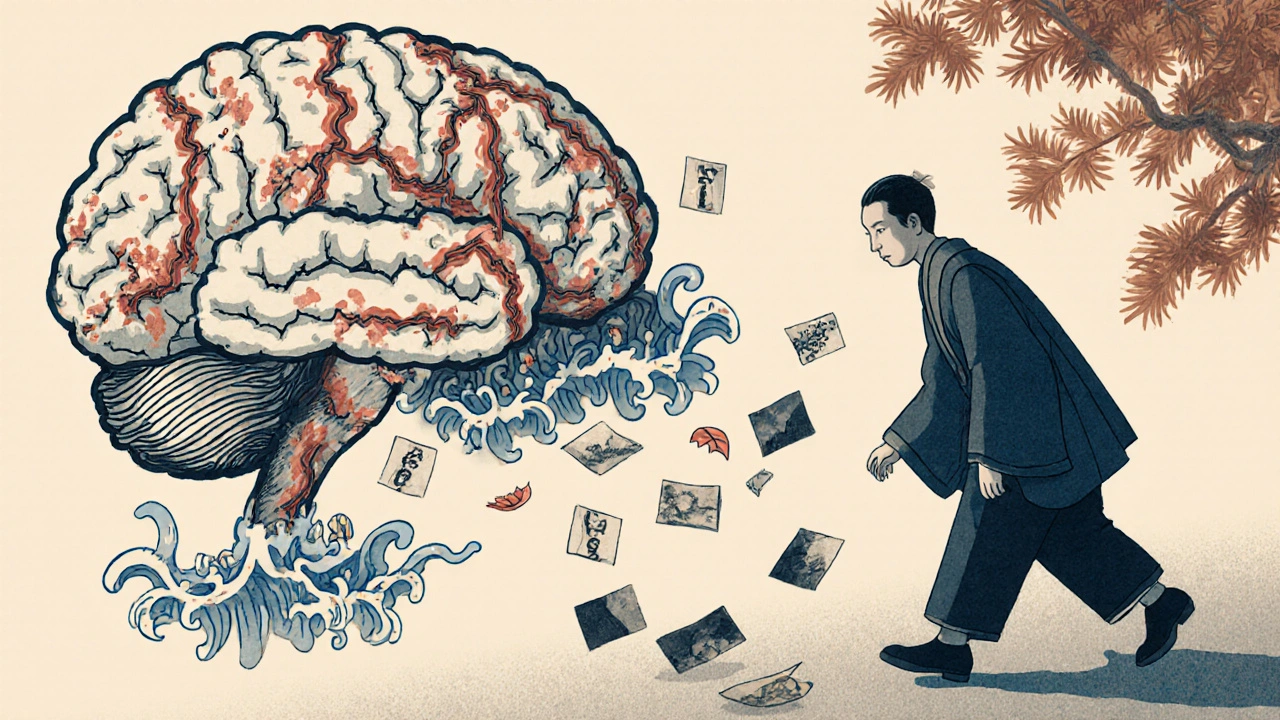
What Exactly Is Dementia?
Dementia isn’t one disease. It’s a group of conditions that slowly steal memory, thinking skills, and the ability to do everyday tasks. You might hear it called Alzheimer’s, but that’s just one kind. Three other major types - vascular dementia, frontotemporal dementia, and Lewy body dementia - affect millions worldwide, yet most people don’t know how different they are. Getting the right diagnosis isn’t just about labels. It changes everything: treatment, safety, and even how long someone might live.
Vascular Dementia: When Blood Flow Fails
Vascular dementia happens when blood vessels in the brain get damaged. This isn’t just about aging. It’s about high blood pressure, diabetes, smoking, or a history of strokes. When blood can’t flow properly, brain cells starve and die. The damage shows up as small strokes or patches of dead tissue on an MRI scan.
Unlike Alzheimer’s, where memory fades slowly, vascular dementia often comes in steps. Someone might seem fine for months, then suddenly get worse after a mini-stroke. They forget appointments, mix up words, or can’t follow a recipe. But they might also stumble walking, have trouble balancing, or lose control of their bladder - signs you don’t usually see early in Alzheimer’s.
Here’s the good news: you can slow it down. Controlling blood pressure (under 130/80 mmHg), managing blood sugar, and taking low-dose aspirin if recommended can cut the risk of further damage. The SPRINT-MIND trial showed that people who kept their systolic pressure below 120 mmHg had 19% fewer cases of mild cognitive decline. This isn’t just about pills - it’s about lifestyle. Walking daily, cutting salt, and quitting smoking make a real difference.
Frontotemporal Dementia: When Personality Changes First
Frontotemporal dementia (FTD) hits people younger than most other dementias - often between 45 and 65. That means someone in their prime working years might start acting strangely. They might become emotionally flat, lose all sense of social rules, or suddenly spend money recklessly. Others might stop speaking clearly or forget the names of common objects.
What’s surprising? Their memory stays sharp in the early stages. A person with FTD might remember your name and last week’s news but won’t care if you’re upset. They might eat with their hands at dinner, say inappropriate things, or become obsessed with routines like lining up spoons. These aren’t personality flaws - they’re brain changes. The frontal and temporal lobes, which control judgment and language, are shrinking.
Doctors use MRI scans to spot the shrinkage and PET scans to see reduced brain activity in those areas. Blood tests rule out thyroid or vitamin issues. There’s no cure yet, but SSRIs (antidepressants) can help with impulsivity or agitation. Speech therapy helps those losing language skills. The biggest challenge? Many are misdiagnosed as having depression, bipolar disorder, or even schizophrenia. One study found up to half of FTD cases were first labeled as psychiatric problems. That delay means families miss critical support and safety planning.

Lewy Body Dementia: The Hidden Dementia
Lewy body dementia (LBD) is the third most common type, yet it’s the most misunderstood. It’s caused by clumps of a protein called alpha-synuclein - called Lewy bodies - that build up in brain areas controlling movement, thought, and sleep. LBD includes two forms: dementia with Lewy bodies (DLB) and Parkinson’s disease dementia (PDD). The difference? Timing. If dementia comes before or within a year of movement problems, it’s DLB. If movement problems come first and dementia follows after a year, it’s PDD.
Here’s what sets LBD apart: three core symptoms you won’t find together in other dementias.
- Fluctuating alertness - One minute they’re clear and talking, the next they’re staring blankly, unresponsive.
- Visual hallucinations - Seeing people, animals, or lights that aren’t there. These aren’t scary to the person - they believe they’re real.
- Parkinson’s movement issues - Shuffling walk, stiff muscles, loss of facial expression.
Many also have REM sleep behavior disorder - acting out dreams, yelling, or kicking in their sleep. This can show up years before dementia starts.
Medication mistakes here can be deadly. Common Alzheimer’s drugs like donepezil can help, but antipsychotics like haloperidol or risperidone can cause severe reactions: extreme stiffness, high fever, even death. Up to 75% of LBD patients react badly to these drugs. That’s why diagnosis matters so much. DaTscan imaging, which shows dopamine transporter activity, helps confirm LBD with 85-90% accuracy. Cholinesterase inhibitors like rivastigmine are the preferred treatment. Proper diagnosis can reduce hospital visits by 30%.
How These Three Dementias Compare
| Feature | Vascular Dementia | Frontotemporal Dementia | Lewy Body Dementia |
|---|---|---|---|
| Primary Cause | Blocked or burst blood vessels | Build-up of tau or TDP-43 proteins in frontal/temporal lobes | Lewy bodies (alpha-synuclein) in brainstem and cortex |
| Typical Age of Onset | 65+ | 40-65 (youngest of all) | 50+ |
| Memory Loss Early On? | Yes, but not always first | No - behavior or language changes come first | No - attention and perception problems dominate |
| Key Symptoms | Step-wise decline, poor judgment, movement issues | Personality changes, impulsivity, language loss | Fluctuating attention, visual hallucinations, Parkinsonism |
| Diagnostic Tool | MRI showing brain infarcts or white matter damage | MRI showing frontal/temporal atrophy; FDG-PET | DaTscan, clinical criteria (2+ core symptoms) |
| Medication Risks | Antihypertensives, aspirin help | SSRIs for behavior; avoid antipsychotics | Antipsychotics can be fatal |
| Prognosis | Varies - depends on stroke risk | 6-10 years after diagnosis | 5-8 years after diagnosis |

Why Getting It Right Matters
Misdiagnosis isn’t just a mistake - it’s dangerous. Someone with Lewy body dementia given an antipsychotic for hallucinations might end up in intensive care. Someone with frontotemporal dementia labeled as ‘just being rude’ misses out on support that could keep them safe at home. And someone with vascular dementia who doesn’t control their blood pressure is likely to have another stroke - and lose more brain function.
There’s also a hidden cost. In the U.S. alone, dementia costs $355 billion a year. Globally, it’s $1.3 trillion. Yet research funding for LBD and FTD combined is less than $50 million annually - a fraction of what Alzheimer’s gets. That’s not fair. These aren’t rare conditions. Together, they make up nearly 40% of all dementia cases.
Knowing the difference helps families plan. It helps doctors choose the right meds. It helps caregivers understand why their loved one suddenly can’t focus, sees things that aren’t there, or behaves completely out of character. It’s not madness. It’s biology.
What You Can Do Now
If you or someone you know is showing signs of dementia, don’t wait. See a neurologist - not just a GP. Ask for brain imaging and specific tests. If hallucinations or movement problems are present, push for a DaTscan. If personality changes started young, ask about FTD. If there’s a history of strokes or high blood pressure, make sure vascular causes are ruled out.
Track symptoms. Note when they happen, how long they last, and what triggers them. Write down changes in behavior, speech, or movement. Bring this to your doctor. The more detail you have, the better the chance of a correct diagnosis.
And if you’re caring for someone with any of these types - educate yourself. Support groups exist. The Lewy Body Dementia Association, the Association for Frontotemporal Degeneration, and the National Institute on Aging offer free resources. You’re not alone. And understanding the type of dementia isn’t just helpful - it’s lifesaving.
Can vascular dementia be reversed?
No, brain damage from strokes or blocked vessels can’t be undone. But you can stop it from getting worse. Controlling blood pressure, cholesterol, and blood sugar can prevent new damage. Many people stabilize after the initial decline if risk factors are managed aggressively.
Is frontotemporal dementia hereditary?
About 30-40% of FTD cases have a strong family history. Mutations in genes like C9orf72, MAPT, and GRN are linked to inherited forms. If multiple family members had early-onset dementia or behavioral changes, genetic counseling may be helpful.
Can Lewy body dementia be diagnosed with a blood test?
Not yet. Diagnosis relies on symptoms and imaging like DaTscan. But new blood tests for proteins like GFAP and neurofilament light are being studied and may help in the next few years. Right now, clinical evaluation remains the gold standard.
Why do people with Lewy body dementia see things that aren’t there?
Lewy bodies disrupt the brain’s visual processing areas and the parts that filter sensory input. This makes the brain misinterpret signals - shadows become people, patterns turn into animals. These hallucinations aren’t hallucinations in the psychiatric sense; the person truly believes they’re real. Telling them they’re not real often causes distress. Instead, validate their experience and gently redirect.
Can someone have more than one type of dementia?
Yes. Up to 40% of people with Alzheimer’s also have Lewy bodies. Many older adults have mixed dementia - vascular changes plus Alzheimer’s plaques, or FTD with some Alzheimer’s pathology. This makes diagnosis harder but doesn’t change the need for careful medication management.
Next Steps for Families
Start with a neurologist who specializes in dementia. Don’t settle for a quick diagnosis based on memory tests alone. Push for brain imaging. Ask about biomarkers. If you’re told it’s Alzheimer’s but the symptoms don’t fit - especially if hallucinations, movement issues, or personality shifts are prominent - get a second opinion.
Join a support group. Caregiving for any type of dementia is exhausting. But caring for someone with LBD or FTD comes with unique challenges - unpredictable behavior, dangerous reactions to meds, early-onset loss of independence. You need people who get it.
And remember: knowing the type isn’t about doom. It’s about control. It’s about choosing the right path, avoiding dangerous mistakes, and giving your loved one the best possible care - not just for today, but for every day ahead.
12 Comments
Just want to say the part about vascular dementia and SPRINT-MIND is gold. I’ve seen my uncle go from walking fine to needing a cane after one silent stroke. Blood pressure control isn’t just ‘good advice’-it’s the difference between losing your independence and keeping it. Low-dose aspirin? Only if your doc says so, but yeah, lifestyle changes matter more than pills.
Oh wow. Another ‘educational’ post that makes dementia sound like a Netflix documentary. ‘Lewy bodies build up’-sure. And my cat builds up nap karma. But let’s not pretend this isn’t just another way to sell DaTscans and rivastigmine while families drown in silence. The real tragedy? No one talks about the loneliness of watching someone you love become a stranger… and then being told to ‘just manage it.’
Here’s the uncomfortable truth no one wants to admit: we’re all just one bad gene or one uncontrolled BP reading away from becoming a statistic. The brain doesn’t care if you’re rich, smart, or ‘good’-it just decays. And we treat dementia like a moral failure instead of a biological accident. We medicate, we scan, we label… but we never really sit with the horror of it. That’s the real dementia-the one in our collective denial.
lol at the table. Like anyone’s gonna remember all this. My aunt had LBD and they gave her risperidone. She got so stiff she couldn’t swallow. Took 3 weeks to recover. No one warned us. Just ‘it’s Alzheimer’s’ until she started yelling at the ceiling. Then panic. Please stop pretending this is science. It’s guesswork with fancy machines.
One cannot help but reflect upon the epistemological implications of the diagnostic frameworks presented herein. The ontological status of the ‘Lewy body’ as a pathological entity presupposes a Cartesian dualism between protein aggregation and subjective experience-an assumption that, if unexamined, risks reifying biomedical reductionism at the expense of phenomenological truth. The lived reality of hallucinatory perception in LBD cannot be reduced to dopamine transporter activity, no matter how statistically significant the DaTscan may be.
Moreover, the economic disparity in research funding reveals not merely a funding gap, but a moral failure of the neuroscientific hegemony that privileges Alzheimer’s as the archetypal dementia, thereby marginalizing those whose suffering does not conform to the dominant narrative. The silence surrounding FTD is not incidental-it is structural.
And yet, one must ask: in a world where the commodification of health is paramount, can any diagnosis ever be truly liberating-or merely another mechanism of control?
I just want to say, as someone who’s been caregiving for my mom with FTD for 7 years now… this article made me cry-not because it was sad, but because it finally said what I’ve been screaming into the void for years. She didn’t ‘get rude’-her frontal lobe was dying. The way people say ‘just be patient’ or ‘she’s acting out’… it breaks me. I wish every doctor, every nurse, every family member had to sit with someone who forgets how to say ‘water’ but still remembers the taste of your childhood birthday cake. That’s the real tragedy-not the science, not the stats, but the way we fail to see the person behind the symptoms.
And yes, SSRIs helped. Not cure, not fix-but they gave us back moments. Like when she smiled at the dog again. That’s worth everything.
YOOO I JUST LEARNED THAT LBD CAN SHOW UP AS SLEEP ACTING OUT YEARS BEFORE DEMENTIA?? THAT’S WILD. MY DAD WAS KICKING AND SCREAMING IN HIS SLEEP FOR 4 YEARS BEFORE HE STARTED SEEING PEOPLE. DOCTORS THOUGHT HE HAD PTSD. TURNED OUT IT WAS LBD. I’M TELLING EVERYONE. SAVE YOURSELF THE HELL.
Let’s be real: the only reason LBD and FTD get ignored is because they don’t have a celebrity spokesperson like Alzheimer’s. No ‘Walk to End Alzheimer’s’ marches for people who see dead relatives or suddenly start stealing from the fridge. The system doesn’t care about messy, unpredictable dementia-it wants neat, marketable, memory-loss stories. Meanwhile, families are left to Google symptoms at 2 a.m. while their loved one tries to ‘fix’ the TV by hitting it.
And don’t even get me started on the antipsychotic nightmare. My cousin’s husband got given haloperidol for ‘agitation’-he went into neuroleptic malignant syndrome. ICU. Three months in rehab. All because no one knew the difference between Alzheimer’s and LBD. This isn’t medical knowledge-it’s a death sentence for the uneducated.
And yet, the funding? Pfft. We spend billions on a cure for Alzheimer’s that might not even be Alzheimer’s, while LBD researchers beg for lab supplies. It’s not science. It’s capitalism with a stethoscope.
Also, the table? Perfect. Print it. Tape it to your fridge. If you’re caring for someone with dementia, you need this more than your phone.
Wow. What a beautifully curated piece of medical propaganda. I love how this article makes it sound like we’re all just one DaTscan away from salvation. Meanwhile, in the real world, most people can’t even get a neurologist appointment for 18 months. And the ‘lifestyle changes’ advice? Cute. Tell that to the single mom working two jobs who can’t afford to buy fresh veggies or take a walk because her kid’s in special ed and her husband’s in jail.
Also, ‘don’t settle for a quick diagnosis’-yeah, right. My sister’s doctor wrote ‘Alzheimer’s’ on the chart after a 10-minute chat and a MMSE. No imaging. No history. Just a checkbox. This article reads like a pharma ad written by someone who’s never met a real patient.
And the ‘you’re not alone’ ending? That’s the worst part. We’re not alone-we’re abandoned. By the system. By the money. By the silence.
Back in my day in Texas, we just called it ‘getting old’ and gave ’em a cold drink and a nap. Now we got scans and proteins and acronyms. Dementia ain’t a puzzle to solve-it’s a part of life. You love the person, you hold their hand, you don’t let them fall. All this fancy talk? It helps some. But it don’t change the fact that when your mom forgets your name, you still say ‘I’m here, Mama.’ That’s the only diagnosis that matters.
While the article presents a superficially coherent taxonomy of dementia subtypes, it conspicuously omits the broader geopolitical context of neurodegenerative research funding disparities. The disproportionate allocation of resources toward Alzheimer’s disease-largely driven by Western pharmaceutical interests-reflects a systemic bias against non-Western epistemologies of aging. In many Eastern cultures, dementia is integrated into familial structures without the need for invasive diagnostics or pharmacological intervention. The Western obsession with biomarkers and imaging may, in fact, exacerbate the alienation of patients rather than alleviate suffering.
Furthermore, the emphasis on individual behavioral control (e.g., ‘controlling blood pressure’) ignores the structural determinants of vascular health: food deserts, environmental toxins, and economic inequality. To frame dementia as a matter of personal responsibility is not merely misleading-it is ethically indefensible.
My uncle’s still alive at 82. BP under 120. No more strokes. Walking every day. He doesn’t remember my name anymore-but he remembers the smell of coffee. That’s enough for me.