

Dechallenge & Rechallenge Causality Simulator
Choose Your Scenario
Select a patient case to investigate:
🩺Case A: Skin Rash
Patient develops a mild rash after starting antibiotic metronidazole. Symptoms are uncomfortable but not life-threatening.
Moderate Risk⚠️Case B: Liver Issues
Patient shows elevated liver enzymes after starting a new painkiller. Potential for serious organ damage exists.
High RiskStep 1: Perform Dechallenge
The doctor stops the suspected medication. What happens?
Step 2: Consider Rechallenge
Should the doctor restart the medication to confirm the cause?
Causality Assessment Result
Your Assessment Path:
Causality Strength
Clinical Interpretation
Imagine you start a new medication for high blood pressure. Two days later, your skin breaks out in a painful rash. Is it the pill? Or is it that new laundry detergent you bought last week? This moment of uncertainty is where pharmacovigilance, the science of monitoring drug safety, steps in. Doctors and researchers don't just guess; they use specific clinical tests to prove whether a drug caused a reaction. The two most powerful tools in this toolkit are called dechallenge and rechallenge.
These terms sound technical, but the concepts are actually quite simple. They represent the 'stop and restart' method used to establish a direct link between a medicine and an adverse event. Understanding what these tests mean helps patients and healthcare providers make safer decisions about treatment. It moves the conversation from 'I think this drug hurt me' to 'We have evidence that this drug caused this reaction.'
The Four Pillars of Drug Causality
To understand dechallenge and rechallenge, we first need to look at the bigger picture. In pharmacovigilance, determining if a drug caused a side effect isn't based on one single factor. It relies on four cardinal principles established by experts like Dr. A. Sharma and colleagues at AIIMS New Delhi in their 2018 review published in the Indian Journal of Dermatology.
- Temporal Relationship: Did the side effect happen after taking the drug? Timing matters. If you take a pill on Monday and get a headache on Tuesday, there is a temporal link. But correlation doesn't always equal causation.
- Biological Plausibility: Does it make scientific sense for this drug to cause this reaction? For example, a drug that dilates blood vessels might logically cause dizziness, but it’s less plausible that it would cause hair loss unless known mechanisms suggest otherwise.
- Dechallenge: What happens when you stop the drug?
- Rechallenge: What happens if you take the drug again?
While timing and biology provide clues, dechallenge and rechallenge provide the proof. They are the practical experiments doctors perform (or observe) to confirm suspicion.
What Is Dechallenge?
Dechallenge is the act of discontinuing the suspected medication to see if the symptoms go away. Think of it as removing the variable to see if the result changes. If you suspect a food allergy, you stop eating that food. If the stomach ache disappears, the dechallenge is considered 'positive.'
| Outcome | Description | Implication for Causality |
|---|---|---|
| Positive | Symptoms improve or disappear after stopping the drug. | Suggests a likely causal relationship. The drug is probably the culprit. |
| Negative | Symptoms persist or worsen despite stopping the drug. | Suggests the drug may not be the cause, or the damage is irreversible. |
A positive dechallenge is significant because it shows the body can recover once the offending agent is removed. However, timing is critical. The resolution must happen within a biologically plausible timeframe related to the drug's half-life. If a drug stays in your system for three days, symptoms shouldn't vanish instantly upon stopping, nor should they linger for weeks if the drug is short-acting.
Consider the case of metronidazole, an antibiotic. In a documented case study, a patient developed a fixed-drug reaction (a rash that appears in the same spot every time). When the doctor stopped the metronidazole, the symptoms resolved, though some hyperpigmentation remained. This positive dechallenge was the first major clue that the antibiotic was responsible.
What Is Rechallenge?
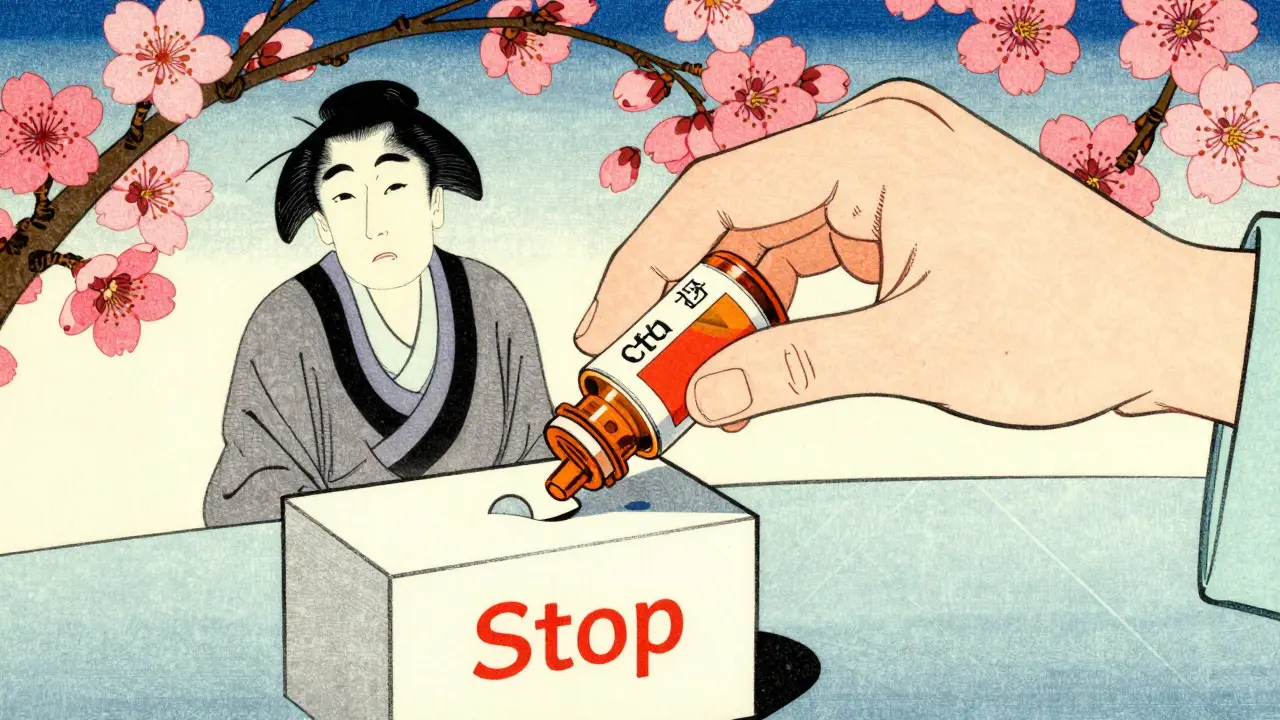
If dechallenge is the 'off switch,' rechallenge is the 'on switch.' Rechallenge involves deliberately giving the patient the same drug again after the symptoms have fully resolved. If the exact same side effect returns, especially at the same anatomical site, the evidence for causality becomes very strong.
In the metronidazole example mentioned earlier, the patient avoided the drug for three months. When they were prescribed it again, the rash returned to the identical spot within two days. This recurrence provided near-conclusive evidence. According to the World Health Organization-Uppsala Monitoring Centre (WHO-UMC) criteria, a successful rechallenge elevates a case from 'probable' to 'definite' causality in nearly all validated instances.
However, rechallenge is not done lightly. It is risky. Why would a doctor intentionally expose a patient to something that made them sick? Usually, it's because the benefits outweigh the risks, or no alternative treatment exists. For example, if a life-saving cancer drug causes a mild rash, a doctor might want to confirm the link before switching therapies permanently.
The Ethical Dilemma of Rechallenge
Here is the catch: rechallenge is often ethically difficult or impossible. If a drug caused Stevens-Johnson Syndrome (a severe skin blistering condition) or liver failure, giving it again could be fatal. Therefore, while rechallenge provides the strongest scientific evidence, it is rarely performed in routine practice for serious adverse events.
Dr. Lisa Thompson from the FDA noted that deliberate rechallenge is approved in only 0.3% of serious adverse drug reaction investigations. It is mostly reserved for non-life-threatening reactions under strict supervision. This limitation means that in about 85% of dermatological cases, doctors rely primarily on dechallenge data rather than rechallenge confirmation.
This creates a gap in certainty. Without rechallenge, we often settle for 'probable' rather than 'definite.' That’s why other tools, like the Naranjo Adverse Drug Reaction Probability Scale, are used to assign points based on available data. But even those scales weigh dechallenge heavily because it is the most common form of evidence available.
Challenges in Real-World Application
Even dechallenge, which seems straightforward, faces hurdles in real-world scenarios. One major issue is polypharmacy-when a patient takes multiple medications. If a patient stops three drugs at once to treat a side effect, and the symptom goes away, which drug was the cause? The dechallenge is positive, but the specific culprit remains unknown.
Another challenge is patient behavior. Many people self-discontinue medications without telling their doctors. If a patient stops a drug on their own and feels better, but doesn't report it, the medical record lacks the structured data needed for accurate causality assessment. This compromises the validity of the dechallenge observation.
Furthermore, delayed reporting makes rechallenge impractical. If a side effect is reported months after the fact, the window for ethical rechallenge has long passed. This is why electronic health records with precise medication timelines are becoming essential. They allow pharmacovigilance specialists to reconstruct the timeline accurately.

The Future of Causality Assessment
Technology is beginning to change how we approach these tests. We are moving toward more objective monitoring. Recent updates to CIOMS guidelines highlight the use of wearable biosensors during dechallenge periods. These devices track physiological parameters objectively, providing resolution data in 78% of cases compared to 52% with traditional self-reported symptoms.
Additionally, scientists are developing alternatives to physical rechallenge. In vitro lymphocyte toxicity assays can now predict individual susceptibility to specific drug reactions with 89% accuracy. This lab-based test reduces the need to actually re-expose a patient to the drug. Machine learning algorithms are also being piloted to predict dechallenge outcomes based on historical data, potentially reducing unnecessary medication discontinuations.
Despite these advances, experts caution that technology cannot fully replace clinical reality. As Dr. Elena Rodriguez stated, no algorithm can substitute for the actual observation of symptom resolution after drug discontinuation. Dechallenge remains the cornerstone of the process.
Why This Matters for Patients
For patients, understanding dechallenge and rechallenge empowers better communication with healthcare providers. If you experience a side effect, note the timing. Ask your doctor if stopping the medication is safe (dechallenge). If symptoms resolve, keep that information handy. It is valuable data for your future care.
Be aware that if a doctor suggests trying a medication again, ask about the risks and benefits of rechallenge. It is a valid medical strategy, but it requires informed consent and close monitoring. Your safety is the priority, and these tests exist to ensure that the treatments you receive do more good than harm.
What is the difference between dechallenge and rechallenge?
Dechallenge is the process of stopping a suspected drug to see if symptoms improve. Rechallenge is the process of restarting the drug after symptoms have resolved to see if they return. Dechallenge suggests a link; rechallenge confirms it.
Is rechallenge always safe?
No, rechallenge is not always safe. It is generally avoided for severe or life-threatening reactions like liver failure or severe skin blistering. It is typically reserved for mild, non-life-threatening side effects where the benefit of confirming the cause outweighs the risk.
What does a positive dechallenge mean?
A positive dechallenge means that the adverse symptoms improved or disappeared after the drug was discontinued. This strongly suggests that the drug was causing the reaction, although it does not definitively prove it without further context.
How do doctors decide if a drug caused a side effect?
Doctors use four main principles: temporal relationship (timing), biological plausibility (scientific sense), dechallenge (stopping the drug), and rechallenge (restarting the drug). Tools like the Naranjo Scale help score these factors to determine probability.
Can technology replace dechallenge and rechallenge?
Not entirely. While wearables and lab tests like lymphocyte assays are improving prediction accuracy, clinical observation of symptom resolution (dechallenge) remains the gold standard. Technology supports these methods but does not yet replace the need for clinical evidence.