

Childhood obesity isn’t just about a child being overweight-it’s a family issue. When a child’s BMI hits the 95th percentile for their age and sex, it’s not a sign they’re eating too much candy. It’s a signal that daily routines, food habits, and home environments need a reset. The good news? The most effective way to fix it isn’t through diets, supplements, or school programs alone. It’s through the family.
Why Family-Based Treatment Works
For decades, doctors tried treating childhood obesity by focusing only on the child. They gave them meal plans, told them to exercise more, and hoped for the best. But the results were disappointing. Kids often slipped back into old habits once the clinic visit ended. Why? Because kids don’t live in isolation. They eat what’s in the fridge, watch TV with their parents, and copy how their caregivers move-or don’t move. Research from the University at Buffalo, led by Dr. Leonard Epstein starting in the 1980s, changed everything. His team developed Family-Based Behavioral Treatment (FBT), a structured approach that trains parents to create a home environment where healthy choices become the default. Today, the American Academy of Pediatrics, the American Psychological Association, and the NIH all agree: FBT is the gold standard for treating children aged 2 to 18. It’s not magic. It’s science. In a major 2023 trial published in JAMA Network Open, kids in FBT programs lost 12.3% more of their excess body weight than those in usual care. And here’s the kicker-parents lost weight too. On average, they dropped 5.7% of their BMI. Even siblings who weren’t directly in the program improved their weight by 7.2%. That’s because when one person changes their habits at home, everyone else follows.The Stoplight Diet: Simple Rules, Real Results
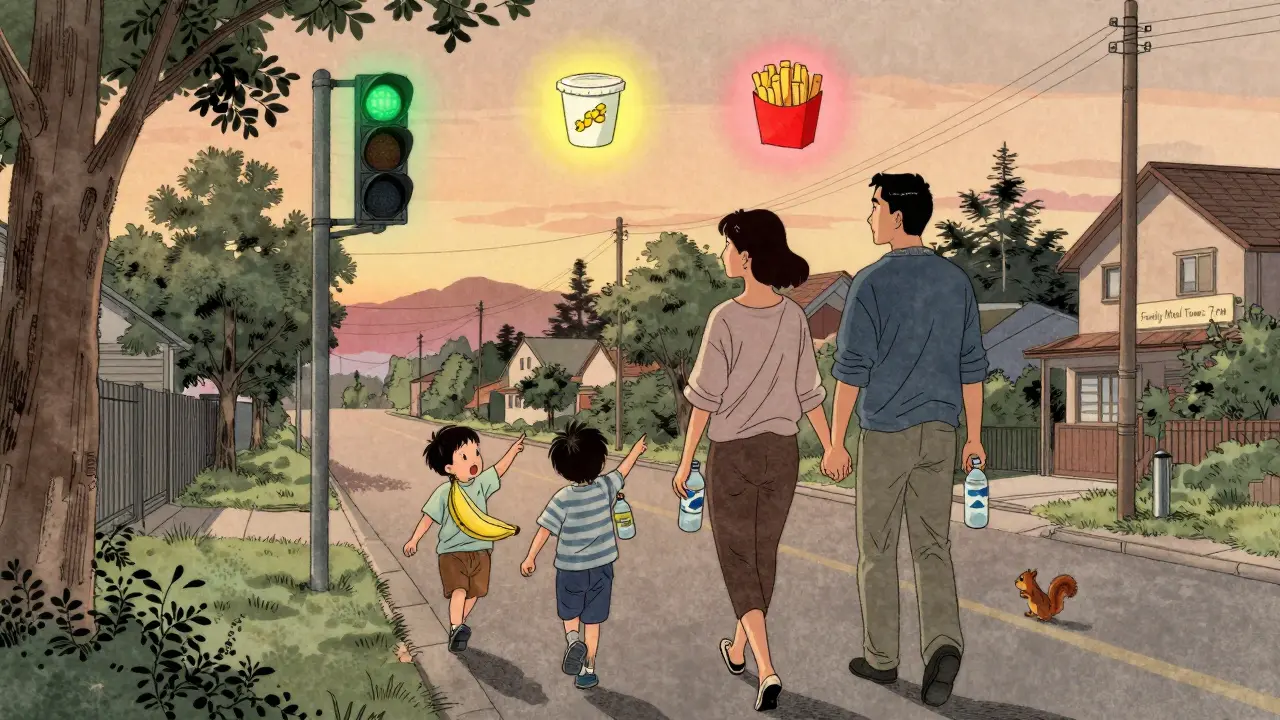
One of the most practical tools in FBT is the Stoplight Diet. It turns confusing nutrition advice into something even a 5-year-old can understand.- Green foods = eat freely: fruits, vegetables, whole grains, lean proteins, low-fat dairy.
- Yellow foods = eat in moderation: whole-grain pasta, cheese, nuts, unsweetened yogurt, lean meats.
- Red foods = eat sparingly: sugary drinks, fried foods, candy, pastries, processed snacks.
Move More, Sit Less
Children need at least 60 minutes of moderate to vigorous physical activity every day. That doesn’t mean forcing them into soccer practice five days a week. It means making movement part of the day.- Walk or bike to school if possible.
- Play tag after dinner.
- Turn off the TV and dance for 15 minutes while dinner cooks.
- Take the stairs instead of the elevator.
How FBT Actually Works in Practice
A typical FBT program lasts 6 to 24 months and includes 16 to 32 sessions. These aren’t therapy sessions in a quiet office. They’re coaching meetings-often held right in the pediatrician’s office. The structure is simple:- Track habits: Families keep food and activity journals. No judgment-just recording.
- Set goals: Small, weekly goals like “eat fruit at breakfast” or “walk after dinner three times this week.”
- Learn parenting skills: How to say no without yelling. How to praise effort, not just results. How to avoid using food as a reward.
- Plan for challenges: What do you do when you’re at a birthday party? When grandparents offer cookies? When the weather’s bad and you can’t go outside?
What Doesn’t Work
Many parents try quick fixes: juice cleanses, weight-loss apps for kids, or telling their child to “just eat less.” These don’t work-and they often make things worse.- Restricting food leads to binge eating later.
- Shaming or blaming increases anxiety and lowers self-esteem.
- Waiting to act is dangerous. A 2022 study from the University of Rochester found that small weight gains in early childhood predict severe obesity by adolescence. If you wait until a child is 14 and obese, even intensive treatment only helps 60% of them.
Cost, Access, and Barriers
FBT costs about $3,200 per family over two years-less than most specialty clinics. Medicare and many private insurers now cover it under code G0447 for intensive behavioral therapy. But here’s the problem: only 5% of eligible kids get it. Why? Because most pediatricians don’t have the time or training. Many families live too far from clinics. Others can’t take time off work. And cultural barriers keep some families from seeking help. Hispanic and Black children make up 54% of childhood obesity cases in the U.S., but only 31% of those in FBT programs. Language gaps, mistrust in the medical system, and lack of culturally relevant materials hold many back. The solution? Integrating FBT into primary care. In the 2023 trial, 87% of families completed at least 12 sessions when coaching happened in their child’s regular doctor’s office. That’s a huge jump from 63% in specialty clinics. And it’s cheaper, easier, and more sustainable.
What Parents Can Do Today
You don’t need a program to start. Here’s what you can do right now:- Make one meal a day a family meal. No phones. No TV. Just eating together. Studies show this cuts obesity risk by 12%.
- Swap one sugary drink a day for water. This alone can reduce BMI by 1.0 unit in 12 months.
- Go for a 10-minute walk after dinner. Do it with your child. Make it a habit.
- Keep fruit visible and snacks hidden. Put apples on the counter. Put chips in a cupboard.
- Be the model. If you drink soda, your child will too. If you sit on the couch all evening, they’ll learn that’s normal.
When to Seek Help
If your child’s BMI is above the 95th percentile and you’ve tried making changes at home for 3-6 months with little progress, it’s time to ask your pediatrician about FBT. Ask if they offer coaching in-office. If not, ask for a referral to a certified behavioral health specialist. For children with severe obesity (BMI over 120% of the 95th percentile), FBT is still the first step-but it may need to be paired with medication or, in rare cases, surgery for teens. The goal isn’t to rush to extreme measures. It’s to start early, stay consistent, and build lifelong habits.The Bigger Picture
Childhood obesity isn’t just a health issue. It’s a social one. It’s shaped by food marketing, school lunches, safe play spaces, and whether parents have time to cook. But while society changes slowly, families can change fast. The most powerful tool you have isn’t a scale or a diet plan. It’s your influence. Your choices. Your routine. Your presence. When families work together, children don’t just lose weight. They learn how to live well.What is the Stoplight Diet and how does it help with childhood obesity?
The Stoplight Diet is a simple food classification system used in family-based treatment for childhood obesity. Green foods (fruits, vegetables, whole grains, lean proteins) can be eaten freely. Yellow foods (cheese, nuts, whole-grain pasta) should be eaten in moderation. Red foods (sugary drinks, fried snacks, candy) should be eaten sparingly. This approach helps families make sustainable changes without banning foods, leading to an average 9.38% reduction in excess weight in children within six months.
Is family-based treatment more effective than just focusing on the child?
Yes. Studies show family-based behavioral treatment (FBT) produces 0.55 standard deviations greater weight loss than interventions focused only on the child. When parents change their habits, children follow. In one 2023 trial, children in FBT lost 12.3% more excess weight than those in standard care, and even siblings not directly in the program improved their weight by 7.2%.
How many sessions does family-based treatment usually take?
Most FBT programs include 16 to 32 sessions over 6 to 24 months. The 2023 JAMA trial used a 26-session plan over 24 months, but families completed an average of 19.7 sessions. The key isn’t hitting every session-it’s consistent participation. Even 12 sessions can lead to meaningful change, especially when integrated into routine pediatric care.
Can FBT help if I have more than one child with weight issues?
Yes. In fact, FBT often helps all children in the household-even those not directly targeted. The same 2023 study found siblings of children in FBT improved their weight outcomes by 7.2% compared to siblings in control groups. When the whole family eats healthier and moves more, everyone benefits.
Is family-based treatment covered by insurance?
Yes. Medicare and many private insurers cover intensive behavioral therapy for obesity under code G0447, which pays for 15-minute sessions with qualified providers. However, only about 5% of eligible children currently receive it, mostly due to lack of awareness or provider access. Ask your pediatrician if they offer FBT in-office or can refer you to a certified coach.
When should I start family-based treatment for my child?
Start as soon as your child’s weight is climbing on their growth chart-even if they haven’t reached obesity yet. Experts recommend beginning FBT as early as age 4 or 5. Waiting until a child is severely obese makes treatment harder. Small changes early lead to much better long-term outcomes than trying to reverse major weight gain later.
What are common barriers to family-based treatment?
Common barriers include scheduling conflicts, parental resistance to changing their own habits, lack of access to trained providers, and cultural or language differences. Families in low-income communities face additional challenges, with only 22% of safety-net clinics able to fully implement FBT. Integrating coaching into regular pediatric visits helps overcome many of these issues.
Can I start FBT at home without a program?
Absolutely. You don’t need a formal program to begin. Start by making one meal a day a screen-free family meal, swapping one sugary drink for water daily, and going for a 10-minute walk after dinner. Keep healthy foods visible and unhealthy ones out of easy reach. Be a role model. These small, consistent steps are the foundation of FBT and can lead to real results over time.
15 Comments
So let me get this straight - we’re telling parents to stop being parents and become nutrition cops? Great. Next they’ll be measuring how many steps the dog takes.
Meanwhile, my kid eats a granola bar for breakfast and calls it a day. He’s fine.
Stoplight diet? More like stoplight guilt trip.
Also - I’m not putting apples on the counter. They’ll just get eaten by the raccoons outside.
Send help. Or cookies. Either works.
Okay but what if the STOPLIGHT DIET is just a front for the CDC to track our kids’ eating habits through smart fridges?
I read a blog once - and this is legit - that the same people who pushed ‘low fat’ in the 90s now own the companies selling ‘healthy snacks’.
They want you to think you’re fixing obesity… but really you’re just feeding Big Health.
And why is it always the MOMS who have to change? Where’s the dad’s accountability? Hmm?
Also - did you know the WHO gets funding from soda companies? I’m not saying… but I’m also saying… 🤫
Oh wow. Another ‘just eat better’ lecture from someone who clearly never had to feed four kids on $30 a week.
Green foods? Cool. Where’s the grocery store that sells ‘green foods’ in my neighborhood? Oh right - next to the pawn shop and the bail bonds place.
And don’t get me started on ‘walk after dinner’ - my kid’s got asthma. The air out there is worse than my ex’s attitude.
So yeah. Thanks for the advice. I’ll just let him eat Lucky Charms and pray.
Also - if you think this is about ‘habits’ and not ‘poverty’… you’re part of the problem.
Let me get this straight - we’re trusting a bunch of ‘experts’ who couldn’t even fix their own diets to tell American families how to raise their kids?
Meanwhile, China’s got kids doing 3-hour PE drills before school and still eating rice with pork belly every night - and they’re not obese.
What’s the real agenda here? Is this about health… or is this about making us feel guilty for being American?
And why is no one talking about how school lunches are funded by the same corporations that sell candy bars?
Wake up, people. This isn’t about veggies. It’s about control.
Also - my kid eats a Big Mac once a week and runs track. He’s fine. Maybe your kid just needs less screen time and more discipline.
PS: I’m not a conspiracy theorist. I just read the news.
I think the key is consistency not perfection
My wife and I started swapping soda for water and now we all drink it
My daughter used to ask for juice every night now she just asks for lemon water
We don’t track everything but we do eat dinner together and no phones
It’s not hard it’s just something you have to make time for
Also I’m not saying this because I’m perfect
I still give my kid candy on weekends
But I don’t feel guilty about it anymore
Because we’re trying
And that’s enough
It is imperative to underscore the empirical validity of Family-Based Behavioral Treatment as the preeminent clinical intervention for pediatric weight management, as substantiated by longitudinal, randomized controlled trials conducted by the National Institutes of Health.
Parents, as primary agents of behavioral reinforcement, must be empowered through structured coaching to establish home environments conducive to sustainable habit formation.
The Stoplight Diet, while seemingly simplistic, operates upon well-established principles of operant conditioning and environmental cue modification.
Moreover, the integration of FBT into primary care settings has demonstrated statistically significant improvements in adherence rates, thereby mitigating systemic access disparities.
It is not a matter of moral failing or parental negligence; it is a matter of systemic underinvestment in preventive pediatric behavioral health.
Let us not mistake the efficacy of science for the imposition of ideology.
And yes - your child can still have a cookie.
But perhaps not five.
I grew up in a household where dinner was rice, beans, and whatever was on sale.
We didn’t have ‘green foods’ labeled.
We had food. We ate it. We played outside until dark.
My mom worked two jobs. My dad didn’t know what BMI meant.
And yet - I’m healthy now.
Maybe the real issue isn’t the food.
It’s that we’ve forgotten how to just… be.
Not track.
Not optimize.
Just eat. Move. Laugh.
And maybe that’s enough.
While I appreciate the general intent of the proposed interventions, I must express profound concern regarding the implicit assumption that behavioral modification can be universally applied without consideration of socioeconomic stratification, cultural dietary norms, and intergenerational food practices.
For instance, in many Latinx households, the use of lard in cooking is not a dietary preference but a cultural heritage - to label it ‘red’ without contextual nuance is not only reductionist, but ethically problematic.
Furthermore, the assertion that ‘parents must model behavior’ presumes a level of temporal autonomy and psychological bandwidth that is unattainable for single parents working two minimum-wage jobs.
The JAMA study, while methodologically sound, fails to account for attrition bias among marginalized populations, and its conclusions are thus not generalizable to the broader demographic.
Additionally, the term ‘Stoplight Diet’ is dangerously reductive, and risks pathologizing normal childhood appetites under the guise of medical authority.
Perhaps, instead of prescribing behavioral checklists, we should be advocating for structural change - living wages, food deserts, and school lunch reform - rather than placing the burden solely on the family unit.
Thank you for your attention to this matter.
Respectfully,
Billy Poling, Ph.D. Candidate in Public Health Ethics
I started doing the 10-minute walk after dinner with my son and now he asks for it every night
He says it’s our time
He talks about school
I don’t talk about his weight
He doesn’t know I’m trying to help
But I think he feels it
And that’s what matters
It’s not about losing weight
It’s about being together
And I didn’t even know that was the goal
Until I started doing it
There’s something deeply human here… that we’ve turned a biological, emotional, systemic issue into a checklist.
It’s not just about food.
It’s about safety.
It’s about connection.
It’s about a child who doesn’t feel heard, so they eat to fill the silence.
And we’re giving them a color-coded chart instead of a hug.
Maybe the real ‘red light’ isn’t the candy.
It’s the loneliness.
And the guilt.
And the fear.
That we’re failing them.
But we’re not.
We’re just tired.
And that’s okay.
What if we stopped trying to fix them…
And just sat with them?
❤️
My 7-year-old asked me why we don’t have candy at home anymore.
I said ‘we do - it’s just not on the counter.’
He looked at me like I was an alien.
Then he opened the fridge and said ‘can I have the apple?’
I cried.
Not because he lost weight.
Because he chose it.
Without me asking.
That’s the magic.
Not the chart.
Not the sessions.
Just… him.
And the apple.
Why bother? I live in a village. No gym. No fruit. Just rice and beans.
My kid runs barefoot to school.
He’s skinny.
So I don’t care about your charts.
Go fix your own life first.
Let’s be real - this whole ‘Stoplight Diet’ is just a liberal Trojan horse to make kids hate American food.
Who decided that pizza is ‘red’? That’s a national treasure!
And why are we letting bureaucrats tell us how to feed our kids? Next they’ll ban Thanksgiving turkey because it’s ‘high-fat’.
My grandpa ate lard with his cornbread and lived to 92.
Now we’re supposed to eat kale and cry?
And don’t even get me started on the ‘family meals’ - what happened to ‘eat what’s put in front of you’?
My kids eat what I cook. No drama.
They’re not obese.
They’re just… American.
And proud of it.
Let’s stop pretending this is about health.
It’s about control.
And it’s un-American.
My son is overweight.
I know.
I don’t know what to do.
I work 60 hours a week.
I don’t have time to cook.
I don’t have money for programs.
I don’t have energy to fight.
I just want him to be happy.
That’s all.
Not a number.
Not a chart.
Just happy.
My daughter used to hate vegetables.
Now she picks them out of my salad.
I didn’t force her.
I didn’t lecture.
I just ate them in front of her.
And smiled.
And didn’t say a word.
Three months later - she asked for broccoli.
And I didn’t even try.
So maybe the answer isn’t in the plan.
Maybe it’s just in the quiet.
And the example.