

Parkinson's Antiemetic Safety Checker
Enter the name of an antiemetic (nausea medication) below to see its risk level for patients with Parkinson's disease.
Why This Matters
Many standard nausea pills block dopamine receptors in the brain. For people with Parkinson's, whose brains already lack dopamine, this can cause severe worsening of symptoms like tremors and rigidity.
Common High-Risk Drugs:
- ⚠️ Metoclopramide (Reglan)
- ⚠️ Prochlorperazine (Stemetil)
- ⚠️ Haloperidol (Haldol)
- ⚠️ Promethazine
Imagine you are feeling sick to your stomach. It is a common side effect of starting Parkinson’s disease medication, specifically levodopa. You go to the doctor or hospital, and they prescribe a standard nausea pill. Within hours, your tremors worsen, your movements slow down, and you feel like your body has locked up. This is not a progression of your condition; it is a dangerous drug interaction.
This scenario plays out far too often. The core problem lies in how many common antiemetics (nausea medications) work. They block dopamine receptors in the brain to stop vomiting. But in a person with Parkinson’s, blocking dopamine is exactly what we want to avoid. Your brain is already struggling with a lack of dopamine due to the loss of neurons in the substantia nigra. Adding a blocker on top of that can undo months of careful treatment.
The Therapeutic Dilemma: Treating Nausea Without Worsening Symptoms
About 40% to 80% of people with Parkinson’s experience nausea when they start taking levodopa combined with carbidopa or benserazide. This creates a catch-22: the medicine that helps you move makes you feel sick, but the medicine that stops the sickness can stop you from moving altogether.
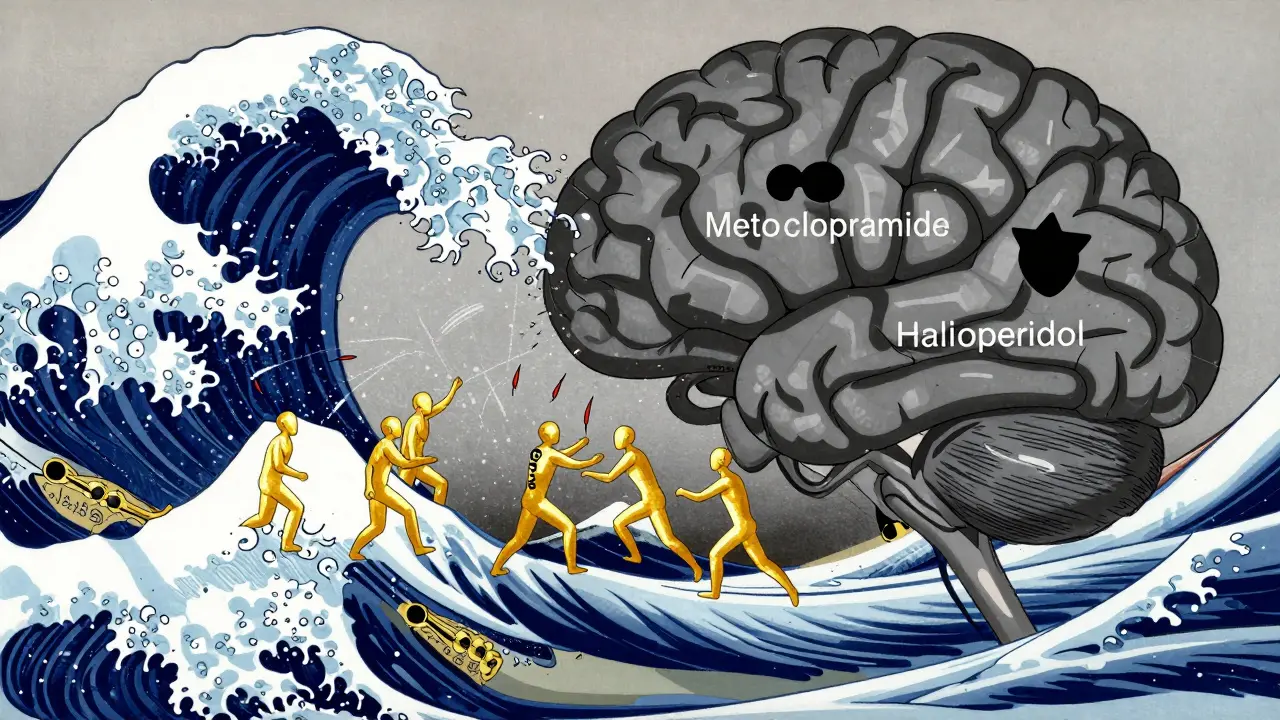
To understand why this happens, you need to look at the mechanism. Most traditional antiemetics target the chemoreceptor trigger zone in the brain. They do this by acting as dopamine D2-receptor antagonists. In a healthy person, this blocks the signal for nausea. In a person with Parkinson’s, these drugs cross the blood-brain barrier and block the few remaining dopamine receptors in the basal ganglia. The result is an exacerbation of motor symptoms like rigidity, bradykinesia (slowness of movement), and tremors.
Historically, this conflict was documented as early as the 1970s. A seminal study by Tarsy, Parkes, and Marsden in 1971 highlighted that while some dopamine blockers caused severe issues, others had unique profiles. Today, clinical guidelines universally flag this interaction as critical. The American Parkinson Disease Association (APDA) lists several common antiemetics as high-risk because they directly interfere with dopamine replacement therapy.
High-Risk Antiemetics: What to Avoid
Not all nausea medicines are created equal. Some are safe, and some are potentially devastating for your mobility. Here are the drugs you must be cautious about:
- Metoclopramide (Reglan): This is perhaps the most commonly prescribed antiemetic, which makes its danger even more significant. It has a 95% risk of worsening Parkinsonian symptoms according to APDA data. It penetrates the central nervous system significantly (20-40%), leading to acute dystonic reactions in 1-10% of patients. Dr. Alberto Espay of the University of Cincinnati notes that inappropriate prescription of metoclopramide is the single most common medication error seen in Parkinson’s patients.
- Prochlorperazine (Stemetil): A phenothiazine derivative that strongly blocks dopamine receptors. Patients report severe 'off' periods requiring hospitalization after receiving this in emergency departments.
- Haloperidol (Haldol): A butyrophenone that carries similar high-risk profiles. It can cause extrapyramidal symptoms (EPS), tardive dyskinesia, and delirium.
- Promethazine and Chlorpromazine: These also block D2 receptors in the brain and should generally be avoided.
If you see any of these names on a prescription label, double-check with your neurologist immediately. Even short-term use can lead to weeks of recovery time to return to your baseline mobility.
Safer Alternatives: Navigating the Options
You do have options. The key is choosing medications that either do not block central dopamine receptors or act primarily outside the brain.
| Medication | Mechanism | Risk Level | Key Considerations |
|---|---|---|---|
| Cyclizine (Vertin) | H1 Receptor Antagonist | Low (5-10%) | First-line choice per GGC Medicines Update. Minimal dopamine interference. |
| Domperidone (Motilium) | Peripheral D2 Antagonist | Very Low (<2%) | Does not cross blood-brain barrier significantly. Not available in injectable form in the US. |
| Ondansetron (Zofran) | 5-HT3 Antagonist | Low-Moderate (15-20%) | Minimal dopamine effects. May have reduced efficacy for certain types of nausea. |
| Aprepitant (Emend) | Neurokinin-1 Antagonist | None Reported | Newer option. 92% efficacy in trials with zero motor symptom worsening. |
| Levomepromazine | Atypical Antipsychotic/Antiemetic | Moderate (30-40%) | Use only after specialist consultation. Start low (6.25mg). |
Cyclizine is often recommended as the first-line antiemetic for Parkinson’s patients. It works by blocking histamine H1 receptors rather than dopamine, making it much safer for motor control. Domperidone is another excellent choice because it stays largely in the gut (peripheral action) and does not enter the brain in significant amounts due to P-glycoprotein efflux mechanisms. However, access can be tricky; it has restricted availability in the United States due to cardiac risks unrelated to Parkinson’s, though it remains widely used elsewhere.
Ondansetron is frequently used because it targets serotonin (5-HT3) instead of dopamine. While safer than metoclopramide, it is not perfect. Some patients find it less effective for the specific type of nausea caused by levodopa, and there is still a small risk profile compared to cyclizine.
Non-Pharmacological Strategies and Lifestyle Tweaks
Before reaching for pills, consider non-drug approaches. Dr. Alberto Espay recommends these as first-line interventions for mild nausea:
- Ginger: Studies suggest 1g of ginger daily can effectively reduce nausea without any neurological side effects.
- Dietary Modifications: Eat smaller, more frequent meals. Large meals can overwhelm the digestive system, especially since Parkinson’s can slow gastric emptying (gastroparesis).
- Hydration: Dehydration worsens nausea. Sip water throughout the day rather than drinking large amounts at once.
- Timing of Medication: Take levodopa with a light snack if an empty stomach causes nausea, but avoid high-protein foods which can interfere with absorption.
What Happens If You Take the Wrong Drug?
If you accidentally take a dopamine-blocking antiemetic like metoclopramide, you might experience:
- Sudden worsening of tremors.
- Increased stiffness or rigidity in limbs.
- 'Freezing' episodes where you cannot initiate movement.
- Acute dystonia, such as involuntary muscle contractions in the neck or face.
In real-world cases, patients have reported needing three weeks to return to their baseline despite increasing their levodopa doses. Hospitalizations occur when 'off' periods become severe enough to cause falls or inability to eat. According to the Michael J. Fox Foundation, 68% of patients who received dopamine-antagonist antiemetics in hospitals reported significant worsening of motor symptoms.

Advocating for Yourself in Medical Settings
One of the biggest challenges is that many doctors outside of neurology are unaware of this interaction. A 2022 study found that only 37% of emergency medicine physicians could correctly identify metoclopramide as contraindicated in Parkinson’s. You must be your own advocate.
Here is how to protect yourself:
- Carry a Wallet Card: The APDA distributes cards listing medications to avoid. Keep one in your wallet and show it to every new provider.
- Ask Direct Questions: When prescribed anything for nausea, ask: "Does this medication block dopamine receptors?"
- Inform Pharmacists: Tell your pharmacist about your Parkinson’s diagnosis so they can screen for interactions before dispensing.
- Document Everything: If you try a new antiemetic, note any changes in your movement. Share this with your neurologist.
The Movement Disorder Society recommends that all medical orders for Parkinson’s patients include a specific notation: "Verify antiemetic safety." Until this becomes universal practice, vigilance is essential.
Future Directions and New Treatments
The landscape is improving. Research into aprepitant, a neurokinin-1 receptor antagonist, shows promise. In a trial of 120 Parkinson’s patients, it achieved 92% efficacy for nausea with zero reports of worsened motor symptoms. Additionally, the Michael J. Fox Foundation is funding research into novel peripheral-acting serotonin modulators designed specifically to treat Parkinson’s-related nausea without touching the brain.
Educational initiatives are also making a dent. The Parkinson’s Foundation’s Quality Improvement Initiative has trained over 1,200 providers, resulting in a 55% reduction in inappropriate prescriptions in participating hospitals. Awareness is growing, but it is not yet universal.
Can I take Zofran (ondansetron) for nausea if I have Parkinson’s?
Yes, ondansetron is generally considered safer than dopamine blockers like metoclopramide. It works by blocking serotonin receptors rather than dopamine. However, it may not be as effective for all types of nausea, and you should still consult your neurologist before starting it.
Why is metoclopramide bad for Parkinson’s patients?
Metoclopramide blocks dopamine D2 receptors in the brain. Since Parkinson’s disease involves a deficiency of dopamine, blocking these receptors further reduces dopamine signaling, leading to worsened motor symptoms like tremors, rigidity, and slowness.
Is domperidone available in the United States?
Domperidone is not widely available in the US due to FDA restrictions regarding potential heart rhythm issues. It is typically only accessible through a special Investigational New Drug (IND) application process. It is more commonly prescribed in other countries like the UK and Canada.
How long does it take to recover from taking a dopamine-blocking antiemetic?
Recovery times vary, but patients often report taking several days to a few weeks to return to their baseline motor function. During this time, your neurologist may adjust your levodopa dosage to compensate for the blocked receptors.
What is the safest antiemetic for Parkinson’s disease?
Cyclizine is often cited as the first-line safest option because it acts on histamine receptors. Domperidone is also very safe due to its peripheral action, but availability varies by region. Aprepitant is a newer option showing great promise with no motor side effects.
14 Comments
hey guys, just wanted to say this is super helpful info. my dad has pd and we were so confused about why his meds stopped working after he got sick. turns out it was the reglan they gave him at the er. crazy how simple the fix is but nobody tells you.
thank you for sharing this! it's really important that people know about these interactions. i hope more doctors start paying attention to this stuff. keep up the good work!
ugh... another post telling us what to do with our bodies!!?? seriously?? do u think we are stupid??? or maybe the big pharma wants us to stay sick so they can sell more drugs!!! :P anywayz, i read that domperidone is safe but who knows if its true or just propaganda from the evil corps... lol
Your comment is completely wrong and dangerous. You should not spread misinformation like this. The medical community has studied these drugs extensively. Metoclopramide is known to worsen Parkinson's symptoms because it blocks dopamine receptors in the brain. This is a fact, not a conspiracy theory. Please stop posting nonsense that could harm people.
lol nisha, calm down a bit? :) i get that it's frustrating when things go wrong, but attacking the source doesn't help anyone. andrew made a valid point about his experience. maybe we can all just try to be nice and share helpful tips instead of fighting? peace out ✌️
Hey everyone! 👋 Just wanted to add that cyclizine is also a great option if you're in the UK or places where it's available. It helped me a lot when I started levodopa. No drowsiness for me either! Hope this helps someone else too 🙌
Wow!! This is such an important topic!!! I never knew that promethazine could be so bad for PD patients!!! My mom takes it for allergies sometimes and now I'm worried!!! Thank you for explaining the mechanism so clearly!!! It makes so much sense why her tremors got worse last time she was nauseous!!! We need to talk to her neurologist ASAP!!!
This article is useless. You should have mentioned American brands only. Why waste time on foreign drugs? Stick to what works here. And don't blame doctors, they are busy saving lives unlike some lazy people complaining online.
Actually, let's look at this from a different angle. Is it possible that the pharmaceutical industry pushes these safer alternatives because they are less profitable? Or perhaps the 'dopamine blocking' narrative is overstated to create fear? I find it interesting how quickly everyone accepts the mainstream view without questioning the underlying motives. Maybe the real issue isn't the drug, but the patient's mindset. Stop blaming the medicine and take responsibility for your own health outcomes.
Brian, your perspective is intriguing but fundamentally flawed. The pharmacology of dopamine antagonists is well-documented and not subject to corporate conspiracy theories. The interaction between metoclopramide and Parkinson's disease is a physiological reality, not a narrative construct. To suggest otherwise ignores decades of clinical evidence and puts patients at risk. We must rely on science, not skepticism for its own sake.
Hi there! I'm Chelsea from Canada, and I totally agree with Frances. It's so important to understand the science behind these medications. In Canada, we often use domperidone as a first-line treatment for nausea in PD patients because it doesn't cross the blood-brain barrier easily. It's been a game-changer for many of my friends with Parkinson's. I hope this information helps everyone navigate their treatment options safely and effectively! 😊
I am deeply concerned by the lack of awareness regarding this critical interaction. It is imperative that healthcare providers prioritize patient safety over convenience. The consequences of prescribing inappropriate antiemetics can be severe and long-lasting. We must advocate for better education and stricter guidelines to prevent such errors. Every life matters, and every decision counts.
good points sarah. i think communication between specialists is key. neurologists and gis often work in silos which leads to these mistakes. we need better integration of care systems to ensure patients get the right meds without harmful interactions. hope this changes soon.
This is exactly what I needed to hear! I've been struggling with nausea since starting my new regimen and was terrified to tell my doctor. Now I feel empowered to ask for cyclizine or domperidone instead of risking my mobility. Thank you for breaking this down so clearly. It gives me confidence to advocate for myself during my next appointment.